Souari Nut
The souari nut refers to the edible seeds produced by trees within the genus Caryocar, a family containing approximately 15 species native to regions…
What is souari nut?
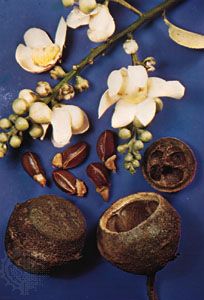
The souari nut refers to the edible seeds produced by trees within the genus Caryocar, a family containing approximately 15 species native to regions including Panama and northern South America.12
These seeds are found within large, coconut-sized fruits that typically contain four nuts surrounded by edible flesh. The nuts themselves are characterized by a warty, red, hard shell and a distinctive kidney shape. Known for their rich flavor, these seeds are also a source of a fatty oil that is extracted for use in cooking.12
What other types of nuts grow in South American rainforests?
South American rainforests are home to several notable nut-producing trees, many of which are related to the Brazil nut (Bertholletia excelsa). These trees are highly valued for their edible seeds and ecological significance within the Amazonian basin.3
Other tropical trees in the same family (Lecythidaceae) that are recognized for their fruits and nuts include:
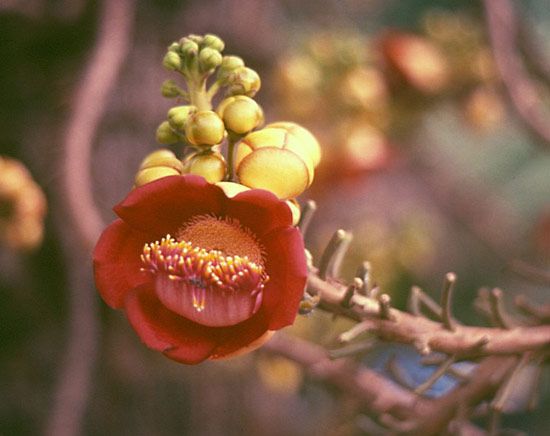
- Cannonball tree (Couroupita guianensis): Known for its distinctive, large, spherical fruits.3
- Anchovy pear (Grias cauliflora): A tropical tree valued for its edible fruit.3
- Monkey pot (Lecythis species): A genus of trees that produce woody, pot-like fruits containing edible seeds.3
Additionally, the souari nut is produced by trees in the genus Caryocar, which are distinct from the Brazil nut family but are also native to South American rainforests and prized for their edible, oil-rich seeds.4
How is oil extracted from nuts for cooking?
To extract oil from nuts for cooking, manufacturers primarily use mechanical pressing or solvent extraction. The process generally begins by cleaning the nuts and removing their shells or hulls.78
Mechanical Pressing
The kernels are ground into a coarse meal to break down cellular structures. This meal is then subjected to high pressure in hydraulic or screw presses.78
- Cold-pressed (Virgin) Oils: When pressed without preliminary heating, the resulting oil contains fewer impurities and is often of high edible quality without further processing.78
- Heated Pressing: Applying heat during pressing increases the yield but may also extract more nonglyceride impurities, resulting in a more highly colored oil.7
Solvent Extraction
For large-scale operations or to recover residual oil from pressed “cake,” volatile solvents like petroleum benzin (commercial hexane) are used. The solvent is percolated through the meal to dissolve the oil; the mixture is then separated, and the solvent is evaporated and recovered for reuse. Extracted oils may undergo alkali refining to remove free fatty acids and impurities before being used for cooking.8910
What are the main characteristics of the Caryocaraceae plant family?
The Caryocaraceae family consists of evergreen trees and shrubs native to the Neotropics, particularly within the Amazonian region. The family is composed of two genera: Anthodiscus (15 species) and Caryocar (6 species).11
Key characteristics of this family include:
- Foliage: The plants feature leaves with three leaflets and basal stipules.11
- Flowers: They produce large flowers arranged in racemes at the ends of branches. These flowers are notable for having many long, spreading stamens, while the petals themselves are relatively inconspicuous.11
- Seedlings: A distinctive morphological trait is that the seedling root is spirally twisted.11
- Economic and Practical Uses:
- Timber: Trees in the Caryocar genus are known for their strong, fine-grained wood, which is utilized in shipbuilding and furniture making.12
- Food: The family is the source of edible souari nuts, which are both collected from the wild and cultivated.11
- Other Uses: Some fruits of the Caryocar genus are utilized as fish poisons.11
Sources
- souari nut — Encyclopædia Britannica
- souari nut — Merriam-Webster
- Brazil nut — Encyclopædia Britannica
- Caryocar — Merriam-Webster
- No rainfores, no Brazil nuts — Encyclopædia Britannica
- Tropical rainforest - Environment — Encyclopædia Britannica
- fat and oil processing - Pressing processes — Encyclopædia Britannica
- oil extraction — Encyclopædia Britannica
- fat and oil processing - Alkali refining — Encyclopædia Britannica
- fat and oil processing - Processes — Encyclopædia Britannica
- Caryocaraceae — Merriam-Webster
- Caryophyllales — Encyclopædia Britannica
- Malpighiales - Ungrouped families — Encyclopædia Britannica
- Caryophyllales - Economic importance — Encyclopædia Britannica
Published on · 3 min read