Monkey Pot
The term "monkey pot" refers to two distinct concepts. Primarily, it describes any shrub or tree belonging to the genus Lecythis within the family…
What is monkey pot?
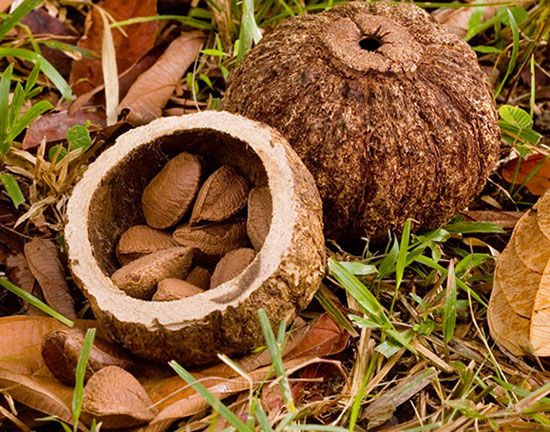
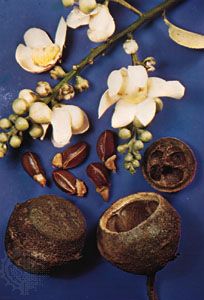
The term “monkey pot” refers to two distinct concepts. Primarily, it describes any shrub or tree belonging to the genus Lecythis within the family Lecythidaceae, native to South America. The name also specifically identifies the plant’s woody, urn-shaped fruit, which is named for its pot-like appearance and size, which is suitable for a monkey to use.12
The seeds of these trees are often edible; for instance, the nuts of L. zabucajo are highly regarded for their taste and resemble Brazil nuts, while the seeds of L. ollaria are processed for oil used in soap manufacturing. Additionally, the wood from these trees is utilized in construction, cabinetwork, and tool handles.1
In a completely different context, a monkey pot is a specialized vessel used in glassmaking. These are round-topped, oval cylinders housed within firebrick arches at the base of a chimney, specifically designed for melting flint glass.2
How do the seeds of the monkey pot tree compare to Brazil nuts?
The seeds of the monkey pot tree (Lecythis species) and the Brazil nut (Bertholletia excelsa) are closely related, as both belong to the Lecythidaceae family.13
While both trees produce edible seeds, they differ in their culinary reputation and usage:
- Taste and Culinary Use: The seeds of Lecythis zabucajo, a type of monkey pot, are noted for being particularly tasty and are often compared to Brazil nuts in flavor. In contrast, Brazil nuts are a major commercially traded nut, valued for their high content of protein, selenium, and other nutrients, and are commonly eaten raw or blanched.13
- Industrial Application: The seeds of another monkey pot species, L. ollaria, are primarily valued as a source of oil used in the production of soaps. Similarly, Brazil nut oil is utilized in various personal care products, including shampoos, conditioners, and skin-care items.13
Both trees are native to South America and share a botanical lineage that includes other tropical trees like the cannonball tree.13
What other plants belong to the Lecythidaceae family?
The Lecythidaceae family, commonly known as the Brazil nut family, is a diverse group of approximately 25 genera and 350 species of pantropical evergreen trees. Beyond the well-known Brazil nut tree (Bertholletia excelsa) and the monkey pot (Lecythis species), the family includes several other notable plants:3
- Cannonball tree (Couroupita guianensis): Named for its large, spherical, woody fruits.4
- Anchovy pear (Grias cauliflora): A tropical tree valued for its fruit.4
- Eschweilera: A large Neotropical genus containing approximately 100 species.3
- Gustavia: A Neotropical genus comprising about 40 species.3
- Barringtonia: An Old World genus with 73 species, distributed from eastern Africa to the Pacific.3
- Scytopetalum tieghemii: A tree found in Sierra Leone and Ghana, noted for its decay-resistant wood used in construction.3
How does the operculum, or lid, of the monkey pot fruit function?
The monkey pot tree (Lecythis species) produces a specialized type of woody fruit known as an operculate capsule. In botanical terms, an operculum functions as a lid at the top of the ovary.157
As the fruit matures and dries, this lid-like structure detaches, allowing the capsule to open and release its seeds. This mechanism is a defining characteristic of the Lecythidaceae family, which includes both the monkey pot and the Brazil nut. The resulting woody, pot-like shell is what gives the tree its common name, as the empty vessels are often large enough to be used by monkeys.751
Sources
- monkey pot — Encyclopædia Britannica
- monkey pot — Merriam-Webster
- Brazil nut — Encyclopædia Britannica
- Lecythidaceae — Merriam-Webster
- Lecythis — Merriam-Webster
- Ericales - Lecythidaceae — Encyclopædia Britannica
- Angiosperm - Fruits — Encyclopædia Britannica
Published on · 3 min read