Stringocephalus
Stringocephalus is an extinct genus of large brachiopods, commonly referred to as lamp shells. These organisms are found as fossils within Devonian marine…
What is Stringocephalus?
Stringocephalus is an extinct genus of large brachiopods, commonly referred to as lamp shells. These organisms are found as fossils within Devonian marine rocks, dating back approximately 416 million to 359 million years.1
Widely distributed across the globe, Stringocephalus fossils have been discovered in regions including western North America, Asia, and northern Europe. The shell of this genus is distinctively identified by a well-developed, curved, beaklike structure.1
What are brachiopods and how do they differ from clams?
Brachiopods, commonly known as lamp shells, are a phylum of bottom-dwelling marine invertebrates that have existed since the Cambrian Period. While they superficially resemble mollusks—such as clams—they are not related to them.23
The primary differences between brachiopods and clams include:
- Symmetry: Brachiopod shells are bilaterally symmetrical, meaning the left and right sides of an individual valve are mirror images of each other. In contrast, clams (bivalve mollusks) typically have shells where the two valves are mirror images of each other, but the individual valves themselves are often asymmetrical.2
- Valve Structure: Brachiopod valves are unequal in size, with one covering the dorsal (top) side and the other the ventral (bottom) side. Clam shells are typically composed of two equal valves that cover the left and right sides of the animal.24
- Anatomy: Brachiopods possess a unique feeding organ called a lophophore, which is housed within the mantle cavity. They are often attached to the seafloor by a fleshy stalk called a pedicle.456
What was the environment like during the Devonian Period?
The Devonian Period (approximately 419.2 to 359 million years ago) was a time of significant biological and geological transformation, often called the “Age of Fishes” due to the rapid diversification of fish in both marine and freshwater environments.9
Climate and Geography
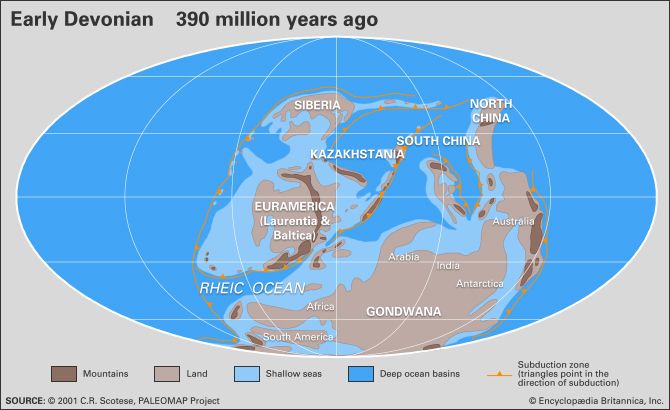
The Earth was generally warmer and more equitable than it is today, with little evidence of significant polar ice caps. The period saw the formation of the supercontinent Laurussia (or Euramerica) through the collision of Laurentia and Baltica, while the southern continents remained joined as Gondwana. Large areas of the Northern Hemisphere were covered by continental deserts and alluvial plains, famously documented in the Old Red Sandstone deposits.101112
Marine and Terrestrial Life
- Marine Ecosystems: Oceans covered about 85 percent of the globe. Shallow shelf seas hosted diverse corals, brachiopods, crinoids, and trilobites. The period also marked the appearance of ammonites9.1013
- Terrestrial Colonization: The Devonian saw the rise of the first forests and the transition of vertebrates to land, with the emergence of the first four-legged amphibians late in the period.109
Periodic drops in ocean oxygen levels caused significant marine extinctions, though these were followed by waves of species diversification.1012
How do fossils help scientists understand ancient marine life?
Fossils are the primary source of information regarding the history of life on Earth, providing scientists with critical data about ancient marine environments and the organisms that inhabited them.14
Understanding Ancient Environments
Fossilized organisms serve as indicators of the conditions present at the time of their deposition. By analyzing the types of fossils found in sedimentary strata, scientists can reconstruct ancient climates and habitats. For example, the presence of specific coral species indicates that the area was once a warm, shallow sea, even if those fossils are now found in high mountain ranges or polar regions. This evidence has historically helped researchers conclude that regions now far from the ocean were once coastal or submerged.14151617
Geologic Context and Evolution
- Relative Dating: Fossils allow geologists to assign relative ages to rock layers. Index fossils—which are easily recognizable, abundant, and geographically widespread—are particularly useful for correlating strata across different regions and continents.1816
- Evolutionary History: The fossil record documents progressive, irreversible changes in organisms over time, providing essential evidence for the theory of evolution evidence for the theory of evolution.1819
- Resource Exploration: By studying microfossils in core samples, geologists can determine the stratigraphic position of fossil fuels, aiding in the exploration of oil and natural gas deposits.1419
Sources
- Stringocephalus — Encyclopædia Britannica
- lamp shells — Encyclopædia Britannica
- Brachiopoda — Merriam-Webster
- branchiopod - Evolution and paleontology — Encyclopædia Britannica
- lamp shells - Form and function — Encyclopædia Britannica
- Circulatory system - Brachiopoda — Encyclopædia Britannica
- clam shrimp — Encyclopædia Britannica
- Silurian Period - Brachiopods — Encyclopædia Britannica
- A Journey Through Time Since the Precambrian - Devonian Period: 419.2 million to about 359 million years ago — Encyclopædia Britannica
- Devonian Period - Paleoclimate — Encyclopædia Britannica
- Devonian Period - Significant geologic events — Encyclopædia Britannica
- Devonian Period - Invertebrates — Encyclopædia Britannica
- Devonian Period - Devonian life — Encyclopædia Britannica
- index fossil — Encyclopædia Britannica
- fossil — Encyclopædia Britannica
- taphonomy — Merriam-Webster
- fossil record — Encyclopædia Britannica
- geology - Paleontology — Encyclopædia Britannica
- paleontology — Encyclopædia Britannica
- Earth sciences - Knowledge of Earth history — Encyclopædia Britannica
- hydrosphere - The modern hydrosphere — Encyclopædia Britannica
Published on · 3 min read