Thick-headed Fly
A thick-headed fly is any member of the family Conopidae (order Diptera), a group of elongated, wasplike flies characterized by having a head that is thicker…
What is thick-headed fly?
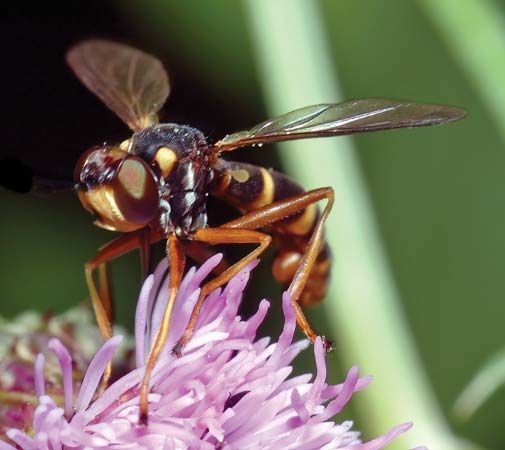
A thick-headed fly is any member of the family Conopidae (order Diptera), a group of elongated, wasplike flies characterized by having a head that is thicker than the thorax. These insects are typically brownish in color, often featuring yellow markings, and generally range in size from 6 to 25 mm (0.2 to 1 inch) in length.12
Key biological features and behaviors include:
- Feeding Organs: All species possess a long, slender proboscis, which is sometimes elbow-shaped in certain species.1
- Reproductive Habits: These flies are parasitic; they deposit their eggs on or inside host insects, such as adult wasps, bumblebees, or grasshoppers, which then serve as a food source for the developing larvae.13
- Classification: Within the order Diptera, they are categorized under the suborder Brachycera-Cyclorrhapha and the series Aschiza. Some researchers suggest they may represent a separate evolutionary line.3
How do thick-headed flies find their host insects?
While the provided search results confirm that thick-headed flies (family Conopidae) are parasitic insects that deposit their eggs on or inside hosts such as wasps, bumblebees, and grasshoppers, they do not contain specific information regarding the precise mechanisms or sensory behaviors these flies use to locate those hosts.
Because the available documentation does not detail the search strategies employed by these flies, I cannot provide an accurate explanation of their host-finding process at this time.
What are some other examples of parasitic flies?
Beyond the thick-headed fly, the order Diptera includes several other families that exhibit parasitic or parasitoid behaviors. These insects have evolved diverse strategies to exploit other organisms for their development and survival.
Notable Examples of Parasitic and Parasitoid Flies
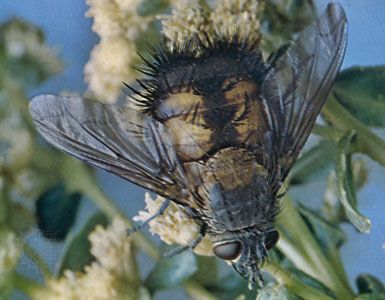
- Tachinid flies (family Tachinidae): These are among the most ecologically significant parasitic flies. Their larvae are internal parasites of other insects, such as caterpillars and beetle larvae. Because they often kill their hosts, they are frequently employed in biological control programs to manage agricultural pests.
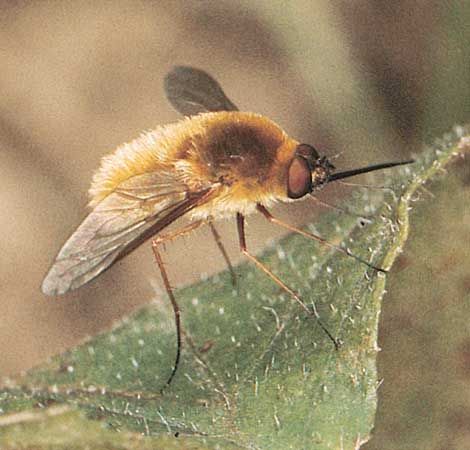
- Bee flies (family Bombyliidae): While adults are often seen hovering over flowers to feed on nectar, their larvae are parasitic. Depending on the species, they may scavenge in the nests of bees and wasps or act as parasites on the larvae of tiger beetles, the eggs of grasshoppers, or the pupae of tsetse flies.
- Bot flies (family Oestridae): These flies are specialized parasites of mammals. Their larvae live in various tissues, including the skin, nasal passages, or digestive tracts of hosts like horses, cattle, rabbits, and squirrels. The human bot fly (Dermatobia hominis) is a notable species that can infect humans, often using other insects to transport its eggs to a host.
- Phorid flies (family Phoridae): Often called coffin flies, these tiny insects scavenge in the nests of social insects like bees, wasps, ants, and termites.
- Louse flies (family Hippoboscidae): These flies are specialized ectoparasites that feed exclusively on the blood of birds and mammals. They have evolved to live in close association with their hosts, and some species have lost their wings entirely.
Why do thick-headed flies mimic the appearance of wasps?
Thick-headed flies (family Conopidae) exhibit a wasplike appearance that serves as a form of Batesian mimicry. In this evolutionary strategy, a harmless or palatable organism evolves to resemble a dangerous or noxious “model”—in this case, stinging wasps or bees—to gain protection from predators.121
By mimicking the conspicuous coloration and physical form of wasps, thick-headed flies deceive potential predators into believing they are capable of stinging or are otherwise unpalatable. Because predators have learned to avoid the painful sting of the model species, they often leave the harmless mimics alone, providing the flies with a significant survival advantage. This resemblance is so striking that these insects are sometimes colloquially referred to as “wasp flies”.12113
Sources
- thick-headed fly — Encyclopædia Britannica
- neuropteran - Annotated classification — Encyclopædia Britannica
- Diptera - Annotated classification — Encyclopædia Britannica
- Conopidae — Merriam-Webster
- thickheaded fly — Merriam-Webster
- tachinid fly — Encyclopædia Britannica
- bee fly — Encyclopædia Britannica
- bot fly — Encyclopædia Britannica
- parasitoid — Encyclopædia Britannica
- parasitism — Encyclopædia Britannica
- Diptera - General features — Encyclopædia Britannica
- Batesian mimicry — Encyclopædia Britannica
- community ecology - Mimicry complexes — Encyclopædia Britannica
- mimicry - Automimicry — Encyclopædia Britannica
- wasp fly — Merriam-Webster
Published on · 3 min read