Tiger Beetle
Tiger beetles are highly effective predators due to their specialized physical adaptations and distinct hunting strategies at different life stages.
How do tiger beetles hunt and what makes them such effective predators?
Tiger beetles are highly effective predators due to their specialized physical adaptations and distinct hunting strategies at different life stages.1
Larval Hunting
Larvae reside in vertical burrows, sometimes reaching 60 cm deep. They wait at the entrance for prey, such as insects or spiders, and lunge to grasp them with sickle-like mandibles. To prevent being pulled out by struggling prey, they anchor themselves using a pair of hooks located on their abdomen.1
Adult Hunting
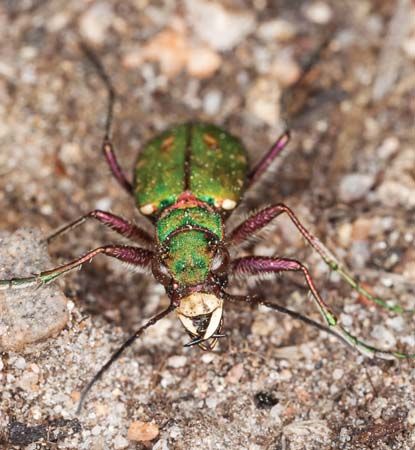
Adults are formidable hunters characterized by their speed and keen vision. They are rapid runners and fliers, with some species, such as Rivacindela hudsoni, capable of reaching speeds of 2.5 meters per second. Because their photoreceptors cannot process visual information quickly enough at top speeds, they often employ a “stop-start” strategy: they sprint toward prey, pause to reorient themselves, and then continue the pursuit.1
Their success is further bolstered by long mandibles, which allow them to capture a wide variety of prey efficiently.1
How have tiger beetles adapted to different climates around the world?
Tiger beetles have adapted to diverse environments primarily through specialized coloration and physical agility. While most of the 2,600 species are found in tropical or subtropical regions, they occupy varied habitats ranging from sunny paths to sandy areas.1
To survive in these environments, tiger beetles utilize several key adaptations:
- Camouflage: Species inhabiting sandy environments often possess light-colored exoskeletons that allow them to blend into their surroundings, providing protection from predators.1
- Coloration: Many species exhibit iridescent colors—such as blue, green, orange, or scarlet—which are produced by a combination of pigments and the physical structure of their exoskeleton.1
- Agility: Tiger beetles rely on their remarkable speed and flight capabilities to escape threats. They are among the fastest insects, with some species capable of running at 2.5 meters per second.12
- Defensive Behavior: When threatened, these beetles use their agility to flee or take flight. Additionally, they are known to inflict painful bites with their long mandibles if handled.12
What habitats do tiger beetles typically inhabit and how are they adapted to these environments?
Tiger beetles, belonging to the family Cicindelidae, are found globally, though they are most prevalent in tropical and subtropical regions. They are typically observed in open, sunlit environments such as sandy areas and sunny paths.1
These beetles have evolved specific physical adaptations to thrive in these habitats:
- Camouflage: Species that live in sandy environments often possess light-colored exoskeletons, which allow them to blend into their surroundings and avoid detection by predators.1
- Vision and Agility: Adults possess bulging eyes that provide keen vision, essential for locating prey. Their long legs and high-speed running capabilities—with some species reaching 2.5 meters per second—allow them to hunt effectively in open spaces.1
- Structural Coloration: Many tiger beetles display vibrant, iridescent colors like blue, green, orange, or scarlet. These colors are produced by a combination of pigments and the physical structure of their exoskeleton, which may serve various ecological functions.1
- Burrowing: Larvae are adapted to their environment by living in vertical burrows up to 60 cm deep, using abdominal hooks to anchor themselves while waiting to ambush prey.1
What are the distinctive physical characteristics of tiger beetles?
Tiger beetles (family Cicindelidae) are characterized by several distinct physical features that support their roles as agile, predatory insects:
- Body Structure: Adults are slender and long-legged, typically measuring 10 to 20 mm (0.4 to 0.8 inches) in length. They possess bulging eyes that provide them with a keen sense of vision, which is essential for their hunting behavior.1
- Coloration: Many species exhibit vibrant, iridescent colors, including blue, green, orange, or scarlet. These colors result from a combination of pigments within the exoskeleton and refractory colors produced by the exoskeleton’s surface characteristics. Species that inhabit sandy environments often display lighter coloration to blend into their surroundings.1
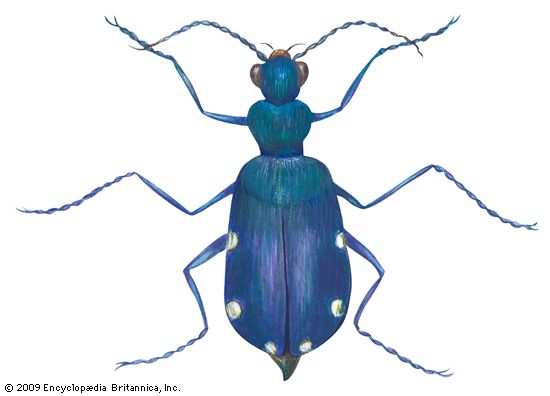
- Wing Covers: The elytra (wing covers) of many species, such as those in the genus Cicindela, often feature distinct, scroll-like markings. For example, the six-spotted tiger beetle is recognized by its shiny bluish-green color and six white markings on its elytra.1
- Mandibles: Both adults and larvae possess powerful, sickle-like mandibles. Adults use these to capture prey and can inflict a painful bite if handled, while larvae use them to grasp prey from their burrows.1
Sources
- tiger beetle — Encyclopædia Britannica
- Coleoptera - Protection — Encyclopædia Britannica
- heteropteran - Legs — Encyclopædia Britannica
- Coleoptera - Larval features — Encyclopædia Britannica
- coloration - Physiological functions — Encyclopædia Britannica
Published on · 3 min read