Top Shell
Top shells are marine snails belonging to the family Trochidae that play a vital role in their ecosystems as herbivores. By feeding on algae and films of…
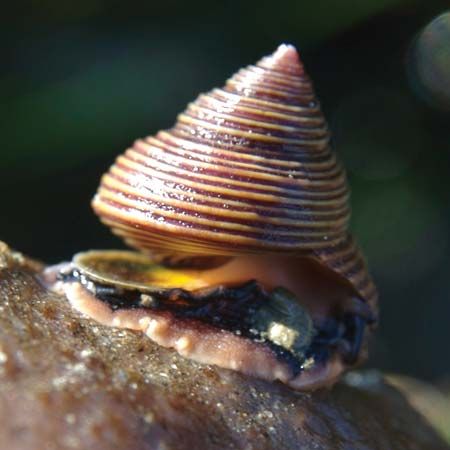
What role do top shells play in their marine ecosystems?
Top shells are marine snails belonging to the family Trochidae that play a vital role in their ecosystems as herbivores. By feeding on algae and films of spores found on rock surfaces, they help regulate the growth of these organisms in various marine environments, ranging from the intertidal zone to deep open seas.1
They are most diverse in shallow waters along rocky shores, where they contribute to the balance of these habitats. While they are primarily known for their conical, nacreous shells—which have historically been harvested for their lustrous mother-of-pearl—their ecological function is centered on their grazing behavior, which maintains the health of the rocky substrates they inhabit.1
What is the scientific name for the top shell family, and how many species does it include?
The scientific name for the top shell family is Trochidae.14
Regarding the number of species, the provided search results do not contain information specifying the total count of species within this family.
Where are top shells typically found in their natural habitats?
Top shells are found in a wide range of marine environments, extending from the intertidal zone down to the deep open seas. While they inhabit these diverse depths, they occur with the greatest diversity in shallow waters along rocky shores, ranging from equatorial regions to high latitudes.1
What are the defining characteristics of gastropods in the top shell family?
Gastropods in the family Trochidae, commonly known as top shells, are defined by several distinct physical and biological characteristics:
- Shell Morphology: They possess a spiral, conical shell that is typically regular in shape, featuring a flat base and an oblique, rhombic aperture. The shell is often marked by heavy ornamentation, though this varies among species.19102
- Internal Structure: A defining feature of the family is the nacreous, or lustrous, mother-of-pearl lining found on the interior of all top shells.110
- Operculum: These snails possess a multispiral operculum, which serves as a protective cover for the animal.29
- Diet and Feeding: All species in this family are herbivorous. They use a specialized, ribbonlike structure in their mouths called a radula to graze on algae or films of spores found on rock surfaces.11112
- Reproduction: Top shells have separate male and female individuals. Fertilization is external, and most species produce free-swimming larvae.1
Sources
- top shell — Encyclopædia Britannica
- top shell — Merriam-Webster
- bivalve - Features of defense and aggression — Encyclopædia Britannica
- heteropteran - Annotated classification — Encyclopædia Britannica
- Trochidae — Merriam-Webster
- Trochilidae — Merriam-Webster
- bivalve - Size range and diversity of structure — Encyclopædia Britannica
- mollusk - Habitats, feeding habits, and associations — Encyclopædia Britannica
- gastropod - Classification — Encyclopædia Britannica
- gastropod - The shell — Encyclopædia Britannica
- radula — Encyclopædia Britannica
- gastropod - Food and feeding — Encyclopædia Britannica
Published on · 2 min read