Myalina
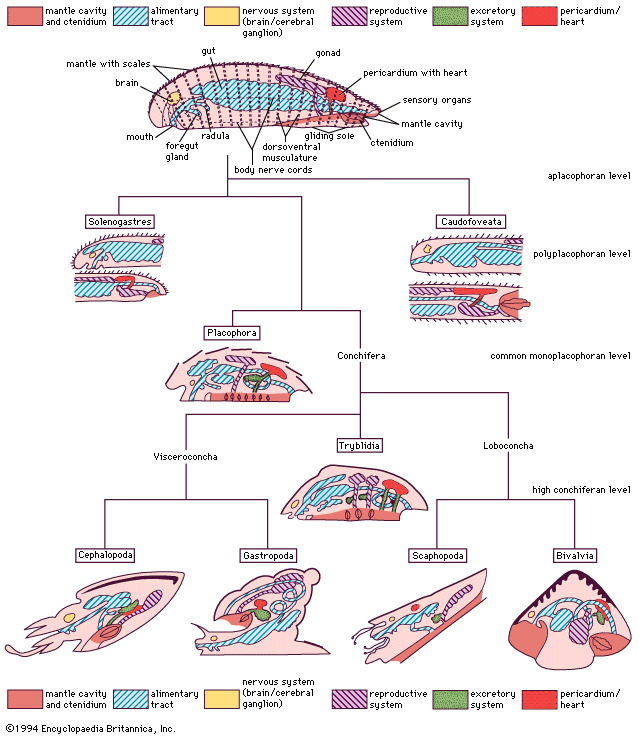
Myalina is an extinct genus of clams that existed from the Early Carboniferous to the Late Permian period, spanning approximately 359 million to 251 million…
What is Myalina?
Myalina is an extinct genus of clams that existed from the Early Carboniferous to the Late Permian period, spanning approximately 359 million to 251 million years ago.1
As a member of the ancient Mytilacea group—which first emerged during the Ordovician Period—Myalina is distinguished by having a thicker shell than other related mytilacids. Because these organisms were abundant in many rock formations, they serve as a valuable tool for stratigraphic correlations.1
What are index fossils and why are they useful to geologists?
An index fossil is any plant or animal preserved in the Earth’s rock record that serves as a marker for a specific span of geologic time or a particular environment.3
To be considered a useful index fossil, a specimen must meet several criteria:
- Distinctiveness: It must be easily recognizable.3
- Abundance: It should be found in large numbers.3
- Wide Distribution: It must have a broad geographic range.3
- Short Temporal Range: The species must have evolved rapidly, existing for only a brief period in geologic history.3
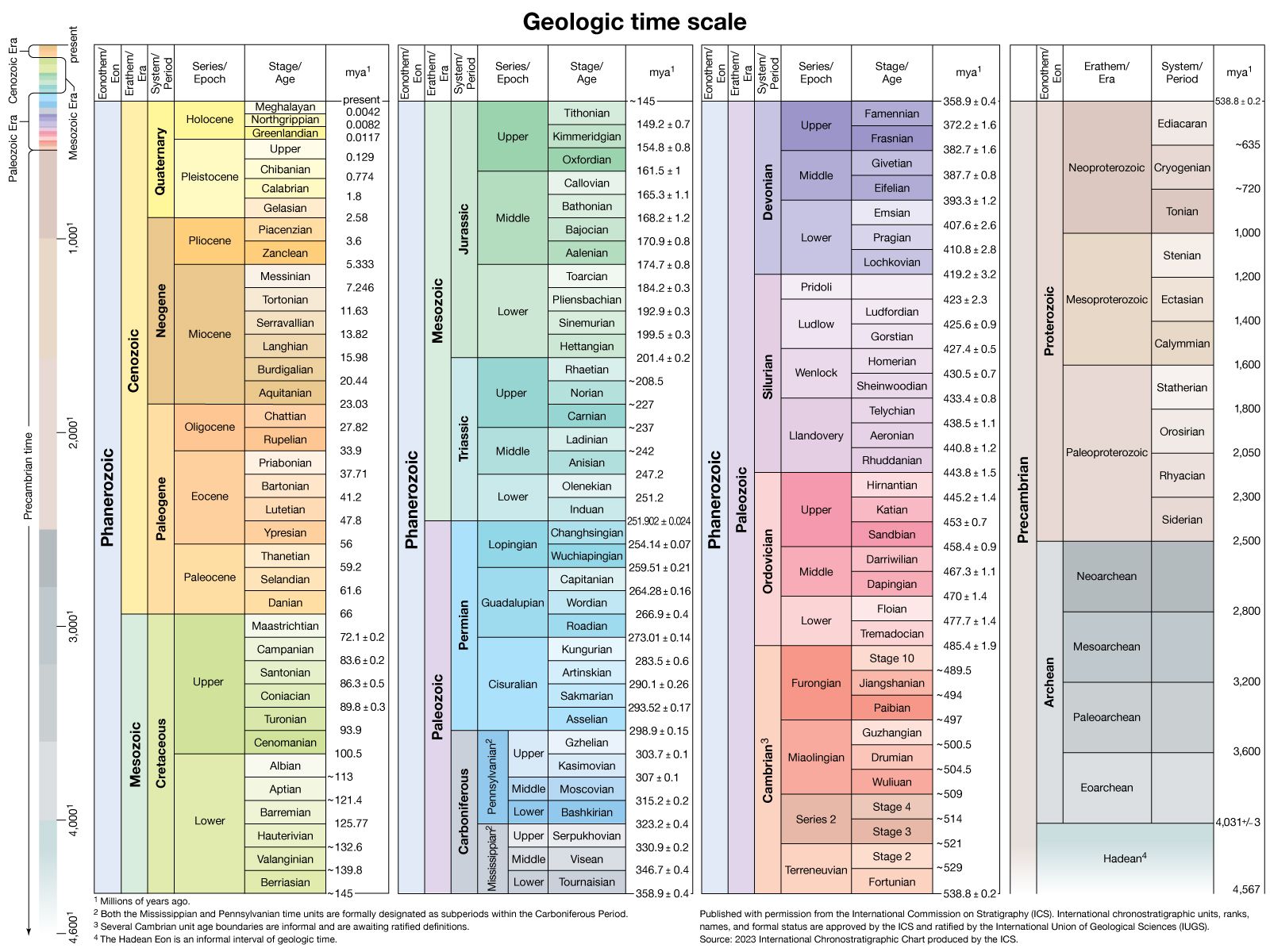
These fossils are essential to geologists because they provide the foundation for defining boundaries within the geologic time scale and enable the stratigraphic correlation of rock layers across different regions. For example, while many trilobites are useful for regional correlation, specific pelagic species like Agnostida are prized for intercontinental correlation due to their rapid evolution and wide distribution. Similarly, conodonts serve as excellent indexes for global biostratigraphy from the late Cambrian through the Triassic Period. the late Cambrian through the Triassic Period.34
How do scientists determine the age of fossils found in rock layers?
Scientists determine the age of fossils and the rock layers in which they are found using two primary methods: relative dating and absolute (radiometric) dating.53
Relative Dating
Relative dating establishes the sequence of events without assigning a specific numerical age. This approach relies on several key principles:
- Law of Superposition: Formulated by Nicolaus Steno, this principle states that in an undisturbed sequence of sedimentary rock, the oldest layers are at the bottom and the youngest are at the top.6
- Biostratigraphy: Paleontologists use index fossils—organisms that were abundant, widely distributed, and existed for a short period—to correlate rock layers across different regions. By identifying the appearance or disappearance of these fossils, scientists can define boundaries in the geologic time scale.75
Absolute Dating
Absolute dating, or geochronology, provides a numerical age by measuring the radioactive decay of isotopes within minerals.89
- Isotopic Analysis: Scientists measure the ratio of “parent” radioactive atoms (such as uranium, potassium, or rubidium) to “daughter” atoms produced by their decay.89
- Precision: Because radioactive decay occurs at a constant, known rate, geochronologists can calculate the time elapsed since a mineral formed. Techniques like uranium-lead dating are highly precise and allow scientists to calibrate the fossil record, providing a timeline that extends back to Earth’s oldest rocks.938
What are the main differences between the Carboniferous and Permian periods?
The Carboniferous and Permian periods represent distinct phases in Earth’s history, marked by significant shifts in climate, geography, and biodiversity.
Climate and Geography
The Carboniferous Period (358.9 to 298.9 million years ago) was characterized by highly variable environments, including widespread coal swamps in the Northern Hemisphere and extensive continental glaciations in the Southern Hemisphere.1011
In contrast, the Permian Period (298.9 to 252.2 million years ago) saw the assembly of the supercontinent Pangea, which fundamentally altered global climates. While early Permian times began with lingering glaciation, the period generally trended toward global warming and increased aridity. By the Late Permian, hot and dry conditions were widespread, leading to the expansion of deserts in tropical and subtropical regions.121314
Biological Evolution
- Plants: The Carboniferous is famous for its vast coal swamps dominated by vascular plants such as lycopods and seed ferns. During the Permian, plant life underwent a significant turnover as gymnosperms—including early conifers—adapted to the increasingly dry terrestrial habitats.101516
- Animals: Carboniferous life included diverse amphibians and the first [reptiles]. The Permian saw a rapid diversification of insects and the emergence of important reptile lineages that would eventually lead to mammals.101216
- Extinction: The Permian ended with the largest mass extinction in Earth’s history, which devastated marine and terrestrial life, whereas the Carboniferous is noted for its extensive preservation of biological events.1210
Sources
- Myalina — Encyclopædia Britannica
- list of mollusks — Encyclopædia Britannica
- index fossil — Encyclopædia Britannica
- Cambrian Period - Correlation of Cambrian strata — Encyclopædia Britannica
- dating: Top Questions — Encyclopædia Britannica
- law of superposition — Encyclopædia Britannica
- geologic history of Earth - Time scales — Encyclopædia Britannica
- dating - Principles of isotopic dating — Encyclopædia Britannica
- dating - Distinctions between relative-age and absolute-age measurements — Encyclopædia Britannica
- A Journey Through Time Since the Precambrian - Permian Period: 298.9 million to 252.2 million years ago — Encyclopædia Britannica
- Permian Period - Paleoclimate — Encyclopædia Britannica
- Permian Period - The Permian environment — Encyclopædia Britannica
- Carboniferous Period - Distinctive features — Encyclopædia Britannica
- Permian Period - Temperature crises — Encyclopædia Britannica
- plant - Evolution of seed plants and plant communities — Encyclopædia Britannica
- Permian Period - Marine and terrestrial life — Encyclopædia Britannica
- Carboniferous Period — Encyclopædia Britannica
Published on · 3 min read