Trumpet Creeper
The trumpet creeper refers to either of two species of ornamental, deciduous vines belonging to the genus Campsis and the family Bignoniaceae. These plants…
What is Trumpet creeper?
The trumpet creeper refers to either of two species of ornamental, deciduous vines belonging to the genus Campsis and the family Bignoniaceae. These plants are characterized by their ability to climb using aerial rootlets.1
The two primary species are:
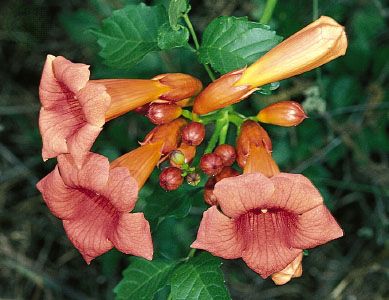
- Campsis radicans: Also known as the trumpet vine or cow itch, this hardy climber is native to the eastern and southern United States. It features terminal clusters of tubular, orange to orange-scarlet flowers.1
- Campsis grandiflora: Known as the Chinese trumpet creeper, this species is native to eastern Asia. While it is a less effective climber than C. radicans, it is noted for producing striking bunches of brilliant scarlet flowers.1
What types of wildlife are attracted to trumpet creeper flowers?
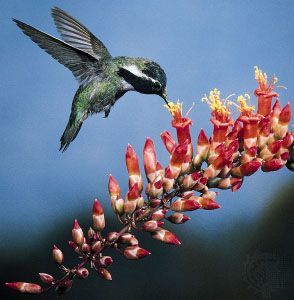
Trumpet creeper flowers are highly attractive to birds, particularly hummingbirds. These plants exhibit classic ornithophilous (bird-pollinated) characteristics, which include their vibrant red or orange-scarlet coloration, tubular shape, and the production of copious amounts of nectar.3
Because these flowers are devoid of scent and feature a wide, tubular mouth, they are specifically adapted to accommodate the beaks and tongues of avian visitors that feed on nectar. While the provided search results do not explicitly list the trumpet creeper as an example, its floral morphology aligns perfectly with the traits of plants that rely on birds for pollination.3
How do aerial rootlets help a plant climb?
Aerial rootlets help a plant climb by serving as specialized adventitious roots that provide a means of attachment to non-soil surfaces. Unlike typical roots that grow underground, these structures arise from stem tissues and allow climbing plants—often referred to as root climbers—to grip supports such as rocks, trees, or other structures.456
By anchoring themselves directly to these surfaces, the plants can secure their position as they grow upward, effectively using the support to reach higher elevations. This mechanism is a common strategy for various species, including English ivy, enabling them to thrive in environments where they must climb to access light or space.45
What are the differences between native and invasive plant species?
The primary difference between native and invasive plant species lies in their evolutionary history and their impact on the environment.
Native species are organisms that have evolved and adapted to a specific ecosystem over long periods, existing in balance with the local environment and other indigenous species. They are integral to the biodiversity of their natural habitats.8
Invasive species, by contrast, are non-native organisms that have been introduced to a new environment—often through human activity—where they lack natural predators or competitors to keep their populations in check. Their impact is characterized by:89
- Competitive Advantage: They often possess traits that allow them to grow and disperse rapidly, monopolizing resources like food, light, and living space.810
- Ecological Disruption: By outcompeting native plants, they can replace diverse natural vegetation, reduce biodiversity, and even force the localized extinction of native species.811
- Economic and Environmental Harm: They can disrupt entire ecosystems, serve as vectors for disease, and cause significant economic damage to biological resources.8
While many introduced species fail to survive in new surroundings, those that become invasive can fundamentally alter the structure and function of the ecosystems they colonize.89
Sources
- Trumpet creeper — Encyclopædia Britannica
- trumpet creeper — Merriam-Webster
- Major types of pollinators - Birds — Encyclopædia Britannica
- Adventitious root — Encyclopædia Britannica
- Root — Encyclopædia Britannica
- Tree - Tree roots — Encyclopædia Britannica
- root climber — Merriam-Webster
- invasive species — Encyclopædia Britannica
- conservation - Removing invasive species — Encyclopædia Britannica
- invasive — Merriam-Webster
- Wetland - Disturbances caused by humans — Encyclopædia Britannica
Published on · 2 min read