Tumbling Flower Beetle
A tumbling flower beetle is any of approximately 1,500 species of beetles belonging to the family Mordellidae. These insects are named for the erratic…
What is tumbling flower beetle?
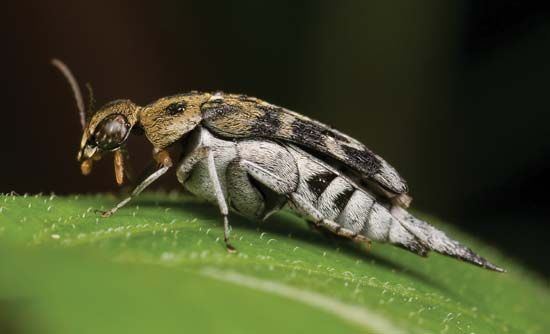
A tumbling flower beetle is any of approximately 1,500 species of beetles belonging to the family Mordellidae. These insects are named for the erratic jumping, turning, and tumbling motions they exhibit when they are caught or disturbed.1
Physically, these beetles are small, typically measuring between 3 and 7 mm (0.1 to 0.3 inch) in length. They are characterized by a black, humpbacked, and wedge-shaped body covered in fine hairs, with a broad anterior end that tapers to a pointed abdomen extending beyond their forewings.12
Adults are active, good fliers, and are most frequently observed on flowers. Their larvae, however, have different habits: some live in and feed on rotten wood or plant stems, while others may attack the heartwood of weak trees or reside in the pith of herbaceous weeds.132
Why do tumbling flower beetles jump and tumble when they are disturbed?
Tumbling flower beetles (family Mordellidae) exhibit their characteristic jumping, turning, and tumbling motions as a defensive response when they are caught or disturbed. This erratic behavior serves as a mechanism to evade potential threats or escape from predators.1
How do the larvae of these beetles survive inside rotten wood?
The larvae of tumbling flower beetles (family Mordellidae) survive inside rotten wood by consuming the decaying plant material as their primary food source. While some species inhabit dead or dying deciduous wood, others are known to attack the heartwood of weakened trees or reside within the pith of herbaceous weeds.16
In the broader context of wood-boring beetles, larvae often possess specialized adaptations to thrive in such environments. For instance, many wood-boring larvae maintain yeast within their digestive tract, which assists in breaking down wood into digestible compounds. Depending on the specific species, these larvae may also exhibit different body forms—such as the soft, cylindrical, or flattened shapes seen in other wood-feeding borers—to navigate their environment effectively.7
What are some other types of beetles that are commonly found on flowers?
Beyond the tumbling flower beetles, several other beetle families are commonly found on flowers, where they often feed on pollen, nectar, or petals.89
Common Flower-Visiting Beetles
- Soldier Beetles (Family Cantharidae): These slender, soft-bodied beetles are frequently found on vegetation and flowers. While some species are carnivorous, others possess specialized mouthparts for feeding on pollen and nectar.1011
- Flower Chafers (Subfamily Cetoniinae): A group within the scarab beetle family, these beetles are noted for their brilliant, often iridescent coloration. They are frequent visitors to flowers, where they browse on petals or consume pollen and nectar.128
- False Blister Beetles (Family Oedemeridae): These beetles are widely distributed, particularly in temperate regions, and are commonly observed on flowers or foliage as adults.9
- Fire-Colored Beetles (Family Pyrochroidae): These relatively large beetles are often found on flowers and foliage, as well as under tree bark.9
- Long-Horned Beetles (Family Cerambycidae): While many are known for their wood-boring habits, adults of certain species, such as the elderberry longhorn, are commonly found feeding on the leaves and flowers of their host plants.13
Sources
- tumbling flower beetle — Encyclopædia Britannica
- Coleoptera - Feeding habits and habitats — Encyclopædia Britannica
- Coleoptera - Annotated classification — Encyclopædia Britannica
- Mordellidae — Merriam-Webster
- mordellid — Merriam-Webster
- Coleoptera - Larval features — Encyclopædia Britannica
- Lepidoptera - Larva, or caterpillar — Encyclopædia Britannica
- soldier beetle — Encyclopædia Britannica
- scarab beetle — Encyclopædia Britannica
- Pollination - Beetles and flies — Encyclopædia Britannica
- Pollination - Evolution of insect pollination — Encyclopædia Britannica
- flower chafer — Encyclopædia Britannica
- soldier beetle — Merriam-Webster
- long-horned beetle — Encyclopædia Britannica
Published on · 2 min read