Spookfish
The term "spookfish" most commonly refers to any of approximately 11 species of small marine fishes in the family Opisthoproctidae. Also known as barreleyes…
What is spookfish?
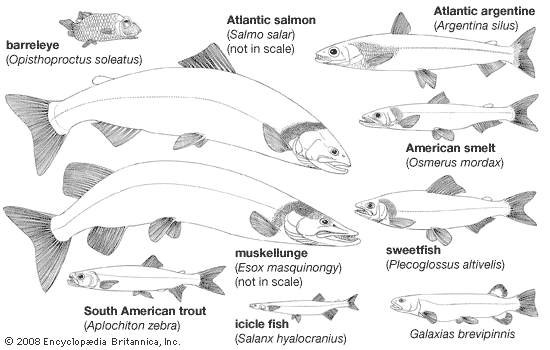
The term “spookfish” most commonly refers to any of approximately 11 species of small marine fishes in the family Opisthoproctidae. Also known as barreleyes, these fish are found in all major oceans at depths typically ranging from 100 to 900 meters (330 to 3,000 feet). Their name is derived from their distinctive, large, tubular eyes that are oriented upward to scan the water above them.1
One notable example is the barreleye (Macropinna microstoma), a Pacific species found along the North American coast that is brownish in color and measures less than 10 centimeters (4 inches) in length. It is important to note that the term “spookfish” can also be used to refer to the chimaera, a different type of cartilaginous fish.12
How do barreleye fish use their tubular eyes to see in the deep sea?
Barreleye fish, also known as spookfish, possess highly specialized tubular eyes that are a remarkable evolutionary adaptation to the extreme darkness of the deep-sea environment. These large, upward-pointing eyes are designed to maximize light-gathering capabilities in an area where sunlight is virtually nonexistent. By orienting their vision toward the surface, these fish can detect the silhouettes of prey or other organisms against the faint, residual light filtering down from above.
While the provided search results detail various ocular adaptations in marine life—such as the concave mirror eyes of scallops or the dual-purpose vision of the four-eyed fish—they do not explicitly describe the internal mechanics of the barreleye’s tubular eyes. However, it is understood that such specialized structures in mid-water deep-sea fishes are generally part of a suite of traits, including luminous organs, that help these animals navigate, hunt, and find mates in the deep ocean’s specialized habitat.
What are some other unique adaptations of deep-sea creatures?
Deep-sea creatures have evolved a variety of specialized adaptations to survive the extreme pressure, cold, and darkness of their environment. These evolutionary traits are among the most specialized in the world.7
Bioluminescence
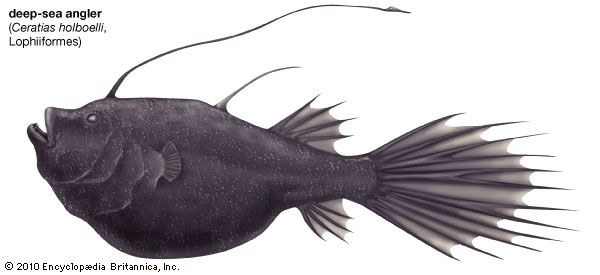
Many deep-sea organisms utilize marine bioluminescence, a chemical process that produces light. This is often used to attract prey or potential mates in the perpetual darkness. For example, the anglerfish uses a luminous, bait-like appendage to lure prey toward its mouth. Other species, such as certain squids, emit luminous clouds to distract predators when threatened.57
Physiological and Structural Adaptations
- Pressure Resistance: To survive the intense hydrostatic pressure of the deep ocean, deep-sea animals lack air-filled compartments like lungs or swim bladders, which would otherwise compress or collapse.8
- Feeding Mechanisms: Mid-water species are frequently characterized by huge mouths and enlarged eyes to help them hunt. In contrast, bottom-dwelling (benthic) species often have smaller eyes and down-turned mouths, as they are adapted to feed on the seafloor.7
- Specialized Hunting: Beyond bioluminescence, some deep-sea fish, such as viperfishes, have developed formidable fanglike teeth to secure prey.7
What is a chimaera and how does it differ from the Opisthoproctidae family?
A chimaera (subclass Holocephali) is a type of cartilaginous fish related to sharks and rays within the class Chondrichthyes. Unlike sharks and rays, which have multiple external gill openings, chimaeras possess a single external gill opening on each side of the body, covered by a flap. Additionally, male chimaeras feature a unique, erectile clasping organ called a tentaculum on their forehead and in front of their pelvic fins.1415
The Opisthoproctidae family, which includes the barreleye fish, is fundamentally different from the chimaera. While the chimaera is a cartilaginous fish, the Opisthoproctidae belong to the bony fishes (Osteichthyes). Bony fishes possess skeletons made of true bone rather than cartilage and have distinct physiological structures, such as swim bladders, which are absent in chimaeras.15
In summary, the primary difference lies in their biological classification: chimaeras are cartilaginous, ancient-lineage fish with unique reproductive organs and gill structures, whereas the Opisthoproctidae are specialized bony fish adapted for deep-sea life.1415
Sources
- spookfish — Encyclopædia Britannica
- spookfish — Merriam-Webster
- tetraodontiform - Annotated classification — Encyclopædia Britannica
- Photoreception - Concave mirror eyes — Encyclopædia Britannica
- deep-sea fish — Encyclopædia Britannica
- atheriniform - Form and function — Encyclopædia Britannica
- Marine bioluminescence — Encyclopædia Britannica
- sea anemone: Top Questions — Encyclopædia Britannica
- Biosphere - Hydrostatic pressure — Encyclopædia Britannica
- gigantism — Merriam-Webster
- echinoderm - Sexual reproduction — Encyclopædia Britannica
- Pelecaniform - Feeding ecology — Encyclopædia Britannica
- Feeding behaviour - Types of food procurement — Encyclopædia Britannica
- chimaera — Encyclopædia Britannica
- chondrichthyan - Distinguishing features — Encyclopædia Britannica
Published on · 3 min read