What’s the Difference Between a Grasshopper and a Cricket?
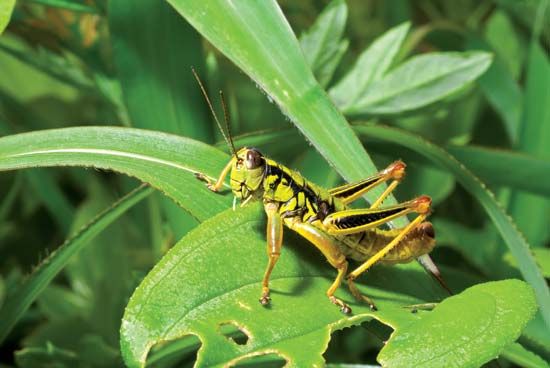
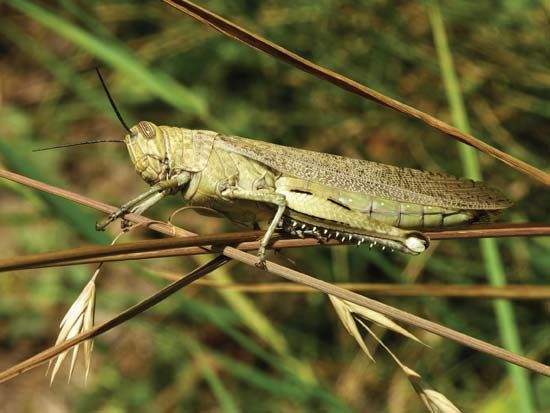
While grasshoppers and crickets are both members of the order Orthoptera, they are distinct insects with several key differences:
What’s the Difference Between a Grasshopper and a Cricket?
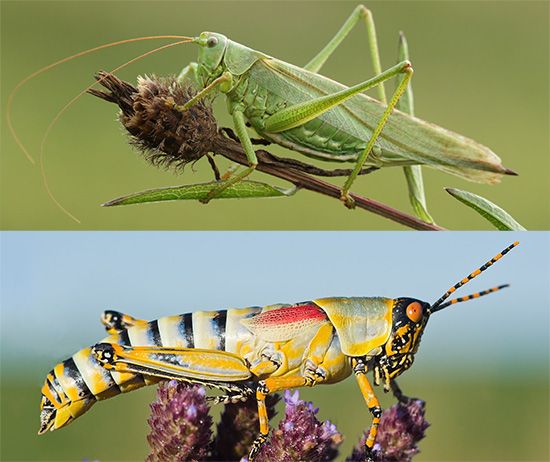
While grasshoppers and crickets are both members of the order Orthoptera, they are distinct insects with several key differences:
- Antennae: Crickets possess significantly longer antennae than grasshoppers.1
- Sound Production: Grasshoppers create noise by rubbing their hind legs against their wings, whereas crickets chirp by shuffling their wings together.12
- Hearing: Grasshoppers have tympanal organs (ears) located on their abdomen near the thorax. In contrast, crickets have these organs on their forelegs.12
- Activity Patterns: Grasshoppers are primarily diurnal (active during the day), while most crickets are nocturnal.13
These insects also occupy different ecological niches and play vital roles in ecosystems as herbivores and food sources for various predatorsystems](https://www.britannica.com/science/ecosystem) as herbivores and food sources for various predators. While some grasshoppers are known as agricultural pests, crickets are increasingly recognized for their potential as a sustainable, protein-rich food source for humans.54
What are locusts and how do they relate to grasshoppers?
Locusts are not a separate biological family from grasshoppers; rather, the term refers to specific species of short-horned grasshoppers that exhibit a unique phenomenon known as phase polyphenism.67
While most grasshoppers remain in a solitary, relatively harmless state, certain species can undergo a dramatic physiological and behavioral transformation when their population density increases due to environmental factors. This transition is governed by a “phase theory,” which distinguishes between two states:68
- Solitary Phase: The insect is sluggish, lives in isolation, and has a coloration that blends into its surroundings.6
- Gregarious Phase: Triggered by crowding, the insect becomes active, nervous, and changes both its physical form (often developing longer wings and different coloration) and its behavior.67
In this gregarious phase, these insects form massive, highly destructive migratory swarms that can travel long distances and devastate crops. Hormonal changes, often stimulated by physical contact and crowding, drive this shift, allowing the population to explode and move as a collective unit. Consequently, the distinction between a “grasshopper” and a “locust” is often a matter of behavioral phase rather than taxonomic classification.687
How do insects like crickets and grasshoppers hear without ears on their heads?
Insects like crickets and grasshoppers do not require ears on their heads to hear because they have evolved specialized auditory structures called tympanal organs located elsewhere on their bodies. These organs consist of a thin, vibrating membrane backed by an air sac, which functions similarly to a human eardrum by detecting pressure changes from sound waves.910
The location of these organs varies by species:
- Crickets and Katydids: Their ears are located on the first segment of their front walking legs (tibiae).1110
- Grasshoppers: Their ears are situated on the first segment of the abdomen, typically hidden beneath the base of their wing covers.91110
When sound waves strike the tympanic membrane, the resulting vibrations are detected by specialized sensory cells called scolophores. These cells then transmit nerve impulses to the insect’s central nervous system. In addition to these primary organs, many orthopterans also utilize sensory hairs across their bodies and Johnston’s organ in their antennae to perceive vibrations in their environment.910
What is the process of stridulation in insects?
Stridulation is the process by which many insects produce sound by rubbing together specially modified parts of their bodies. This mechanism typically involves a “file”—a surface with a row of teeth or ridges—and a “scraper,” a sharp edge or raised vein that rasps against the file to create vibrations.2121314
The specific anatomy and movement vary by group:
- Crickets and Katydids: Males possess a file on one front wing and a scraper on the other. By lifting their wings and shuffling them open and closed, they cause the wing membranes to vibrate, producing their characteristic songs.1213
- Grasshoppers: Many species stridulate by rubbing the inner surface of their hind legs, which are equipped with pegs or serrations, against the raised veins of their folded front wings (tegmina).12
- Beetles: These insects often use various body parts as stridulatory organs, such as rubbing the head against the prothorax or the hind legs against the wing covers (elytra). This behavior occurs in both adults and some larvae.15
- Heteropterans: These insects use a “strigil” or “rasp” (file) and a “plectrum” (scraper) to produce sounds that are often too quiet for humans to hear.14
Stridulation is primarily used for communication, such as attracting mates or signaling to others.131514
Sources
- What’s the Difference Between a Grasshopper and a Cricket? — Encyclopædia Britannica
- Orthoptera - Sound production and hearing — Encyclopædia Britannica
- List of insects - crickets , grasshoppers , and katydids (order Orthoptera ) — Encyclopædia Britannica
- Orthoptera - Habitat — Encyclopædia Britannica
- Orthoptera - Importance — Encyclopædia Britannica
- locust — Encyclopædia Britannica
- Orthoptera - Hormones — Encyclopædia Britannica
- insect - Damage to growing crops — Encyclopædia Britannica
- sound reception - Tympanal organs — Encyclopædia Britannica
- sound reception - Organs of sound reception in invertebrates — Encyclopædia Britannica
- sound reception - Antennae and antennal organs — Encyclopædia Britannica
- stridulation — Merriam-Webster
- sound reception - Behavioral observations — Encyclopædia Britannica
- Coleoptera - Sound production — Encyclopædia Britannica
- heteropteran - Sound production and reception — Encyclopædia Britannica
Published on · 3 min read