What’s the Difference Between Alligators and Crocodiles?
Although alligators and crocodiles share many physical similarities, such as long snouts, powerful tails, and bony-plated backs, they belong to different…
What’s the Difference Between Alligators and Crocodiles?
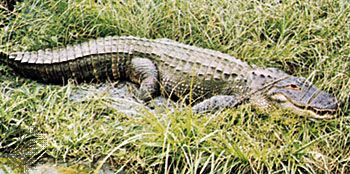
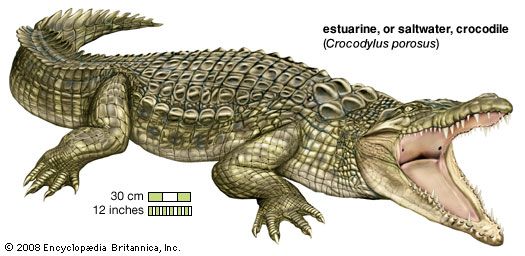
Although alligators and crocodiles share many physical similarities, such as long snouts, powerful tails, and bony-plated backs, they belong to different families and can be distinguished by several key characteristics:
- Snout Shape: Alligators have a broad, U-shaped snout, whereas crocodiles possess a narrower, V-shaped snout.12
- Teeth: When an alligator’s mouth is closed, its lower teeth are typically hidden. In contrast, a crocodile’s upper and lower teeth interdigitate, making the large fourth tooth on the lower jaw clearly visible.123
- Color: Alligators tend to be darker, appearing gray or black, while crocodiles are generally olive or tan.1
- Habitat: Alligators primarily inhabit freshwater environments, while crocodiles are more commonly found in saltwater habitats.1
- Behavior: Crocodiles are generally considered more aggressive than alligators.1
What are caimans and how do they relate to alligators?
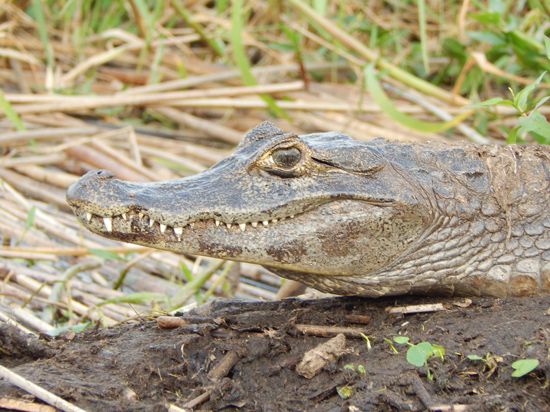
Caimans are a group of Central and South American reptiles that are closely related to alligators. In fact, they are classified within the same family, Alligatoridae, which encompasses all living species of alligators and caimans.567
Like alligators, caimans are amphibious carnivores that live along the edges of rivers and other bodies of water, and they reproduce by laying hard-shelled eggs in nests guarded by the female. While they share this family lineage, there are notable differences:5
- Diversity and Size: There are several species of caimans, ranging from the relatively small smooth-fronted caimans to the black caiman, which is the largest member of the Alligatoridae family and can exceed the size of the American alligator.56
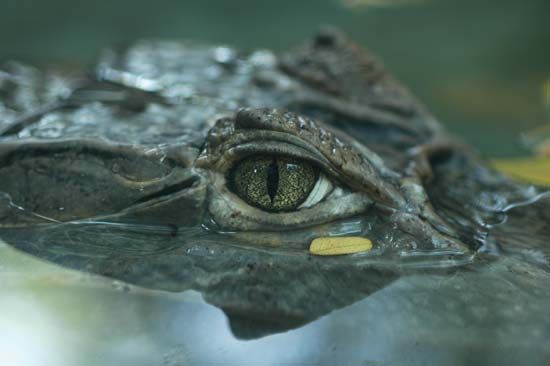
- Physical Features: Some caimans, such as the spectacled caiman, are distinguished by unique features like a bony ridge between the eyes that resembles the nosepiece of eyeglasses.52
- Habitat: While alligators are primarily found in the United States and China, caimans are native to tropical regions of Central and South America.527
What is a gavial and what makes its snout unique?
The gavial—also known as the gharial—is a large, critically endangered crocodilian native to the river systems of South Asia, particularly in India, Nepal, and Bangladesh. It is one of only two living species in the family Gavialidae, the other being the false gavial.89
The gavial is most famous for its exceptionally long, slender snout, which is lined with approximately 110 sharp, interlocking teeth designed for catching fish. This unique snout structure serves two primary purposes:9
- Feeding: The narrow shape allows the animal to sweep its jaws sideways through the water with minimal resistance to capture its primary prey, fish.9
- Communication: Adult males possess a hollow, bulbous structure at the tip of the snout called a ghara (named for its resemblance to an Indian mud pot). This structure acts as a resonator, likely used to amplify vocalizations and serve as a visual display during mating.89
How do these reptiles use their tails for swimming and defense?
Reptiles utilize their tails in highly specialized ways for both locomotion and defense, depending on their species and environment.
Locomotion
For aquatic reptiles like crocodiles, the tail is a primary tool for movement. These animals possess long, muscular tails that are well-suited for swimming. When in the water, they tuck their legs against their bodies and propel themselves forward using lateral, wavelike motions of the tail. This is supported by a unique “I-beam” spinal structure that allows for the efficient transfer of energy from the tail to the rest of the body. On land, the tail also acts as a cantilever to help balance the body during movement.1112
Defense
Reptiles employ several defensive strategies involving the tail:
- Physical Deterrence: Some lizards possess thick tails covered in hard, spiny scales. By swinging these tails vigorously, they can effectively ward off predators like snakes.13
- Autotomy: Certain lizards can voluntarily shed their tails—a process called autotomy—when captured. The detached tail continues to wriggle, confusing the predator and providing the lizard an opportunity to escape.13
- Diversion: Some snakes use their tails as a distraction by raising and moving them slowly to draw attention away from their heads.13
Sources
- What’s the Difference Between Alligators and Crocodiles? — Encyclopædia Britannica
- alligator — Encyclopædia Britannica
- crocodile - Annotated classification — Encyclopædia Britannica
- crocodile - Behavior — Encyclopædia Britannica
- caiman — Encyclopædia Britannica
- spectacled caiman — Encyclopædia Britannica
- Are black caimans larger than alligators? — Encyclopædia Britannica
- 10 Critically Endangered Animals of India - Gharial ( Gavialis gangeticus ) — Encyclopædia Britannica
- gharial — Merriam-Webster
- gavial — Encyclopædia Britannica
- reptile - Use of the tail — Encyclopædia Britannica
- crocodile - Form and function — Encyclopædia Britannica
- crocodile - Locomotion — Encyclopædia Britannica
- Tail — Encyclopædia Britannica
Published on · 3 min read