Why Do Oarfish Swim Vertically?
Oarfish adopt a vertical orientation primarily as a form of camouflage within their deep-water environment. By positioning their flattened bodies vertically…
Why do oarfish swim vertically?
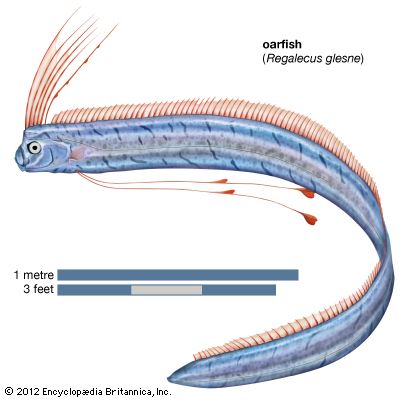
Oarfish adopt a vertical orientation primarily as a form of camouflage within their deep-water environment. By positioning their flattened bodies vertically, they minimize their profile to predators lurking above, while their reflective, silvery skin helps them blend into the surrounding water in the dim light of the depths.1
Beyond camouflage, this posture offers several functional advantages:
- Hunting: The vertical position allows oarfish to more effectively spot prey, such as small fish and plankton, silhouetted against the light filtering down from the surface.1
- Energy Conservation: Because their elongated bodies are susceptible to being displaced by ocean currents, a vertical orientation enables them to utilize their large dorsal fin to navigate more efficiently, helping them conserve energy in an environment where food resources are scarce.1
Swimming in this manner is a distinct adaptation for these creatures, differing from the typical lateral undulatory movements seen in many other elongated fish.23
What do oarfish typically eat in the deep ocean?
Oarfish are predators that primarily consume small fish and plankton in their deep-water habitat. By maintaining a vertical orientation in the water column, they are able to spot these prey items more easily as they appear silhouetted against the light filtering down from the surface.1
How large can oarfish grow compared to other deep-sea fish?
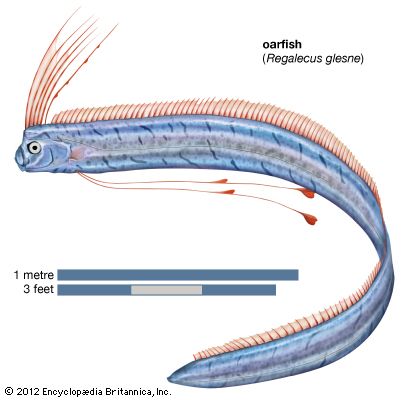
The oarfish (Regalecus glesne) is exceptionally large compared to most other deep-sea fish. It is a ribbon-shaped, elongated creature that can reach lengths of approximately 8 to 9 meters (25 to 30.5 feet) and weigh up to 300 kg (660 pounds).561
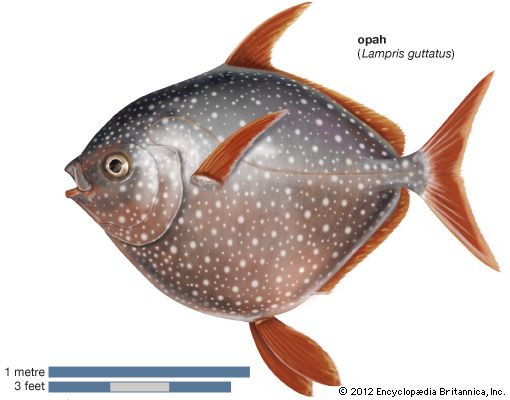
In contrast, many other specialized deep-sea inhabitants are significantly smaller. For example, deep-sea anglerfish, which are well-known for their unique predatory adaptations, typically reach a maximum length of about 1.2 meters (4 feet), with most species being much smaller. Similarly, many other deep-bodied fish, such as beryciforms and zeiforms, generally measure a foot or less in length. While some deep-sea species like the opah can reach weights comparable to the oarfish, the oarfish’s extreme length distinguishes it as one of the most massive and visually striking inhabitants of the deep ocean.715
Why are oarfish sightings often associated with myths or legends?
Oarfish sightings are frequently linked to myths and legends because their unique physical characteristics often lead observers to mistake them for the legendary sea serpent.
The oarfish is a large, ribbon-shaped creature that can grow up to 9 meters (30.5 feet) in length. Its sinuous body, shiny silver color, and long, red dorsal fin—which forms a manelike crest on its head—give it an appearance that aligns with historical descriptions of monstrous marine animals. Because these fish typically inhabit deep waters and are rarely seen at the surface, their occasional appearance can be startling and difficult to identify correctly.510
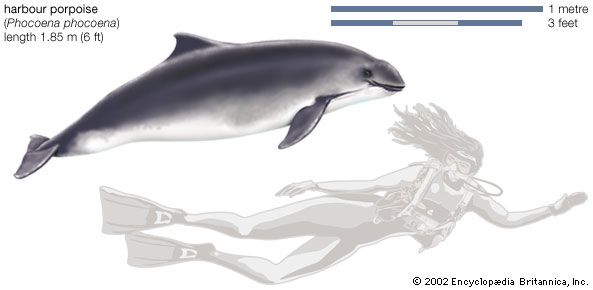
Throughout history, many accounts of sea monsters have been attributed to misidentifications of known animals. In addition to oarfish, other phenomena such as swimming porpoises, floating masses of seaweed, and giant squids have also been cited as the likely basis for various sea serpent legends.10
Sources
- Why do oarfish swim vertically? — Encyclopædia Britannica
- Locomotion - Anguilliform locomotion — Encyclopædia Britannica
- Locomotion - Fish and fishlike vertebrates — Encyclopædia Britannica
- commercial fishing - The oceans — Encyclopædia Britannica
- oarfish — Encyclopædia Britannica
- deep-sea fish — Encyclopædia Britannica
- oarfish — Merriam-Webster
- anglerfish — Encyclopædia Britannica
- atheriniform - General features — Encyclopædia Britannica
- sea serpent — Encyclopædia Britannica
Published on · 2 min read