Why Is Grass Green?
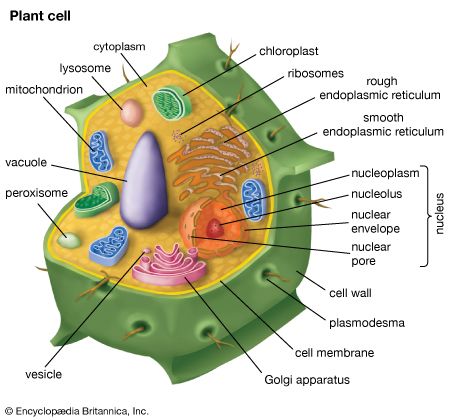
Grass appears green primarily due to the presence of chlorophyll, a pigment located within the chloroplasts of plant cells.
Why Is Grass Green?
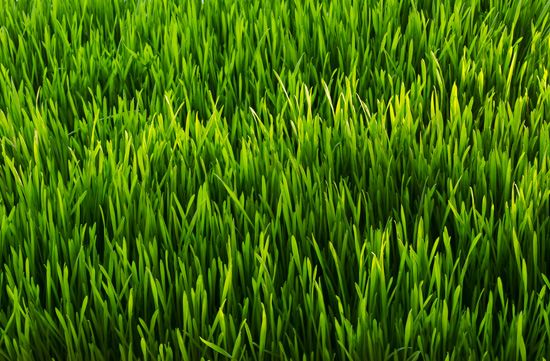
Grass appears green primarily due to the presence of chlorophyll, a pigment located within the chloroplasts of plant cells1.1
Chlorophyll is essential for photosynthesis, the process by which plants convert light energy into chemical energy. This pigment absorbs light most efficiently in the blue and red portions of the electromagnetic spectrum, while reflecting green light, which is why grass and other plants appear green to the human eye.21
Because most grasses consist almost entirely of chlorophyll-rich leaves and stems rather than woody tissue, this green coloration is dominant throughout their aboveground structures. While plants may contain other pigments like carotenoids, chlorophyll is typically present in such high concentrations during the growing season that it masks these other colors.31
How does photosynthesis create energy for plants?
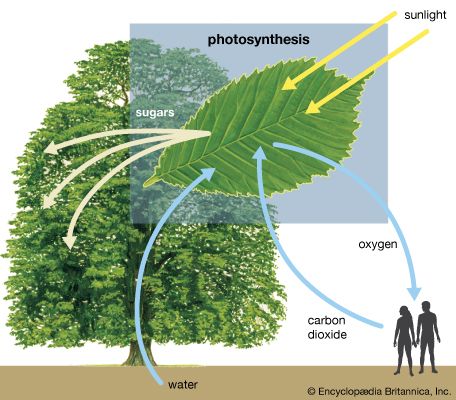
Photosynthesis is the biological process by which plants, algae, and certain bacteria convert light energy into chemical energy stored in carbohydrates like glucose. This process occurs within specialized cell organelles called chloroplasts and consists of two interdependent stages:
The Light Reactions
Occurring in the thylakoids of the chloroplast, these reactions capture solar energy. Pigments such as chlorophyll and carotenoids act as antennae to absorb light, which is then transferred to a reaction center. This energy triggers an electron flow that creates a charge difference across the membrane, effectively acting like a battery. This process generates two high-energy molecules: ATP and NADPH.567
The Dark Reactions (Calvin-Benson Cycle)
Taking place in the stroma, these reactions do not require direct sunlight. Instead, they utilize the ATP and NADPH produced during the light reactions to convert carbon dioxide into simple sugars. Through a series of enzyme-catalyzed steps, carbon is fixed and reduced to form energy-rich compounds that sustain the plant.672
The overall chemical transformation is represented by the formula: 6CO2+12H2O→C6H12O6+6O2+6H2O6CO_2 + 12H_2O \rightarrow C_6H_{12}O_6 + 6O_2 + 6H_2O6
Why do some leaves change color in the autumn?
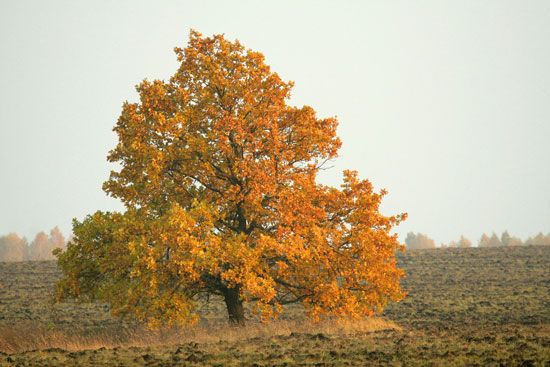
In autumn, the vibrant color changes in deciduous leaves are primarily caused by the breakdown of chlorophyll, the green pigment responsible for photosynthesis.89
As days grow shorter and temperatures drop, trees prepare for winter dormancy. During this period, chlorophyll production slows and the existing pigment is gradually broken down. This process reveals other pigments that were previously masked by the dominant green color:984
- Carotenoids: These pigments, which are present in the leaf throughout the growing season, become visible as the chlorophyll fades, producing yellow and orange hues.89
- Anthocyanins: In some species, the breakdown of chlorophyll is accompanied by the accumulation of these pigments, which impart red or purple colors to the leaves.89
- Tannins: These compounds are responsible for the dull brown colors seen in leaves such as those of the oak tree.9
Ultimately, these changes occur as the tree forms an abscission layer at the base of the leaf petiole, eventually causing the leaf to separate from the stem.9
What are the differences between chlorophyll a and chlorophyll b?
Chlorophyll a and chlorophyll b are the primary types of chlorophyll found in higher plants and green algae. While both pigments are essential for photosynthesis, they serve distinct roles in the capture of light energy.10
- Chlorophyll a: This is the primary pigment involved in the light-dependent reactions of photosynthesis. It acts as the central molecule that directly converts light energy into chemical energy. Other pigments, known as accessory pigments, absorb light at different wavelengths and transfer that energy to chlorophyll a for use.102
- Chlorophyll b: This pigment functions as an accessory pigment. It absorbs light energy at different wavelengths than chlorophyll a and transfers that energy to chlorophyll a to facilitate the photosynthetic process.102
Structurally, both molecules consist of a central magnesium atom surrounded by a porphyrin ring with a long phytol side chain. The differences between them arise from minor modifications to specific side groups attached to the porphyrin ring.10
Sources
- Why Is Grass Green? — Encyclopædia Britannica
- Chlorophyll: Top Questions — Encyclopædia Britannica
- Photosynthesis - Chloroplasts — Encyclopædia Britannica
- Why are plants green? — Encyclopædia Britannica
- photochemical reaction - Photochemical steps in photosynthesis — Encyclopædia Britannica
- Plant - Basic mechanisms — Encyclopædia Britannica
- Photosynthesis - The Calvin-Benson cycle — Encyclopædia Britannica
- Why Do Leaves Change Color in the Fall? — Encyclopædia Britannica
- Leaf — Encyclopædia Britannica
- Chlorophyll — Encyclopædia Britannica
- accessory pigment — Merriam-Webster
Published on · 3 min read