Wood Hoopoe
There are eight species of wood hoopoes, which belong to the family Phoeniculidae within the order Coraciiformes. These tropical African birds are divided…
How many species of wood hoopoes are there, and how do they differ?
There are eight species of wood hoopoes, which belong to the family Phoeniculidae within the order Coraciiformes. These tropical African birds are divided into two genera: Phoeniculus and Rhinopomastus.1
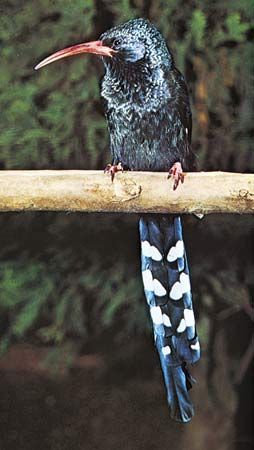
While all wood hoopoes share a similar appearance—typically featuring greenish or purplish black plumage and long, graduated tails—they differ primarily in their bill morphology and social behavior:12
- Bill Shape: The three species within the genus Rhinopomastus are commonly known as scimitarbills or scimitar-billed hoopoes. Their bills are distinctively shaped, ranging from slightly to strongly downcurved, and are specifically adapted for probing into bark and crevices to find insects.1
- Social Structure: Species such as the green wood hoopoe are highly social, living in close-knit, cooperative groups that engage in unique displays, such as “flag-waving” with pieces of bark. In contrast, forest-dwelling species of wood hoopoes tend to be less social and are often found as lone individuals.12
What are some interesting adaptations of wood hoopoes?
Wood hoopoes exhibit several specialized adaptations that allow them to thrive in their tropical African habitats:
- Bark-Climbing Morphology: Unlike many other birds in their order, wood hoopoes possess long, slender toes equipped with sharp, curved claws. This physical structure is a specialized adaptation for their habit of climbing along tree trunks and branches.1
- Specialized Bill Shape: Their bills are slender and range from slightly to strongly downcurved. This design is highly effective for probing into crevices, crannies, and under bark to extract insects. The three species in the genus Rhinopomastus, often called scimitarbills, have particularly pronounced downcurved bills for this purpose.41
- Broad Wings: Wood hoopoes have broad wings, which are well-suited for their lifestyle of feeding while moving on foot through trees.1
- Social Behavior: Many wood hoopoes are highly social, foraging in noisy, conspicuous bands of 5 to 10 individuals. The green wood hoopoe lives in close-knit groups that perform unique “flag-waving” displays, where individuals wave pieces of bark while others gather to rock their bodies and call.24
Where are wood hoopoes typically found in the wild?
Wood hoopoes are exclusively found in the tropical and subtropical regions of Africa. Within this range, they occupy various environments, including forests where some species may be observed as solitary individuals perched high in trees, while others are known to forage in noisy, social bands of 5 to 10 individuals moving through the branches.16
What role do wood hoopoes play in their ecosystem?
Wood hoopoes play several roles within their African ecosystems, primarily as insectivores and as participants in complex biological interactions:
- Insect Control: With their slender, downcurved bills, wood hoopoes are specialized to probe into tree crevices and under bark to extract insects. By foraging in groups, they actively search for and consume these invertebrates, helping to regulate insect populations within their forest habitats.17
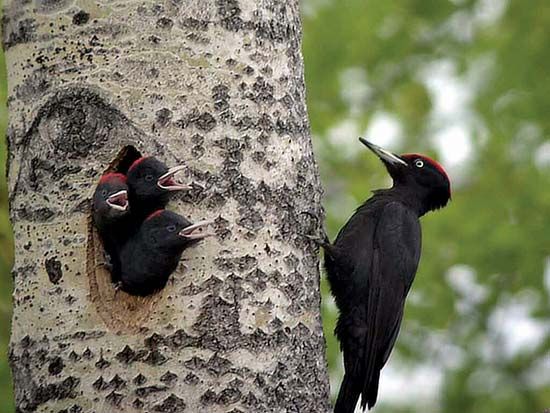
- Nesting Dynamics: Wood hoopoes rely on existing cavities, such as those created by woodpeckers, for their own nesting sites. The availability of these holes can influence the size of their breeding populations.2
- Host for Parasites: Wood hoopoes serve as hosts for honey guides, which are obligate social parasites. Honey guides lay their eggs in the nests of wood hoopoes, and the resulting nestlings often destroy the host’s own young. This relationship is significant, as the frequency of this parasitism can be a critical factor in the population status of wood hoopoes.2
Sources
- Wood hoopoe — Encyclopædia Britannica
- Coraciiform - Social behaviour — Encyclopædia Britannica
- Hoopoe — Encyclopædia Britannica
- Coraciiform - Life history — Encyclopædia Britannica
- Coraciiform - Morphological specializations — Encyclopædia Britannica
- Coraciiform - Distribution — Encyclopædia Britannica
- Coraciiform - Relationships with other species — Encyclopædia Britannica
Published on · 3 min read