Woodcock
The woodcock possesses a highly specialized feeding behavior centered on its diet of earthworms. To locate and capture its prey, the bird drums its feet on…
What is unique about the woodcock’s feeding behavior and diet?
The woodcock possesses a highly specialized feeding behavior centered on its diet of earthworms. To locate and capture its prey, the bird drums its feet on the ground to attract worms to the surface. Once they emerge, the woodcock uses its long, sensitive bill—which is uniquely capable of opening at the tip like a pair of forceps—to extract them from the soil.1
This feeding strategy is remarkably intensive; a single woodcock may consume up to twice its body weight, or approximately 450 grams (1 pound), of earthworms in a single day. Because this diet is so dependent on soft, accessible soil, the birds are forced to migrate as soon as the ground begins to freeze, as the cold prevents them from accessing their primary food source.1
What are the distinctive physical characteristics of the woodcock?
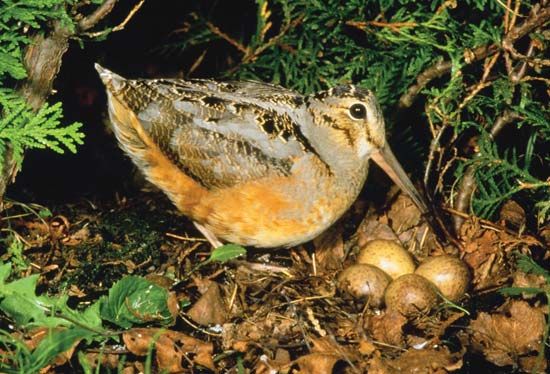
The woodcock is a squat-bodied, long-billed bird belonging to the family Scolopacidae. Its physical characteristics are highly specialized for its environment and lifestyle:
- Vision: The woodcock has a 360° field of vision, as its eyes are set farther back on its head than those of any other bird. Additionally, its ear openings are located below, rather than behind, the eye sockets.1
- Bill: It features a long, sensitive bill that is uniquely capable of opening at the tip like a pair of forceps, allowing it to extract prey from the soil.1
- Plumage and Camouflage: The bird is covered in buffy-brown, mottled plumage, which provides effective camouflage against dead leaves, allowing it to remain hidden until it is nearly stepped upon.1
- Wings: The wings are very rounded. In some species, the outermost wing feathers are attenuated to produce vibratory sounds during flight.1
- Size: The American woodcock is approximately 28 cm (11 inches) long, while the Eurasian woodcock is slightly larger, reaching about 35 cm in length.1
What are some interesting mating and courtship behaviors of woodcocks?
Woodcocks exhibit fascinating and distinct courtship behaviors that vary by species, primarily occurring at dusk.1
American Woodcock Courtship
The male American woodcock performs an elaborate aerial display to attract a mate. This sequence involves:
- Aerial Song: The male produces a sweet, varied whistling sound while in flight.1
- Soaring and Dropping: He spirals upward to heights of 60–90 meters (200–300 feet) before fluttering back down to his starting point.1
- Repetition: This soaring and dropping sequence can be performed repeatedly for up to 30 minutes.1
- Vibratory Sounds: The bird’s outermost wing feathers are attenuated, allowing him to produce distinct vibratory sounds during flight, seemingly at will.1
Eurasian Woodcock Courtship
The courtship display of the Eurasian woodcock, known as “roding,” differs significantly from its American counterpart:
- Flight Path: The male flies low over the treetops, following a triangular path.1
- Vocalizations: During this flight, he emits croaking sounds rather than the whistling song of the American species.1
These displays serve as vital courtship signals, which biologists often view as indicators of male quality and mechanisms for mate choice.5
What are the migration patterns of woodcocks?
Woodcocks are highly dependent on environmental conditions for their migration, as their specialized feeding habits—extracting earthworms from the soil with their long, sensitive bills—make it necessary for them to depart an area as soon as the ground begins to freeze.1
Unlike some bird species that follow a rigid, calendar-based schedule, woodcocks rely on surrounding conditions to initiate their spring and autumn migrations. Their flight patterns are dictated by fluctuations in temperature and barometric pressure, making them sensitive to weather changes. A sudden period of cold weather during the autumn, for instance, can trigger an immediate departure.6
While the American woodcock breeds in temperate North America and winters in the southeastern United States, the Eurasian woodcock breeds across the temperate Old World from Great Britain to Japan, with occasional migrants wandering to the eastern United States. Because their movements are not strictly regulated by fixed dates, they avoid the potential catastrophes that might arise from a lack of flexibility when ecological conditions, such as food availability, vary from year to year.16
Sources
- Woodcock — Encyclopædia Britannica
- Piciform - Form and function — Encyclopædia Britannica
- Sex - Sex differences in animals — Encyclopædia Britannica
- Photoreception - Diversity of eyes — Encyclopædia Britannica
- Animal social behavior - Social interactions involving sex — Encyclopædia Britannica
- Migration - Physiological stimulus of migration — Encyclopædia Britannica
- Migration - In Europe — Encyclopædia Britannica
Published on · 3 min read