Willet
The willet (Catoptrophorus semipalmatus) is a large, long-billed shorebird native to the Americas. A member of the Scolopacidae family—which also includes…
What is Willet?
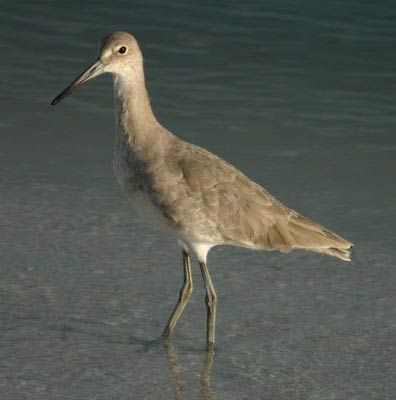
The willet (Catoptrophorus semipalmatus) is a large, long-billed shorebird native to the Americas. A member of the Scolopacidae family—which also includes curlews, turnstones, and snipes—the bird is named for its distinct, loud call.1
Measuring approximately 40 centimeters (16 inches) in length, the willet is characterized by its gray plumage and striking black-and-white wings. While they may resemble the greater yellowlegs when their wings are folded, their unique wing pattern is a key identifier in flight.1
Once a declining species, the willet has seen a population revival due to the protection of its breeding habitats, which range from ponds in southwestern Canada and Colorado down to Mexico, as well as from Nova Scotia to Florida and the West Indies. During the winter, these birds migrate to seacoasts stretching from California and the Carolinas as far south as Peru and French Guiana.1
What other birds belong to the Scolopacidae family?
The Scolopacidae family is a diverse group of small to medium-sized shorebirds found worldwide. These birds are typically characterized by their finely patterned plumage in shades of brown, gray, black, white, and chestnut, as well as their slender bills, which vary in length and shape.2
Members of the Scolopacidae family include:
- Sandpipers: A wide-ranging group of waders that vary significantly in size.12
- Snipes: Known for their long, sensitive bills used for probing in soft mud.32
- Woodcocks: Often found in woodland habitats, distinct from many other shorebirds.32
- Curlews: Large shorebirds recognized by their long, downward-curving bills.34
- Turnstones: Named for their habit of flipping over stones and debris to find food.42
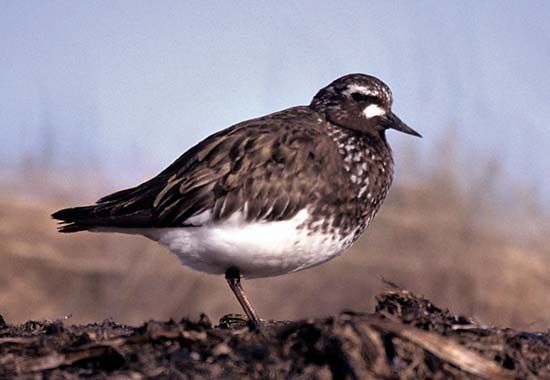
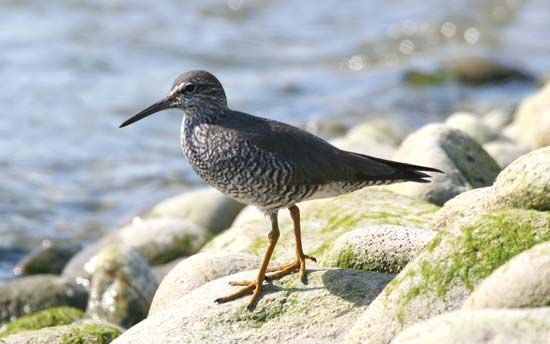
- Tattlers: Birds often associated with rocky shorelines.3
- Godwits: Large, long-legged waders with long, slightly upturned or straight bills.3
In total, the family comprises approximately 86 species, ranging in length from 12.5 to 61 centimeters (5 to 24 inches).2
How do shorebirds adapt to living near the ocean?
Shorebirds have evolved a variety of specialized adaptations to thrive in coastal and saline environments. These adaptations primarily focus on feeding efficiency and the management of salt intake.
Feeding Adaptations
Shorebirds exhibit diverse bill shapes tailored to their specific foraging methods:5
- Probing: Many species, such as sandpipers and snipe, possess long, slender, and flexible bills. These are often equipped with a mobile tip containing tactile sense organs, allowing the birds to detect and grasp prey like worms or larvae underground.5
- Specialized Tools: Oystercatchers have laterally flattened, blade-like bills used to pry open or hammer into shellfish. Curlews utilize long, downcurved bills to probe deep into crustacean burrows.56
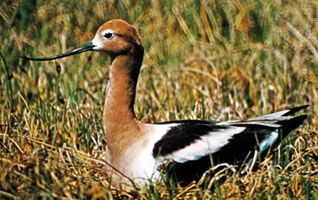
- Surface Foraging: Avocets sweep their bills side-to-side through shallow water to capture small prey, while turnstones use their bills to flip over stones and debris to expose food.6
Physiological Adaptations
Because many shorebirds consume salt water or prey from saline environments, they must maintain ionic balance. They achieve this through supraorbital glands, also known as nasal or salt glands, located in the skull above the eyes. These glands concentrate and discharge excess sodium chloride through the nostrils, preventing the buildup of harmful salt levels in the blood.57
Why is the willet’s call considered distinctive?
The willet (Catoptrophorus semipalmatus) is considered to have a distinctive call because its name is derived directly from the sound it makes; the call is imitative of the bird’s name.18
Sources
- Willet — Encyclopædia Britannica
- Scolopacidae — Merriam-Webster
- Charadriiform - General features — Encyclopædia Britannica
- Charadriiform - Annotated classification — Encyclopædia Britannica
- Charadriiform - Adaptations for feeding — Encyclopædia Britannica
- Migration - In Europe — Encyclopædia Britannica
- Shorebird — Encyclopædia Britannica
- Charadriiform - Shorebirds (suborder Charadrii) — Encyclopædia Britannica
- Charadriiform - Locomotion and feeding behaviour — Encyclopædia Britannica
- Ciconiiform - Bill shape — Encyclopædia Britannica
- Pelecaniform - Physiological adaptations — Encyclopædia Britannica
- Salt marsh — Encyclopædia Britannica
- willet — Merriam-Webster
Published on · 3 min read