Zeravshan Range
The Zeravshan Range is a mountain chain located in Tajikistan and Uzbekistan that forms part of the Gissar-Alay system. Stretching over 230 miles (370 km) in…
What is Zeravshan Range?
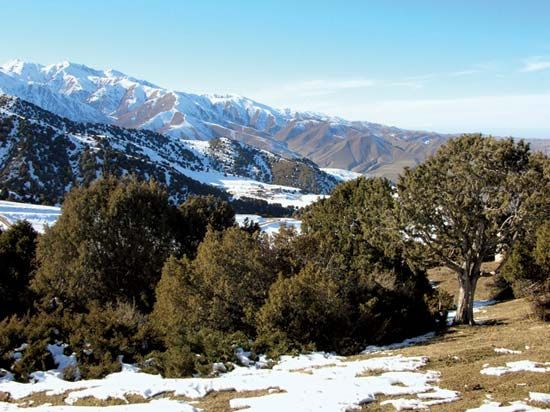
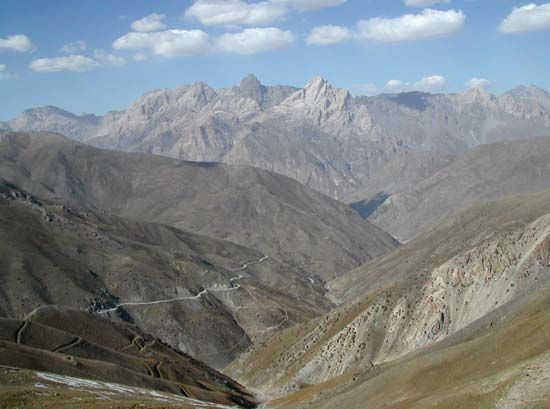
The Zeravshan Range is a mountain chain located in Tajikistan and Uzbekistan that forms part of the Gissar-Alay system. Stretching over 230 miles (370 km) in an east-west direction, it runs parallel to the Turkistan Range, situated between the Zeravshan Valley to the north and the Yagnob and Iskanderdarya valleys to the south.1
The range is divided into four distinct sections by the Fandarya, Kshtut, and Magian rivers. Its topography is characterized by high elevations, with many peaks exceeding 16,500 feet (5,000 meters); the highest point is Chimtorga, which reaches 18,009 feet (5,489 meters).1
The region experiences a semiarid climate featuring hot, dry summers and winter-dominant precipitation, which occurs primarily as snow at higher altitudes. Vegetation transitions from short scrub and grasses at lower levels to alpine meadows at approximately 11,500 feet (3,500 meters).1
What is the Gissar-Alay mountain system?
The Gissar-Alay is a mountain system located in Central Asia, which includes the Zeravshan Range as one of its constituent parts.
While the provided search results confirm that the Zeravshan Range is a component of the Gissar-Alay system, they do not contain a comprehensive description of the entire Gissar-Alay mountain system itself. Other mountain ranges mentioned in the search results, such as the Altai Mountains, Kyrgyz Ala Range, Altun Mountains, and Sarykol Range, are distinct geographical features and are not identified as part of the Gissar-Alay system.
How do mountain ranges influence local climates?
Mountain ranges significantly influence local climates by acting as physical barriers to atmospheric flow and altering the vertical movement of air. These effects create diverse mesoclimates and microclimates that vary over short distances.678
Atmospheric Barriers and Precipitation
When moist air encounters a mountain range, it is forced upward, a process that cools the air and causes moisture to condense, resulting in orographic precipitation on the windward slopes. As the air descends on the leeward side, it is compressed and warmed, leading to drier, hotter conditions. This region of significantly reduced rainfall is known as a rain shadow of significantly reduced rainfall is known as a rain shadow.98101112
Temperature and Wind Effects
- Altitude: With increasing elevation, temperature, pressure, and humidity generally decrease. This allows for the development of distinct vertical temperature zones, such as the tierra caliente, tierra templada, and tierra fria found in tropical highlands.611
- Wind Patterns: Mountains can “funnel” air through valleys, increasing wind speeds, and generate local mountain-valley wind circulations.6
- Air Mass Blocking: Large mountain barriers can prevent cold air from continental interiors from moving across them, often resulting in milder climates on the windward side compared to inland regions.7
What are alpine meadows and where are they found?
Alpine meadows are high-altitude, treeless ecosystems dominated by herbaceous plants, such as grasses and forbs, or low-growing shrubs. These meadows exist above the tree line—the critical elevation where the climate becomes too harsh to support tree growth.1415
Characteristics and Location
- Environment: Alpine meadows are found in mountainous regions worldwide, situated between the upper limit of the forest and the permanent snow line.16
- Vegetation: The flora is typically composed of hardy, low-stature plants, including various species of grasses, sedges, and flowering plants like gentians, buttercups, and primroses. In some regions, these areas are known as alpages, a term from which the name of the Alps is derived.1416
- Human and Ecological Use: In many mountain systems, these lush pastures are utilized for seasonal livestock grazing, such as sheep and cows, during the short summer months. However, these ecosystems are sensitive to environmental pressures, including global warming, overgrazing, and human development.16
Sources
- Zeravshan Range — Encyclopædia Britannica
- Altai Mountains — Encyclopædia Britannica
- Kyrgyz Ala Range — Encyclopædia Britannica
- Altun Mountains — Encyclopædia Britannica
- Sarykol Range — Encyclopædia Britannica
- Highland climate — Encyclopædia Britannica
- Atmosphere - Mountain barriers — Encyclopædia Britannica
- Orographic precipitation — Encyclopædia Britannica
- rain shadow — Merriam-Webster
- Rain shadow — Encyclopædia Britannica
- Microclimate — Encyclopædia Britannica
- Sierra Madre - Climate — Encyclopædia Britannica
- orographic rain — Merriam-Webster
- Mountain ecosystem - Flora — Encyclopædia Britannica
- Mountain ecosystem - Environment — Encyclopædia Britannica
- Alps - Plant and animal life — Encyclopædia Britannica
Published on · 3 min read