Acre River
The Acre River (formerly known as the Aquiri) is a river located primarily in western Brazil. It originates on the border of Peru and flows eastward, serving…
What is Acre River?
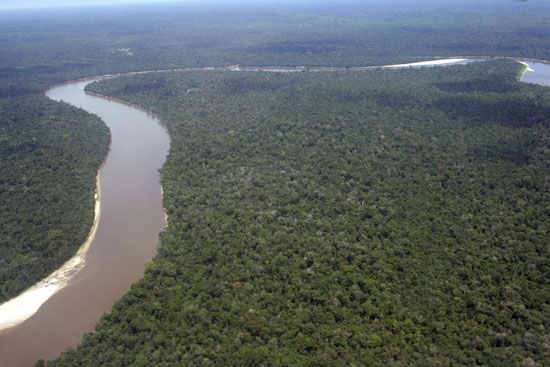
The Acre River (formerly known as the Aquiri) is a river located primarily in western Brazil. It originates on the border of Peru and flows eastward, serving as a portion of the boundary between Brazil and Bolivia.
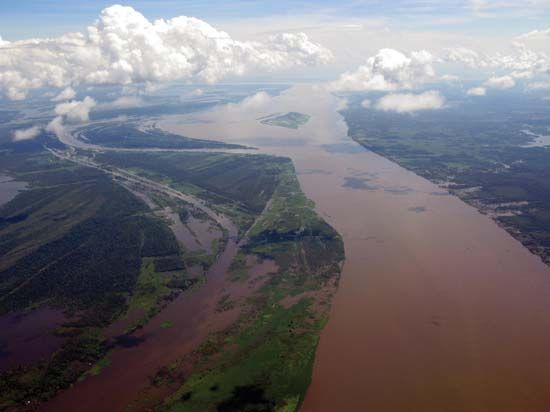
Upon reaching the town of Brasiléia, the river turns north, continuing for a total course of approximately 400 miles (645 km). It flows in a north-northeasterly direction through the Brazilian states of Acre and Amazonas. The river eventually empties into the Rio Purus—a major tributary of the Amazon—at the town of Boca do Acre.1
What is the importance of the Purus River in the Amazon basin?
The Purus River is a vital component of the Amazon basin, serving as one of the major southern tributaries of the Amazon River. Its importance is defined by several key characteristics:23
- Hydrological Significance: Originating in the Peruvian Andes, the Purus is a “whitewater” river, meaning it carries heavy sediment loads derived from the geologically youthful and tectonically active mountains. It functions as a massive drainage system for the half-submerged, lake-flooded districts it traverses.24
- Navigability: Most of its 1,995-mile (3,211-km) course is navigable, providing essential transportation routes through the rainforests of Peru, Acre, and Amazonas.4
- Economic Role: The river provides access to the rubber-rich forests of the region, historically facilitating the gathering of rubber from forests along its course.42
- Geographic Complexity: It is recognized as one of the world’s most meandering streams; the straight-line distance from its source to its mouth is less than half the length of its actual winding path.4
How does the geography of the Amazon rainforest affect river flow?
The geography of the Amazon rainforest and its surrounding basin profoundly influences river flow through complex interactions between vegetation, soil, and topography.
Hydrological Regulation
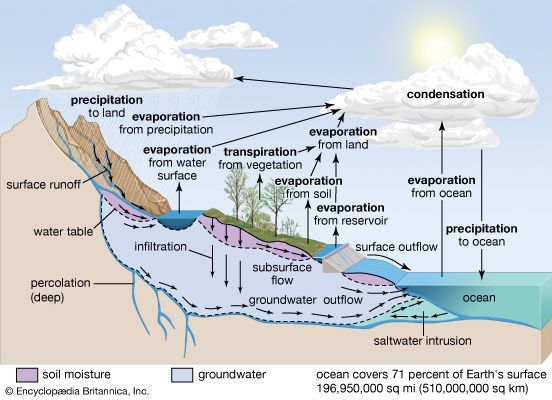
The dense forest acts as a massive biological regulator of the hydrologic cycle. Through transpiration and evaporation, the forest recycles significant amounts of water, contributing to the region’s high rainfall. The forest canopy and litter layers function as filters and sponges, regulating the interception and storage of water. By slowing the movement of water into the river system, the forest cover ensures that streamflow remains more gradual, reliable, and uniform compared to unforested land, which sheds water swiftly and increases flood risks.67
Topography and Basin Structure
The Amazon basin is a vast structural depression situated between the Guiana Highlands and the Brazilian Highlands. The river’s gradient is extraordinarily slight; for example, at the Peruvian border, the elevation is less than 300 feet (90 metres) despite being 2,000 miles from the Atlantic. This gentle slope, combined with the basin’s enormous size and the storage capacity of its floodplains, results in the river’s characteristic slow, rhythmic rise and fall.89
Channel Dynamics
The river system occupies a vast network of drowned valleys filled with alluvium. Because the landscape is relatively flat, the rivers often develop meandering channels. These meanders are equilibrium features that minimize variance in water-surface slope, though they maximize variance in channel depth. During flood periods, the river can expand significantly, filling the floodplain and spreading out over a band 35 miles (55 km) wide or more.8109
What kind of wildlife lives along the Acre River?
The Acre River, which flows through the state of Acre in western Brazil, is situated within a region of tropical rainforest that supports a diverse array of wildlife.
While specific studies limited exclusively to the banks of the Acre River are not detailed in the provided search results, the surrounding forest environment is known to host several notable species, including:
- Peccaries: Piglike animals common to the region.
- Capybaras: The world’s largest rodents, which are semiaquatic and often found near water.
- Agoutis: Short-haired, short-eared rodents.
- Tapirs: Large, hoofed quadrupeds.
- Red deer: Also found within the state’s forest zones.
These animals inhabit the broader Amazonian ecosystem that the Acre River traverses. Because the river is a tributary system within the Amazon basin, it shares ecological characteristics with the wider region, which is home to thousands of fish species, caiman, river turtles, and river dolphins.1313
Sources
- Acre River — Encyclopædia Britannica
- Purus River — Encyclopædia Britannica
- Amazon River - Physiography of the river course — Encyclopædia Britannica
- Pusur River — Encyclopædia Britannica
- Brazil - Rivers of Brazil — Encyclopædia Britannica
- Amazon River - Hydrology of the Amazon River — Encyclopædia Britannica
- Amazon River - Landforms and drainage patterns — Encyclopædia Britannica
- Amazon River - Soils of the Amazon River — Encyclopædia Britannica
- Amazon River - Climate — Encyclopædia Britannica
- Status of the world’s tropical forests - Global implications of deforestation — Encyclopædia Britannica
- forestry - Watershed management and erosion control — Encyclopædia Britannica
- river - Meandering channels — Encyclopædia Britannica
- Amazon River: Top Questions — Encyclopædia Britannica
- Acre — Encyclopædia Britannica
Published on · 3 min read