Caiman Lizard
The caiman lizard refers to any member of the genus Dracaena within the family Teiidae. These lizards, which include the species D. guianensis and D.…
What is caiman lizard?
The caiman lizard refers to any member of the genus Dracaena within the family Teiidae. These lizards, which include the species D. guianensis and D. paraguayensis, are native to streamside, forested regions of South America.1
Key characteristics of the caiman lizard include:
- Physical Appearance: They are olive green in color and possess flattened tails featuring a double crest, which aids in swimming. D. guianensis can grow to a maximum length of 122 cm (48 inches).1
- Habitat and Behavior: These lizards are semi-aquatic, spending a significant portion of their time in the water.1
- Diet: They are specialized predators that feed primarily on snails. They use their strong teeth to crush the shells, spitting out the fragments before swallowing the snail.1
- Reproduction: Caiman lizards are egg-layers.1
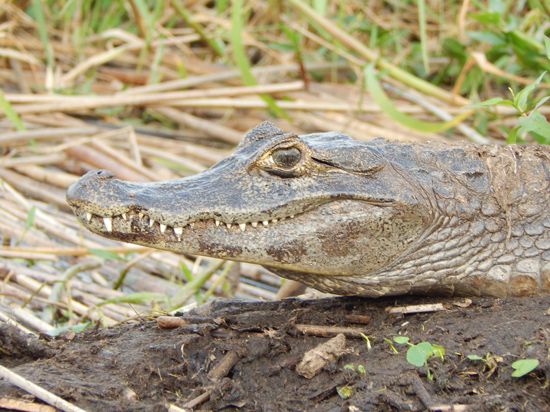
It is important to note that despite the name, the caiman lizard is a type of lizard and is distinct from the caiman, which is a crocodilian reptile related to the alligator.23
How does the caiman lizard differ from actual caimans?
The caiman lizard and the caiman are fundamentally different animals, despite the shared name. The primary distinction lies in their biological classification and physical characteristics.
Biological Classification
- Caiman Lizard: These are members of the genus Dracaena within the family Teiidae. They are true lizards, which are distinct from the crocodilian order.1
- Caiman: These are crocodilian reptiles belonging to the family Alligatoridae, making them close relatives of alligators.45
Key Differences
Feature
Caiman Lizard
Caiman (Crocodilian)
Order
Squamata (Lizards)
Crocodilia
Diet
Specialized snail eaters
Carnivorous (fish, birds, mammals)
Physical Traits
Olive green, flattened tail with double crest
Bony plates (osteoderms), powerful jaws, varied snout shapes
Size
Up to 122 cm (48 inches)
Ranges from 1.2 meters to over 5 meters
While both animals are semi-aquatic and native to South America, their evolutionary paths are entirely separate. Caiman lizards are specialized predators that use strong teeth to crush snail shells, whereas caimans are apex or near-apex predators that consume a wide variety of prey, including fish, birds, and mammals.146
What special adaptations help the caiman lizard hunt snails?
The caiman lizard (Dracaena) possesses specialized physical adaptations that allow it to thrive as a mollusk predator in the forested, streamside regions of South America.
Its primary adaptations for hunting and consuming snails include:
- Crushing Dentition: Unlike many lizards that have sharp, tricuspid teeth for grabbing prey, the caiman lizard has evolved blunt, rounded teeth located in the back of its jaw. These are specifically designed to exert the force necessary to crush hard snail shells.17
- Feeding Technique: Once the lizard has captured a snail, it uses its powerful jaws to break the shell. It then spits out the shell fragments before swallowing the soft body of the snail.1
- Aquatic Mobility: Because they spend a significant portion of their time in the water, these lizards have developed flattened tails featuring a double crest, which serves as an effective adaptation for swimming while hunting for their aquatic prey.1
What other types of lizards belong to the Teiidae family?
The family Teiidae consists of a diverse group of New World lizards found primarily in tropical and subtropical regions. These lizards are characterized by their elongated, forked tongues, which they use to detect chemical cues in their environment.91011
According to scientific classification, the family includes approximately 122 species across 10 genera, exhibiting a wide range of physical forms and ecological roles. Notable members of the Teiidae family include:10
- Tegus: Large, often carnivorous lizards of the genus Tupinambis. They are well-known for their powerful build and are found in various habitats, including savannas and rainforests.1210
- Racerunners and Whiptails: Members of the genus Cnemidophorus, these lizards are known for their active foraging behavior and lacertid-like appearance.1011
- Caiman Lizards: Specifically the genus Dracaena, these are large, semi-aquatic lizards that have evolved to specialize in eating snails.10
While the family is quite diverse, they all share specific anatomical traits, such as the absence of osteoderms (dermal bone) and an open supratemporal fossa.10
Sources
- caiman lizard — Encyclopædia Britannica
- spectacled caiman — Encyclopædia Britannica
- black caiman — Encyclopædia Britannica
- Cuvier’s dwarf caiman — Encyclopædia Britannica
- caiman — Encyclopædia Britannica
- caiman — Merriam-Webster
- lizard - Dentition — Encyclopædia Britannica
- snake - Skull and sense organs — Encyclopædia Britannica
- Teiidae — Merriam-Webster
- tegu — Encyclopædia Britannica
- lizard - Annotated classification — Encyclopædia Britannica
- teiid — Merriam-Webster
Published on · 3 min read