Caribbean Current
The Caribbean Current is a powerful, warm surface ocean current that flows westward through the Caribbean Sea. It is formed by the junction of the North…
What is Caribbean Current?
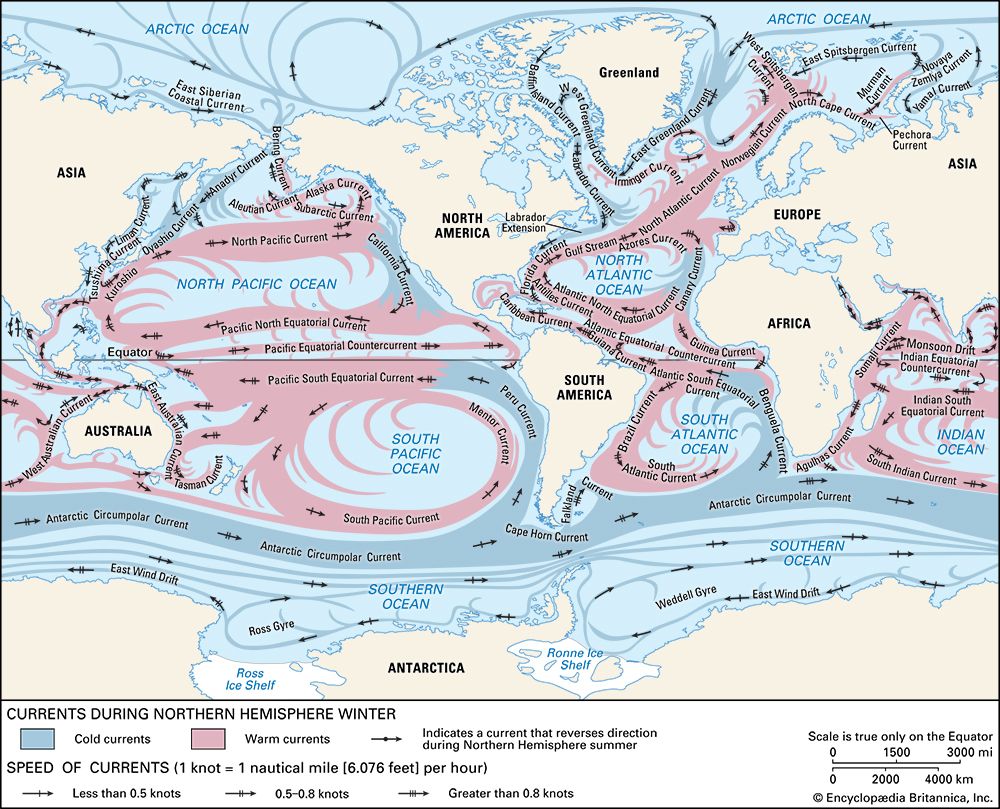
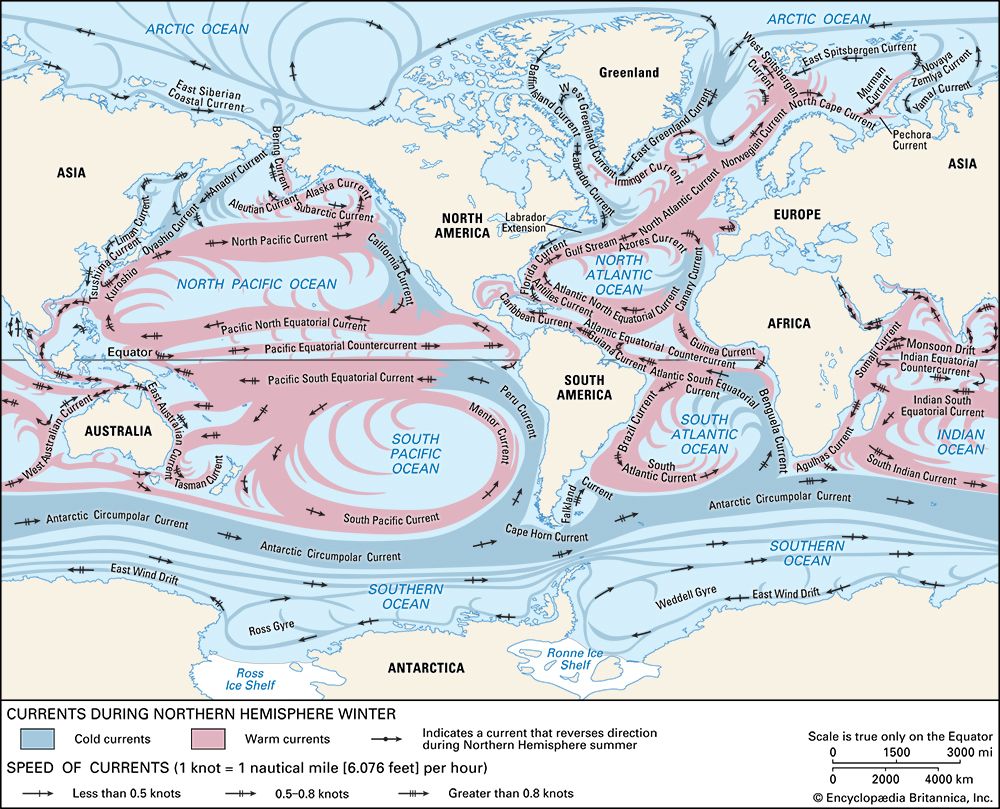
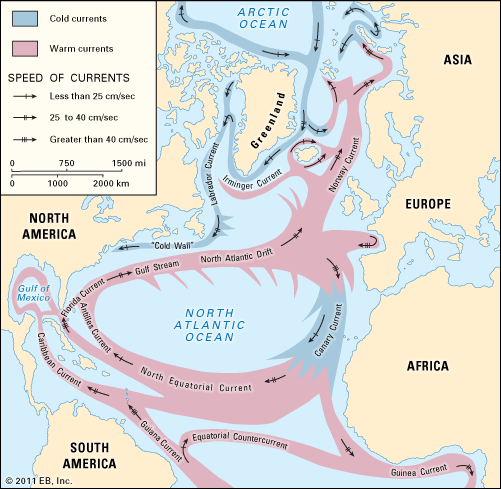
The Caribbean Current is a powerful, warm surface ocean current that flows westward through the Caribbean Sea. It is formed by the junction of the North Equatorial Current and the Guiana Current.1
As it moves, the current flows through the Yucatán Channel and into the Gulf of Mexico. It eventually exits through the Straits of Florida, where it forms the Florida Current, a major component of the Gulf Stream system. The current flows at an average rate of approximately 38 to 43 cm (15 to 17 inches) per second and transports roughly 27,500,000 cubic meters of water per second.12
How do trade winds influence ocean currents?
Trade winds are a primary driver of global ocean circulation, influencing surface currents through direct wind stress and complex physical interactions.
Direct Wind Influence
Trade winds blow persistently from east to west across tropical regions, exerting stress on the ocean surface that sets water in motion. This direct action is responsible for the westward flow of the major Equatorial currents, such as the North and South Equatorial currents in the Atlantic and Pacific oceans.456
Ekman Transport and Vertical Movement
The influence of these winds extends deeper than the immediate surface through a process known as Ekman transport. As wind moves the surface water, the Coriolis force deflects the flow—to the right in the Northern Hemisphere and to the left in the Southern Hemisphere. This creates:47
- Convergence and Downwelling: Where surface waters accumulate, they are forced downward, creating regions of downwelling that can influence sea levels and drive deeper geostrophic currents.4
- Divergence and Upwelling: Where winds pull surface water away from an area (such as along certain coastlines or the Equator), nutrient-rich subsurface water is drawn upward to replace it, a process known as upwelling.4
Large-Scale Circulation
Trade winds also help maintain the accumulation of warm water that feeds major boundary currents. For example, in the Atlantic, trade winds force surface water into the Caribbean Sea and through the Yucatán Channel. This accumulation creates a hydrostatic head—a difference in sea level—that serves as a primary driving force for the Gulf Stream.89
What is the difference between surface currents and deep-water currents?
Surface currents and deep-water currents differ primarily in their driving forces, speed, and vertical extent within the ocean.
Surface Currents
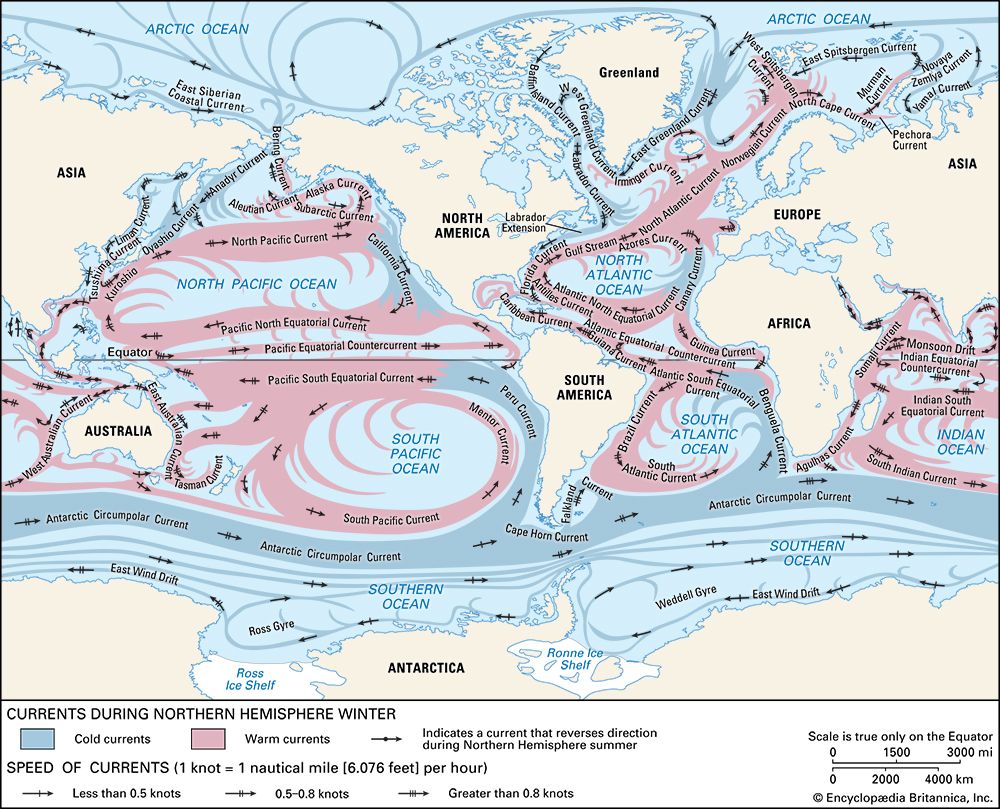
Surface currents are primarily wind-driven ocean currents that dominate the upper layers of the sea. These currents are organized into large, anticyclonic cells known as gyres, which are shaped by the global wind field and the Coriolis force.51213
- Characteristics: They are generally more vigorous and faster than deep-water currents.12
- Examples: Well-known surface currents include the Gulf Stream and the Kuroshio, which transport significant amounts of heat from the tropics toward higher latitudes.513
Deep-Water Currents
Deep-water currents, often referred to as thermohaline circulation, are driven by horizontal differences in temperature and salinity rather than wind.12
- Characteristics: These currents are much more sluggish, typically moving at about 1 centimeter (0.4 inch) per second, but they extend to the seafloor and form a global circulation pattern that replaces deep water with surface water and vice versa.12
- Mechanism: Dense, cold water sinks in polar regions—such as the North Atlantic and near Antarctica—and spreads across the ocean floor, eventually upwelling to complete the cycle.12
While surface currents are configured as regional gyres, deep-water currents envelop the global ocean, playing a critical role in transporting heat, nutrients, and solids across vast distances.12
How does the Gulf Stream impact the climate of Europe?
The Gulf Stream system significantly moderates the climate of northwestern Europe, contributing to winters that are remarkably mild for such high latitudes.215
Mechanisms of Climate Influence
The warming effect is primarily facilitated by the North Atlantic Current, an extension of the Gulf Stream system that transports warm, saline water toward the polar seas. This process is a key component of the thermohaline circulation, a large-scale overturning of the ocean that transfers heat from the tropics to high latitudes, where it is released into the atmosphere.216
Regional Impacts
- Temperature Anomalies: Prevailing westerly winds carry the warmth and moisture from these waters across the continent. Consequently, regions like Norway experience winter air temperatures significantly higher—sometimes by more than 40 °F (22 °C)—than the global average for those latitudes.2
- Vegetation and Ecosystems: This climatic modification allows for the growth of subtropical vegetation and winter crops in areas like southwestern England, which would otherwise be much cooler and potentially drier without this heat transport.215
Sources
- Caribbean Current — Encyclopædia Britannica
- Gulf Stream — Encyclopædia Britannica
- Caribbean Sea - Hydrology — Encyclopædia Britannica
- ocean current - Ekman layer — Encyclopædia Britannica
- ocean current - Distribution of ocean currents — Encyclopædia Britannica
- Equatorial current — Encyclopædia Britannica
- ocean current - Coriolis effect — Encyclopædia Britannica
- Trade wind — Encyclopædia Britannica
- Coriolis force — Encyclopædia Britannica
- Pacific Ocean - The trade winds — Encyclopædia Britannica
- Atlantic Ocean - The North Atlantic — Encyclopædia Britannica
- thermohaline circulation — Encyclopædia Britannica
- ocean current - Pressure gradients — Encyclopædia Britannica
- subtropical gyre — Encyclopædia Britannica
- Climate - Thermohaline circulation — Encyclopædia Britannica
- How Do Ocean Currents Affect the Biosphere? — Encyclopædia Britannica
Published on · 3 min read