Cat Shark
A cat shark (also spelled catshark) refers to any of more than 150 species of small, mottled sharks belonging to the order Carcharhiniformes.
What is cat shark?
A cat shark (also spelled catshark) refers to any of more than 150 species of small, mottled sharks belonging to the order Carcharhiniformes.1
These sharks are typically characterized by their slender bodies and elongated eyes, which give them a catlike appearance. Most species measure less than 90 cm (3 feet) in length and often feature bold body markings. They are found in tropical and temperate marine environments worldwide, where they primarily feed on invertebrates and small fishes. Despite their predatory nature, no species is known to be aggressive toward humans.1
Taxonomically, cat sharks are divided into 17 genera within the families Scyliorhinidae and Pentanchidae, though some classifications group them all under Scyliorhinidae. The genus Apristurus, which includes the demon and ghost cat sharks, is particularly notable for its high diversity. While the term most commonly refers to the family Scyliorhinidae, it is sometimes used to describe other small sharks, such as the leopard shark or members of the genus Parascyllum.12
How do catsharks use their catlike eyes to hunt?
The premise that catsharks use their eyes in a “catlike” manner to hunt is inaccurate. While catsharks are named for their slender bodies and elongated, catlike eyes, there is no evidence in the provided search results that these eyes function like the vertical slit pupils of terrestrial cats, which are adapted for crepuscular hunting and depth perception.34
Instead, catsharks—like most sharks—rely on a well-integrated sensory system to locate prey. While their eyes are often acute enough to discriminate the size, shape, and color of their prey, they primarily use a highly developed sense of smell to find food. Additionally, they utilize a lateral line system to detect vibrations in the water and a network of ampullae to sense the weak electrical signals emitted by their prey. These combined senses allow them to hunt effectively in their marine environments.1
What are some other types of small sharks found in the ocean?
Beyond the cat shark, the ocean is home to a wide variety of small shark species, many of which belong to the order Squaliformes, commonly known as dogfish.
Notable Small Shark Groups
- Dogfish (Order Squaliformes): This group includes several families, such as the Centrophoridae (gulper sharks) and Squalidae. The spiny dogfish (Squalus acanthias) is one of the most widely known species; it typically measures 60 to 120 cm (2 to 4 feet) in length and is often found in dense schools. These sharks are characterized by a sharp spine located in front of each of their two dorsal fins, which can cause painful wounds due to associated venom glands.5
- Gulper Sharks (Family Centrophoridae): These are another group of small sharks within the order Squaliformes. Examples include the gulper shark (Centrophorus granulosus) and the little gulper shark (Centrophorus uyato), which are found in various oceans, including the Atlantic and Indian.5
- Lantern Sharks (Family Etmopteridae): Some deep-sea sharks, such as the blackbelly lanternshark (Etmopterus lucifer) and the southern lanternshark (E. granulosus), are notable for their ability to produce light through chemical reactions in their luminous organs.6
While many of these species are small and generally harmless to humans, it is important to note that even small specimens can occasionally be hazardous if provoked.7
How do bottom-dwelling sharks adapt to their environment?
Bottom-dwelling sharks have evolved a variety of physical and behavioral adaptations to thrive in their specific environments. Unlike their open-ocean counterparts, which are often streamlined for fast, predatory swimming, bottom-dwelling species typically exhibit a stout, blunt-headed body shape and more sluggish habits.3
Key Adaptations
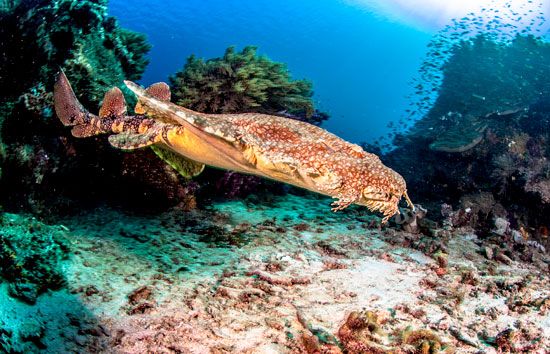
- Morphology and Camouflage: Many bottom-dwelling sharks, such as the wobbegong, possess skin flaps and protective coloration that allow them to blend in closely with the seafloor, effectively hiding them from both prey and predators.3
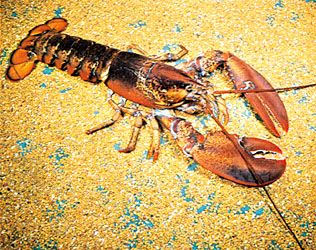
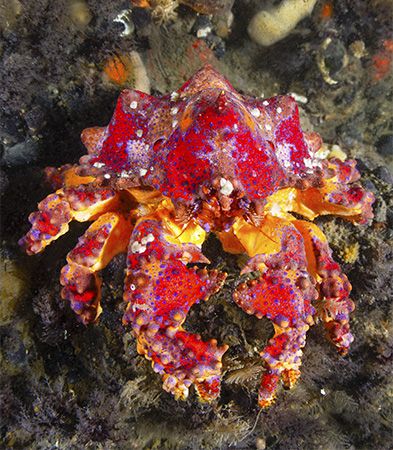
- Feeding Mechanisms: These sharks often occupy a different ecological niche, feeding on invertebrates like crabs, lobsters, and mollusks. To process this diet, many species have developed coarse, pavementlike, crushing teeth rather than the shearing teeth found in open-water predators.123
- Respiration: Because they often remain stationary on the substrate, many bottom-dwelling sharks utilize spiracles—specialized structures that force water through the gills—allowing them to breathe without needing to swim constantly.1314
- Sensory Integration: Like all sharks, they rely on a well-integrated system of senses to locate food in the dark or obscured conditions of the seafloor. This includes a highly developed sense of smell, a lateral line system for detecting vibrations, and ampullae that sense the weak electrical signals emitted by prey.1215
Sources
- cat shark — Encyclopædia Britannica
- cat shark — Merriam-Webster
- chondrichthyan - Sharks — Encyclopædia Britannica
- Why do cats have slit pupils? — Encyclopædia Britannica
- shark - Description and habits — Encyclopædia Britannica
- Bioluminescence - The range and variety of bioluminescent organisms — Encyclopædia Britannica
- sand shark — Encyclopædia Britannica
- dogfish — Encyclopædia Britannica
- chondrichthyan - Danger to human life — Encyclopædia Britannica
- shark - Hazards to humans — Encyclopædia Britannica
- shark — Encyclopædia Britannica
- chondrichthyan - Rays — Encyclopædia Britannica
- shark: Top Questions — Encyclopædia Britannica
- fish - Locomotion — Encyclopædia Britannica
- chondrichthyan - Senses — Encyclopædia Britannica
- Do Sharks Sleep? — Encyclopædia Britannica
- coloration - Background matching — Encyclopædia Britannica
- chondrichthyan - Respiration — Encyclopædia Britannica
- coloration - Disruptive coloration — Encyclopædia Britannica
Published on · 3 min read