Cedaria
Cedaria is a genus of trilobites, which were extinct arthropods. These organisms are recognized as useful index fossils for dating Cambrian rocks and time…
What is Cedaria?
Cedaria is a genus of trilobites, which were extinct arthropods. These organisms are recognized as useful index fossils for dating Cambrian rocks and time, specifically ranging from approximately 542 million to 488 million years ago. Physically, Cedaria was small, characterized by a well-developed tail section and a prominent head section.1
It is important to distinguish this genus from the term “cedar,” which refers to various types of coniferous trees and is unrelated to the prehistoric marine life of the Cedaria genus.2
What are trilobites and when did they live?
Trilobites are a group of extinct arthropods defined by their distinctive three-lobed, three-segmented body structure. These exclusively marine animals possessed a chitinous exoskeleton that they shed as they grew, leaving behind the fossils commonly found today.3
Regarding their timeline:
- Appearance: They first appeared approximately 521 million years ago, near the start of the Cambrian Period3.
- Ancestry: It is likely that their ancestors originated during the Ediacaran Period of Precambrian times, potentially related to organisms like Spriggina.3
- Extinction: While they dominated the seas during the Cambrian, their numbers declined in later eras, with the final forms persisting into the Permian Period (ending roughly 251.9 million years ago).3
Trilobites varied significantly in size and behavior, ranging from small scavengers to large predators, and are frequently used by scientists for stratigraphic correlations.3
Why are index fossils important to scientists?
Index fossils are essential tools for scientists because they serve as the primary basis for defining boundaries in the geologic time scale and for the correlation of rock strata across different locations4.
To be considered a useful index fossil, a specimen must possess specific characteristics that allow geologists to reliably date deposits:
- Short temporal range: The species must have existed for only a brief moment in geologic history, ensuring that its presence indicates a specific time interval.45
- Wide geographic distribution: Being found in many locations allows scientists to link separated outcrops that formed simultaneously.45
- Abundance and distinctiveness: They must be common enough to be easily discovered and unique enough in appearance to avoid misidentification.45
By applying the principle of faunal succession, geologists use these fossils to establish the relative age of rock layers. This method has been consistently validated by modern radiometric dating, confirming the accuracy of fossil-based stratigraphic records.5
What characterizes the Cambrian period?
The Cambrian Period was the first time division of the Paleozoic Era, lasting from approximately 538.8 million to 485.9 million years ago. It is characterized by several major environmental and biological shifts:6
Biological Evolution
The period is most famous for the “Cambrian explosion,” a rapid evolutionary event where many major animal phyla first appeared. This era marked the widespread evolution of hard body parts, such as calcium carbonate shells, which significantly improved the fossil record. Life was primarily confined to shallow marine environments, featuring organisms like trilobites, sponges, mollusks, and the predator Anomalocaris.789
Climate and Geography
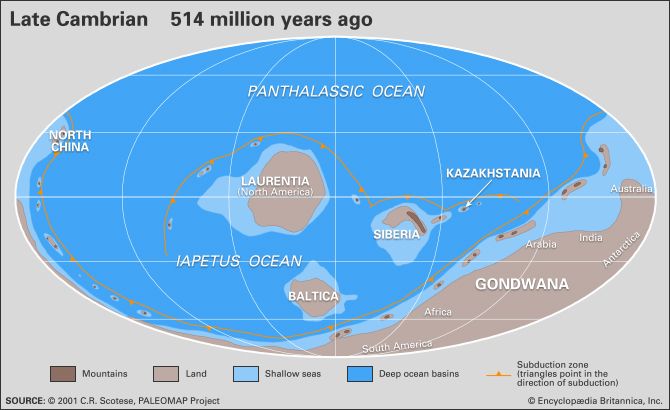
The Cambrian climate was generally warmer than today, with global average temperatures reaching approximately 22 °C (72 °F). The period lacked polar ice caps, and the absence of widespread glacial deposits suggests a stable, equable climate. Geographically, the supercontinent Rodinia had fragmented, leading to the formation of distinct paleocontinents like Laurentia, Baltica, and Siberia, while the supercontinent Gondwana began to assemble. Rising sea levels and increased erosion altered ocean chemistry, likely increasing oxygen levels and facilitating the diversification of complex life.9108
Sources
- Cedaria — Encyclopædia Britannica
- cedar — Merriam-Webster
- trilobite — Encyclopædia Britannica
- index fossil — Encyclopædia Britannica
- dating - Principles and techniques — Encyclopædia Britannica
- Cambrian Period: Top Questions — Encyclopædia Britannica
- Cambrian Period - Paleoclimate — Encyclopædia Britannica
- Cambrian explosion — Merriam-Webster
- A Journey Through Time Since the Precambrian - Cambrian Period: 541 million to 485.4 million years ago — Encyclopædia Britannica
- Cambrian explosion — Encyclopædia Britannica
- Cambrian Period - Correlation of Cambrian strata — Encyclopædia Britannica
Published on · 3 min read