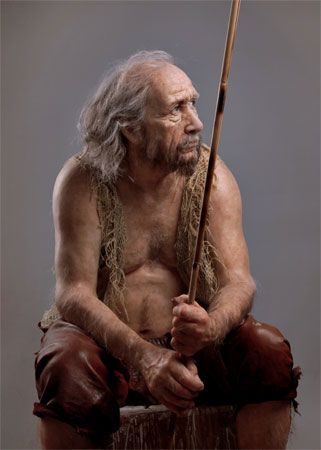
Chancelade Skeleton
The Chancelade skeleton, discovered in 1888 in southwestern France, is a 17,000-year-old fossil that provides insight into the Cro-Magnon population of…
How does the Chancelade skeleton fit into the broader picture of human migration and evolution in Europe?
The Chancelade skeleton, discovered in 1888 in southwestern France, is a 17,000-year-old fossil that provides insight into the Cro-Magnon population of Europe. While early analysis by Jean-Léo Testut incorrectly categorized the remains as an “Eskimo type,” modern consensus identifies the specimen as a representative of the early modern humans (Homo sapiens) who inhabited Europe between 40,000 and 10,000 years ago, following the Neanderthals.1
The skeleton, found in a deliberate burial, exhibits physical traits characteristic of Cro-Magnons, such as larger skulls, wider faces, and more prominent browridges compared to contemporary populations. These features indicate that the specific physical characteristics defining modern humans emerged after the time of the Chancelade specimen. Associated with Magdalenian artifacts, the find serves as a significant marker of human presence during the late Paleolithic period.12
What is the Chancelade skeleton, and where was it discovered?
The Chancelade skeleton is a 17,000-year-old fossil of a human belonging to the genus Homo. It was discovered in 1888 within a rock shelter located in Chancelade, in southwestern France.1
The remains were found in a curled position beneath the shelter’s floor, which indicates a deliberate burial. While the French anatomist Jean-Léo Testut initially classified the skull as an “Eskimo type” and proposed a distinct “Chancelade race,” modern experts have reclassified the specimen as Cro-Magnon. Cro-Magnons were early modern humans (Homo sapiens) who inhabited Europe between 40,000 and 10,000 years ago, following the Neanderthals. Compared to modern humans, these individuals possessed larger skulls, wider faces, and more prominent browridges, suggesting that the physical traits defining contemporary humans emerged after the time of this specimen.1
What methods were used to date and analyze the Chancelade skeleton?
The provided search results do not contain specific information regarding the exact scientific methods used to date or analyze the Chancelade skeleton beyond its general identification as a 17,000-year-old fossil and its initial anatomical study by Jean-Léo Testut. While broader paleoanthropological techniques such as potassium-argon dating and relative dating are used to analyze hominin remains, these specific methods are not explicitly cited in relation to the Chancelade specimen in the provided text.13
What physical characteristics make the Chancelade skeleton unique among Cro-Magnon remains?
The Chancelade skeleton is distinguished from other Cro-Magnon remains by a specific set of physical traits that led early researchers to misidentify it as a distinct “Chancelade race” with “Eskimo” affinities.
Key characteristics that define the specimen include:
- Stature and Features: The skeleton is noted for being short-statured and having a long nose.
- Cultural Association: The remains were discovered in association with Magdalenian artifacts, which are characteristic of the late Paleolithic era in Europe.
- General Cro-Magnon Traits: Like other early modern humans (Homo sapiens), the specimen exhibits features that differ from contemporary populations, specifically larger skulls, wider faces, and more prominent browridges.
While French anatomist Jean-Léo Testut once argued these features represented a unique racial type, modern consensus classifies the skeleton as a representative of the Cro-Magnon population. These findings highlight that the physical characteristics typical of modern humans are of more recent origin and postdate this 17,000-year-old specimen.12
Sources
- Chancelade skeleton — Encyclopædia Britannica
- Chancelade man — Merriam-Webster
- Homo erectus - Dating the fossils — Encyclopædia Britannica
Published on · 2 min read