Chipmunk
Chipmunks are small, terrestrial squirrels belonging to the genus Tamias. Their physical appearance is defined by several key characteristics:
What are the distinguishing physical characteristics of chipmunks?
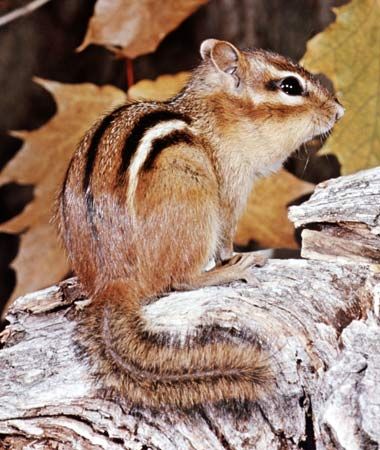
Chipmunks are small, terrestrial squirrels belonging to the genus Tamias. Their physical appearance is defined by several key characteristics:
- Striped Pattern: Most species are easily recognized by their distinct markings, typically featuring five dark brown stripes running lengthwise down their bodies, often alternating with lighter gray-brown or whitish stripes.12
- Cheek Pouches: A primary feature is their large internal cheek pouches, which they use to transport food back to their burrows.1
- Body and Tail: They possess prominent eyes and ears, delicate claws, and a furry tail. Body length generally ranges from 8 to 16 cm (3.1 to 6.3 inches), while their tails measure between 6 and 14 cm (2.4 to 5.5 inches).1
- Size Variation: The eastern chipmunk is the largest species, while the least chipmunk is the smallest, weighing roughly half as much as its eastern counterpart.1
Where are chipmunks typically found in the wild, and what habitats do they prefer?
Chipmunks are primarily found in North America, with a range extending from southern Canada to west-central Mexico. The Siberian chipmunk is the only species native to the Old World, inhabiting regions from northwestern Russia through Siberia to northern Japan and China1.
These animals are ecologically versatile and occupy a wide variety of habitats, ranging from sea level to elevations of 3,900 meters (12,800 feet). They are particularly well-adapted to rocky terrain, including cliffs, boulders, and canyonlands. Their preferred environments include:
- Forests: Ranging from coniferous and deciduous forests to montane forests.1
- Open Areas: Timberline slopes, rock-bordered alpine meadows, and dry scrublands or sagebrush deserts.1
While they are terrestrial, they are also skilled climbers that exploit the resources of forest understories and rocky outcrops.1
What are the different species of chipmunks, and how do they differ?
There are 25 recognized species of chipmunks within the genus Tamias, which are small, terrestrial squirrels known for their distinctive striped patterns and large internal cheek pouches. While they share many physical traits, they exhibit significant diversity in size, habitat, and behavior:1
- Eastern chipmunk: The largest species, native to the deciduous forests of eastern North America. It is characterized by its reddish-brown fur and specific stripe pattern.1
- Least chipmunk: The smallest species, weighing approximately half as much as the eastern chipmunk.1
- Hopi chipmunk: Found in the American Southwest, this species is uniquely adapted to climbing sheer rock faces and overhangs within canyonlands.1
- Uinta chipmunk: Inhabits montane forests and displays behavior similar to tree squirrels, often nesting in trees or abandoned bird nests rather than relying solely on ground burrows.1
- Siberian chipmunk: The only species native to the Old World, with a range spanning from Russia and Siberia to Japan and China.1
While most classifications group these under the single genus Tamias, some taxonomists divide them into three separate genera: Tamias, Eutamias, and Neotamias.1
What is a chipmunk?
A chipmunk is any of the 25 species of small, striped, terrestrial squirrels belonging to the genus Tamias. These rodents are members of the family Sciuridae within the order Rodentia.1
Physically, chipmunks are recognized by their prominent eyes and ears, furry tails, and delicate claws. A defining feature is their large internal cheek pouches, which they use to transport food—such as seeds, nuts, and berries—to their burrows for storage.1
Ecologically versatile, chipmunks are primarily found in North America, ranging from southern Canada to west-central Mexico, with the Siberian chipmunk serving as the only Old World species. They are adapted to diverse environments, including rocky terrain, coniferous and deciduous forests, and even sagebrush deserts. While they are skilled climbers, they spend much of their time on the ground and are active only during the day.1
Sources
- chipmunk — Encyclopædia Britannica
- Siberian chipmunk — Merriam-Webster
- chipmunk — Merriam-Webster
- list of rodents — Encyclopædia Britannica
Published on · 3 min read