Desna River
The Desna River is a significant waterway that originates in the Smolensk Upland of western Russia. It flows southward for approximately 700 miles (1,130 km)…
What is Desna River?
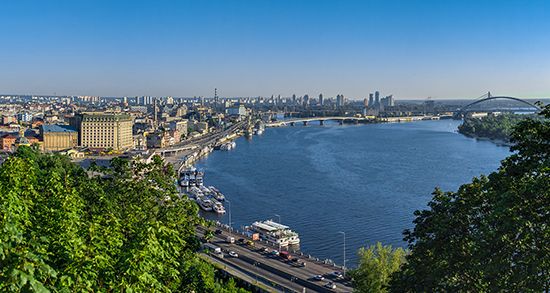
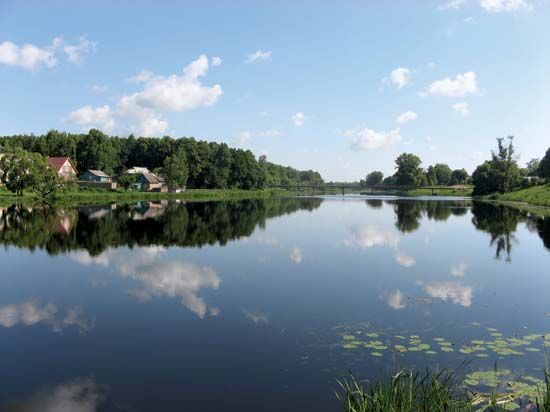
The Desna River is a significant waterway that originates in the Smolensk Upland of western Russia. It flows southward for approximately 700 miles (1,130 km) through southwestern Russia and northern Ukraine before joining the Dnieper River near Kyiv.12
As one of the longest tributaries of the upper Dnieper, the Desna plays a vital role in the river network of the region, contributing significantly to the basin’s annual runoff. While sources vary slightly on the exact length of the river—with some estimates citing 550 miles (885 km)—it remains a key geographical feature of the Eastern European landscape.312
How does the Dnieper River system support the surrounding ecosystems?
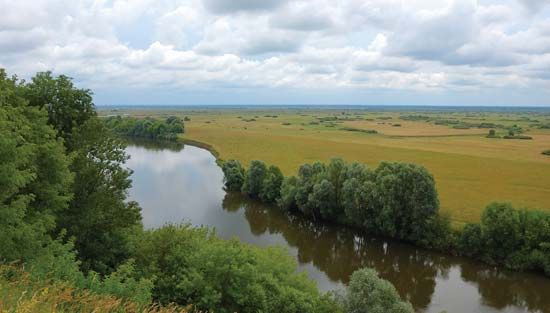
The Dnieper River system historically supported diverse ecosystems through its varied landscapes, ranging from swampy forests and meadows in the north to fertile steppes in the south. The river’s natural state featured extensive floodplains, islands, and marshes that provided essential habitats for flora and fauna.4
However, the intensive development of the river for hydroelectric power and irrigation has significantly altered these ecosystems. The construction of large dams and reservoirs has had several negative impacts:5
- Hydrological Changes: Damming has reduced seasonal flow variations and lowered the annual outflow of the river by approximately 20 percent.5
- Habitat Loss: Vast territories, including former islands and swampy areas, have been inundated by reservoirs, destroying natural floodplain vegetation and reed beds.4
- Pollution: Effluents from urban centers, industrial regions, and agricultural runoff have degraded water quality, causing serious damage to the river’s estuary and surrounding wetlands.5
- Disruption of Species: The dams act as barriers that have reduced upstream access for anadromous fish, disrupting their natural life cycles.5
While the river remains a vital resource for human industry and agriculture, these modifications have fundamentally transformed its original ecological character.5
What role do major rivers play in the history of Eastern Europe?
Major rivers have been fundamental to the history of Eastern Europe, serving as vital arteries for trade, political development, and human settlement for millennia.657
Trade and Communication
Rivers provided the easiest, and often the only, means of circulation for traders, explorers, and settlers. In the 4th to 6th century CE, the Dnieper River became the backbone of the “route from the Varangians to the Greeks,” a network connecting the Black Sea to the Baltic Sea and linking Slavic peoples with Mediterranean civilizations. Similarly, the Danube River served as a major commercial highway, with international agreements eventually establishing it as a regulated waterway for trade across the continent.7685
Political Evolution and Defense
Rivers often defined the boundaries of empires and the locations of power. The Danube served as the northern frontier of the Roman Empire, and its banks were lined with fortresses that later became major cities like Vienna, Budapest, and Belgrade. In the East European Plain, the Volga River acted as the historic cradle of the Russian state, while the Dnieper was central to the founding of the ancient Kievan state.8569
Modern Transformation
In the 20th century, these rivers were heavily modified to support industrialization. Through the construction of dams, reservoirs, and canals—such as the Volga-Don Canal—governments created integrated networks for hydroelectric power, irrigation, and deepwater navigation, fundamentally altering the natural hydrology of the region to fuel economic growth.610
What are the differences between a river’s source and its mouth?
The source and the mouth represent the two opposite ends of a river’s journey.
- Source: Also known as the headwaters, headstream, or riverhead, this is the beginning point of a stream or river. It is often where a river originates from a spring, fountain, or other water source.121314
- Mouth: This is the place where a river enters a larger body of water, such as an ocean, sea, or lake. At this location, rivers often deposit sediment, which can lead to the formation of a delta depending on the balance between sediment delivery and the energy of the receiving water body.1516
A riverine ecosystem is defined by this longitudinal flow, exhibiting a gradual change in temperature, dissolved materials, and turbidity as water travels from the source to the mouth.17
Sources
- Desna River — Encyclopædia Britannica
- Desna — Merriam-Webster
- Dnieper River - Physiography — Encyclopædia Britannica
- Dnieper River — Encyclopædia Britannica
- Dnieper River - History and economy — Encyclopædia Britannica
- Europe - Topographic influences — Encyclopædia Britannica
- Danube River - History — Encyclopædia Britannica
- Danube River — Encyclopædia Britannica
- river - Significance in early human settlements — Encyclopædia Britannica
- Volga River — Encyclopædia Britannica
- canals and inland waterways - Major inland waterways of Europe — Encyclopædia Britannica
- river's mouth — Merriam-Webster
- headwaters — Merriam-Webster
- river - Deltas — Encyclopædia Britannica
- riverhead — Merriam-Webster
- Biosphere - Water currents — Encyclopædia Britannica
- source — Merriam-Webster
- riverine ecosystem — Encyclopædia Britannica
Published on · 3 min read