Did Dinosaurs Really Have Feathers?
Yes, many dinosaurs did have feathers. While dinosaurs were long depicted as featherless, extensive fossil evidence discovered since the 1990s confirms that…
Did Dinosaurs Really Have Feathers?
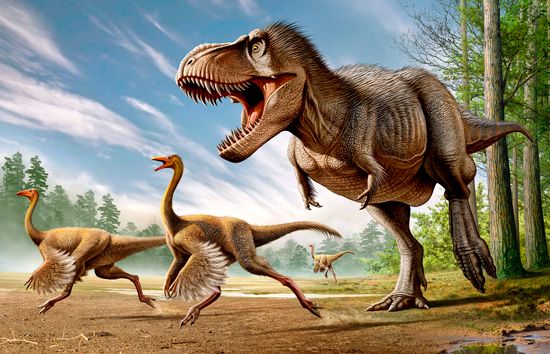
Yes, many dinosaurs did have feathers. While dinosaurs were long depicted as featherless, extensive fossil evidence discovered since the 1990s confirms that numerous species possessed feathers or featherlike structures.123
These structures were not originally evolved for flight. Instead, scientists believe they served purposes such as thermal insulation, camouflage, species recognition, or display. Early forms, such as those found on the theropod Sinosauropteryx, consisted of simple, hair-like filaments made of keratin, while later species exhibited more complex, branched feathers.34512
Research indicates that feathers were not unique to birds or even dinosaurs; evidence suggests they may have originated in a common ancestor of dinosaurs and pterosaurs over 250 million years ago. Because birds are the only surviving lineage of dinosaurs, the presence of feathers on these ancient animals reinforces the evolutionary link between them.213
If feathers did not evolve for flight, what were their original purposes?
Before feathers were adapted for flight, they served several critical biological functions. Paleontological evidence suggests that the primary original purposes of these structures included:
- Thermal Insulation: Early filamentous structures, often described as a “pelage” or coat of hair-like filaments, provided warmth by stabilizing the animal’s body temperature, indicating that many dinosaurs were warm-blooded.26
- Communication and Display: Feathers likely played a role in social signaling, helping individuals distinguish between species, sexes, or age groups.246
- Camouflage: Coloration patterns on feathers provided camouflage, helping dinosaurs blend into their environments to avoid predators or ambush prey.24
- Brooding: In some lineages, such as oviraptorosaurs, long feathers on the limbs were used to cover and protect eggs in nests, keeping them warm and shielded from the environment.2
- Balance: Some researchers speculate that feathers may have assisted with balance while the animals were running.4
These diverse functions demonstrate that feathers were highly versatile evolutionary adaptations long before they acquired aerodynamic properties.56
What are pycnofibres and how do they differ from modern bird feathers?
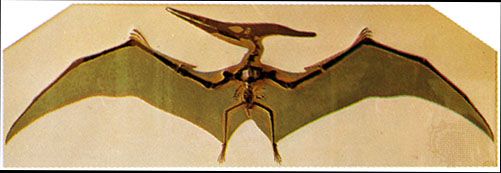
Pycnofibres are branching, featherlike structures found in pterosaurs, the flying reptiles of the Mesozoic Era. Identified in fossils dating back approximately 160 million years, these structures appeared in tufts and are distinct from the simple, straight filaments seen in some early dinosaurs.2
The primary differences between pycnofibres and modern bird feathers include:
- Structure: Modern bird feathers are highly complex, consisting of a central shaft (rachis) with paired branches (barbs) that often feature interlocking barbules and hooks to create a stiff, aerodynamic vane. In contrast, pycnofibres are branching, tufted structures that lack the complex, vaned architecture characteristic of flight-capable bird feathers.2
- Evolutionary Origin: While both are composed of keratin, evidence suggests that the common ancestor of pterosaurs and dinosaurs—living over 250 million years ago—may have possessed a simple, filamentous body covering. Pterosaurs developed pycnofibres as a distinct evolutionary path, whereas the lineage leading to modern birds evolved through a series of increasingly complex stages, moving from simple filaments to downy structures and eventually to the vaned feathers used for flight.28
- Function: Pycnofibres likely served as insulation or for display, whereas modern bird feathers have evolved specialized forms, such as asymmetrical vanes, specifically to facilitate flight.28
How do scientists determine the colors of dinosaur feathers from fossils?
Sorry, the Britannica knowledge base does not contain this information.
Sources
- How Do We Know That Dinosaurs May Have Had Feathers? — Encyclopædia Britannica
- Did Dinosaurs Really Have Feathers? — Encyclopædia Britannica
- dinosaur - Dinosaur descendants — Encyclopædia Britannica
- dinosaur: Top Questions — Encyclopædia Britannica
- Bird - The origin of feathers — Encyclopædia Britannica
- feathered dinosaur — Encyclopædia Britannica
- Reproductive behaviour - Displays — Encyclopædia Britannica
- pterosaur — Encyclopædia Britannica
Published on · 3 min read