Skink
Skinks exhibit diverse reproductive strategies, with species being either oviparous (egg-laying) or viviparous (live-bearing). While most egg-laying skinks…
How do skinks reproduce, and do they exhibit any parental care?
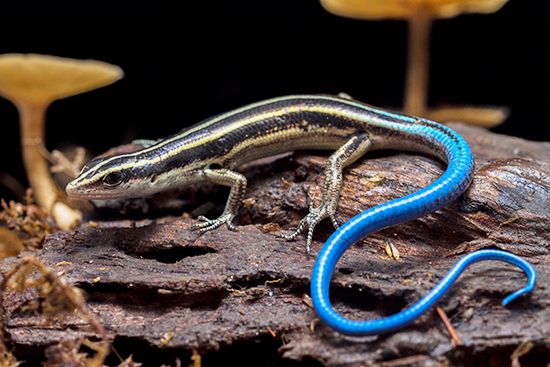
Skinks exhibit diverse reproductive strategies, with species being either oviparous (egg-laying) or viviparous (live-bearing). While most egg-laying skinks deposit their eggs in nests and abandon them, many species give birth to fully developed young. Some viviparous skinks have evolved complex placentae to transfer nutrients directly to their offspring, with some species possessing structures as complex as those found in mammals.12
Parental care among skinks is generally minimal, but there are notable exceptions. Females of certain species, such as the five-lined skink (Plestiodon fasciatus), remain with their eggs throughout the incubation period. These mothers protect the clutch, turn the eggs regularly, and will retrieve them if they are scattered.3
Furthermore, some Australian species, such as the Baudin Island spiny-tailed skink, exhibit more advanced social behaviors; females can recognize their own offspring using chemical signals, and juveniles may remain within their mother’s home range for an extended period to gain a survival advantage.3
Are there any skink species that have unusual or unique features?
Skinks (family Scincidae) are a diverse group of lizards that have evolved several remarkable and unique adaptations to survive in various environments, from deserts to tropical forests.
Unique Physical Adaptations
- Burrowing Features: Many ground-dwelling and burrowing skinks possess a transparent “window” scale in place of a movable lower eyelid. This allows them to protect their eyes from debris while still being able to see while underground.1
- Sand-Swimming: Sand skinks (Scincus), or sandfish, are uniquely adapted for life in windblown sand. They feature fringes of scales on their toes that act like paddles, countersunk lower jaws, and specialized nasal and ear openings that prevent sand from entering their bodies.1
- Limb Reduction: Some species have evolved reduced or entirely absent limbs, and others exhibit sunken eardrums.1
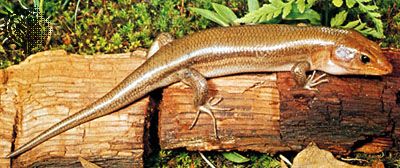
- Tail Regeneration: Many skinks can voluntarily release their tails to escape predators. These tails often feature bright colors to distract the attacker, and the skinks may later return to consume the shed tail to recover lost energy.1
Reproductive and Sensory Peculiarities
- Complex Placentation: While many skinks are egg-layers, about one-third are live-bearers. Some species, such as Mabuya heathi, have evolved a placenta as complex as that found in mammals, through which the mother provides over 99 percent of the nutrients required for embryonic development.14
- Chemical Communication: Skinks rely heavily on chemical signals to interact socially and find prey. They use their tongues to collect these signals and deposit them into the Jacobson’s organ in the roof of their mouth, which transmits information to the brain. This system allows males to distinguish between sexes and even identify sexually receptive females.1
What role do skinks play in their ecosystems?
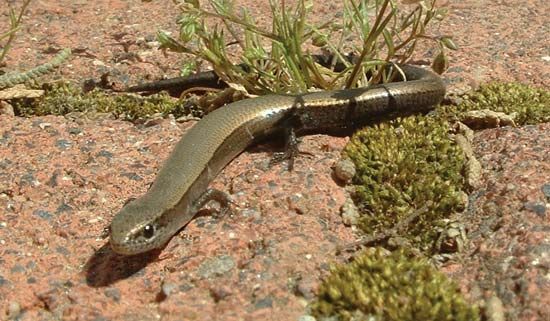
Skinks play a vital role in their ecosystems primarily as consumers within the food web. Their specific ecological function depends largely on their size and diet:
- Invertebrate Control: Most skink species are insectivores that feed on insects and other small invertebrates. By preying on these organisms, they help regulate populations of small arthropods within their habitats.1
- Herbivory: Larger species of skinks are herbivorous and consume various types of fruits. In these roles, they may contribute to seed dispersal or interact with plant life in their respective environments.1
- Trophic Position: As small-to-medium-sized lizards, skinks serve as a food source for various predators, occupying a position in the food web that links primary consumers (insects) to higher-level predators.16
Through these feeding relationships, skinks facilitate the transfer of energy and matter within their communities, contributing to the overall balance of their local environments.16
How many species of skinks exist, and where are they commonly found?
There are approximately 1,275 species of skinks (family Scincidae) worldwide.
Skinks are represented across most of the globe, though they are particularly diverse in the following regions:
- Southeast Asia: This region and its associated islands host a high concentration of species.
- Australia: Skinks are especially prevalent in the continent’s desert environments.
- North America: They are common in the temperate regions of the continent.
While they are found in a wide variety of habitats, they are primarily secretive ground dwellers or burrowers. Some species are also arboreal (tree-dwelling) or semiaquatic. Notably, while certain genera like Plestiodon are dominant in north temperate regions of the New World and Japan, they are entirely absent from Europe.
Sources
- skink — Encyclopædia Britannica
- reptile - Embryonic development and parental care — Encyclopædia Britannica
- lizard - Parental care — Encyclopædia Britannica
- snake - Snakes and humans — Encyclopædia Britannica
- lizard - Embryonic development and sex determination — Encyclopædia Britannica
- food web — Encyclopædia Britannica
- Scincidae — Merriam-Webster
- reptile - North temperate zone — Encyclopædia Britannica
Published on · 3 min read