Dinosauromorph
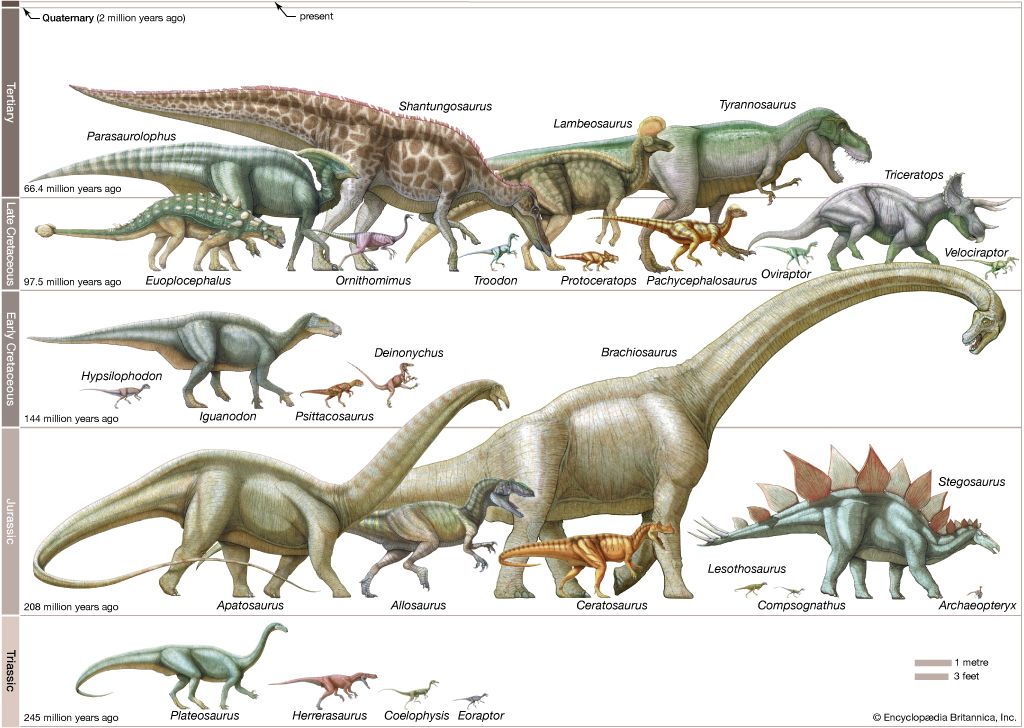
The evolution of dinosauromorphs involved a transition from small, primitive forms to the diverse and specialized body plans seen in dinosaurs.
How did the body structure of dinosauromorphs change over time?
The evolution of dinosauromorphs involved a transition from small, primitive forms to the diverse and specialized body plans seen in dinosaurs.
Structural Evolution
Basal dinosauromorphs were typically small, bipedal animals with uniform backbones and simple, triangular hip girdles. Over time, the lineage developed key anatomical refinements that distinguished true dinosaurs from their ancestors:1
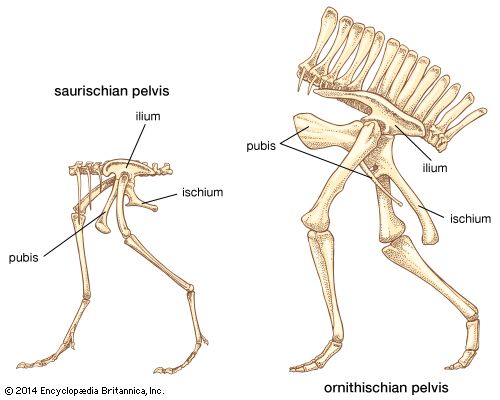
- Hip and Pelvis: While basal forms had simple hips, dinosaurs evolved a fully open hip socket (acetabulum) and an increased number of sacral vertebrae, which provided greater structural support. This eventually diverged into the distinct Saurischia and Ornithischia pelvic configurations.23
- Limbs and Stance: Early dinosauromorphs possessed a bowed femur and a hingelike knee, allowing for an erect, parasagittal gait. Dinosaurs further optimized this by shifting to a vertical hind-limb posture, which eliminated side-to-side motion and allowed for more efficient, high-speed locomotion.14
- Skeletal Refinements: Dinosaurs developed specific features such as a long deltopectoral crest on the humerus and a cnemial crest on the tibia, alongside the loss of the prefrontal bone.2
These changes facilitated greater agility, improved food processing, and, in many lineages, a significant increase in body size.2
What is the evolutionary relationship between dinosauromorphs and dinosaurs?
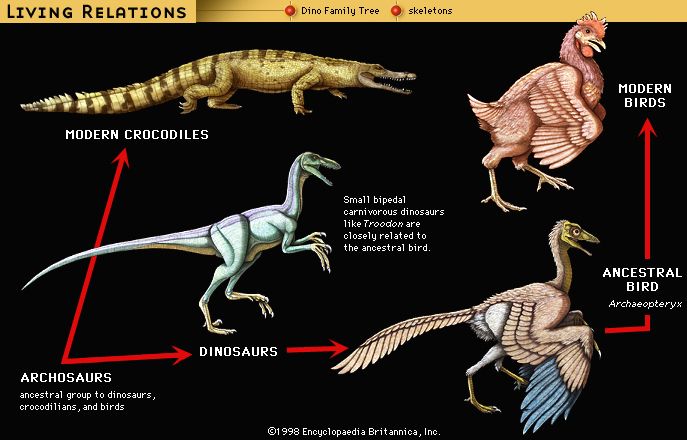
The evolutionary relationship between dinosauromorphs and dinosaurs is defined by a hierarchical classification within the group of archosaurian reptiles. The clade Dinosauromorpha encompasses all dinosaurs—including birds, theropods, sauropodomorphs, and ornithischians—as well as nondinosaurian reptiles that are more closely related to dinosaurs than to pterosaurs.1
In this relationship, dinosaurs represent the more derived members of the Dinosauromorpha, possessing a specific suite of anatomical features that distinguish them from their basal, nondinosaurian relatives. While basal dinosauromorphs exhibit primitive traits such as simple, triangular hip girdles and less specialized backbones, true dinosaurs evolved unique characteristics, including:
- A fully open hip socket (acetabulum).13
- A loss of the prefrontal bone.3
- A long deltopectoral crest on the humerus and a cnemial crest on the tibia.3
- An increased number of sacral vertebrae.3
These refinements provided dinosaurs with superior posture, more efficient locomotion, and enhanced metabolic capabilities, which contributed to their eventual dominance during the Mesozoic Era.13
How do paleontologists use dinosauromorph fossils to understand the evolution of dinosaurs?
Paleontologists use dinosauromorph fossils as a vital framework for understanding the evolution of dinosaurs by filling the gaps in the fossil record and identifying the stepwise acquisition of dinosaurian traits. Because the transition from ancestral archosaurs to true dinosaurs was a gradual process, these fossils allow scientists to trace how specific anatomical features were modified over time.3
By comparing basal dinosauromorphs—such as Lagerpeton and Marasuchus—with early dinosaurs, researchers can isolate the key evolutionary innovations that defined the Dinosauria clade. Key structural changes identified through this comparative analysis include:31
- Pelvic Refinement: The transition from simple, triangular hip girdles to the fully open hip socket (acetabulum) characteristic of dinosaurs.31
- Skeletal Specialization: The loss of the prefrontal bone and the development of a long deltopectoral crest on the humerus and a cnemial crest on the tibia.3
- Locomotion: The shift toward a more efficient, vertical hind-limb posture and parasagittal gait, which improved speed and energy efficiency.31
These fossils help paleontologists construct phylogenetic trees, providing a clearer picture of how dinosaurs diverged from other archosaurs and eventually achieved terrestrial dominance.36
What are the key characteristics that define dinosauromorphs?
Dinosauromorphs are a group of archosaurian reptiles that includes all dinosaurs—such as birds, theropods, sauropodomorphs, and ornithischians—along with nondinosaurian reptiles that are more closely related to dinosaurs than to pterosaurs.1
The group is defined by a combination of shared anatomical traits that distinguish them from other archosaurs. Key characteristics of dinosauromorphs include:
- Locomotion: They possess features indicating an erect, parasagittal gait, meaning they walked with their limbs positioned directly under the body, swinging fore and aft rather than rotating.1
- Limb Anatomy: They share a bowed femur (thighbone), a hingelike knee, a strong, straight tibia (shin bone) with a reduced fibula, a hingelike ankle, and a long foot with elongated toe bones.1
- Basal Features: Nondinosaurian (basal) dinosauromorphs are generally smaller and more primitive than true dinosaurs. Their backbones are more uniform with fewer distinct segments, their shoulder girdles are robust, and their hip girdles are simple and triangular.1
- Femur Structure: Unlike true dinosaurs, the head of the femur in basal dinosauromorphs is not as well offset from the shaft.1
Sources
- dinosauromorph — Encyclopædia Britannica
- reptile - Walking and crawling — Encyclopædia Britannica
- dinosaur - Dinosaur ancestors — Encyclopædia Britannica
- Triassic Period - The first dinosaurs — Encyclopædia Britannica
- dinosaur - Classification — Encyclopædia Britannica
- reptile - Fossil distribution — Encyclopædia Britannica
- transitional fossil — Merriam-Webster
- dinosaur - Sauropoda — Encyclopædia Britannica
- dinosaur - Prosauropoda — Encyclopædia Britannica
- phylogenetics — Encyclopædia Britannica
- archosaur — Encyclopædia Britannica
- saurischian — Encyclopædia Britannica
Published on · 3 min read