Freckled Duck
The freckled duck (Stictonetta naevosa) is a rare species of waterfowl native to Australia and Tasmania. It is characterized by its metallic-gray plumage…
What is Freckled duck?
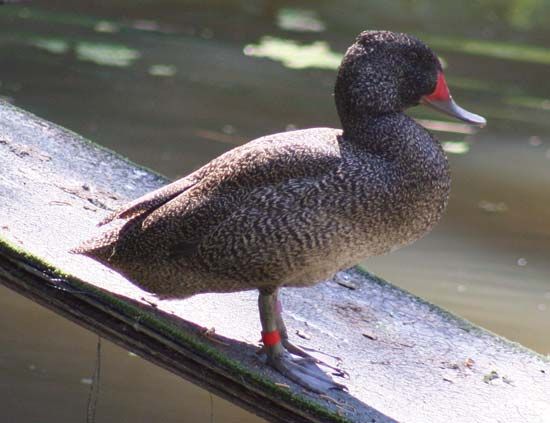
The freckled duck (Stictonetta naevosa) is a rare species of waterfowl native to Australia and Tasmania. It is characterized by its metallic-gray plumage covered in dark, speckled markings, and during the breeding season, the drake’s bill turns a distinctive red.12
As a surface feeder, the freckled duck is unique among its relatives; it lacks typical courtship displays, alarm calls, and demonstrative pair bonds. Taxonomically, it is not considered a “true duck” and may belong to its own separate tribe, Stictonettini, within the family Anatidae. Due to its rarity, the Australian government has classified the species as endangered and implemented measures to protect it.13
What makes the Freckled duck different from true ducks?
The freckled duck (Stictonetta naevosa) is distinct from “true ducks”—those classified within the subfamily Anatinae—primarily due to its unique behavioral and biological traits. While true ducks typically exhibit specific courtship displays, alarm calls, and demonstrative pair bonds, the freckled duck lacks these characteristics entirely.1
Taxonomically, the freckled duck is not considered a true duck. It is placed within the family Anatidae but is so distinct that it may constitute its own separate tribe, Stictonettini. Unlike true ducks, which are often categorized into groups like dabbling, diving, or perching ducks based on their behaviors, the freckled duck remains outside these major classifications. Its physical appearance is also notable, featuring dark, speckled markings on its metallic-gray plumage and a bill that turns red in the drake during the breeding season.12
Why is the Freckled duck considered an endangered species?
The freckled duck (Stictonetta naevosa) is classified as an endangered species primarily due to its extreme rarity and vulnerability within its native Australian habitat. While the provided information notes its status as a rare waterfowl and highlights the protective measures implemented by the Australian government, it does not explicitly detail the specific environmental or human-driven pressures—such as habitat loss or hunting—that led to its decline.1
Because the species is biologically distinct from other members of the family Anatidae, its unique evolutionary position and specialized behavioral traits may also contribute to its sensitivity to environmental changes.1
What are some other unique types of waterfowl found in Australia?
Australia is home to several unique species of waterfowl that possess distinct evolutionary and behavioral characteristics. Beyond the freckled duck, notable examples include:
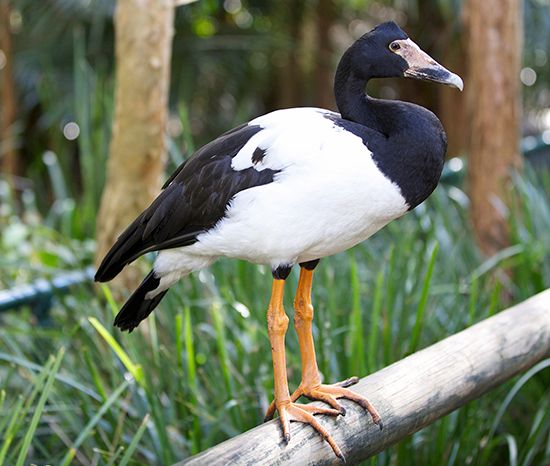
- Magpie goose: This large, unusual bird is often considered the sole member of its own subfamily or even a separate family within the order Anseriformes. It is distinguished by its vulturish appearance, virtually unwebbed toes that allow it to perch in trees, and a unique breeding structure consisting of one male and two females. Unlike other waterfowl, it molts its flight feathers gradually, meaning it never experiences a flightless period.4
- Cape Barren goose: A large, gooselike bird native to Australia, it is frequently cited as a distinct species that does not fit neatly into the traditional categories of true geese or ducks.5
These species highlight the diversity within the family Anatidae, which includes a wide range of birds that have adapted to various ecological niches across the continent.
Sources
- Freckled duck — Encyclopædia Britannica
- freckled duck — Merriam-Webster
- Duck — Encyclopædia Britannica
- Magpie goose — Encyclopædia Britannica
- Goose — Encyclopædia Britannica
- Anseriform - Importance to humans — Encyclopædia Britannica
- Anseriform - General features — Encyclopædia Britannica
- Perching duck — Encyclopædia Britannica
Published on · 2 min read