Teal
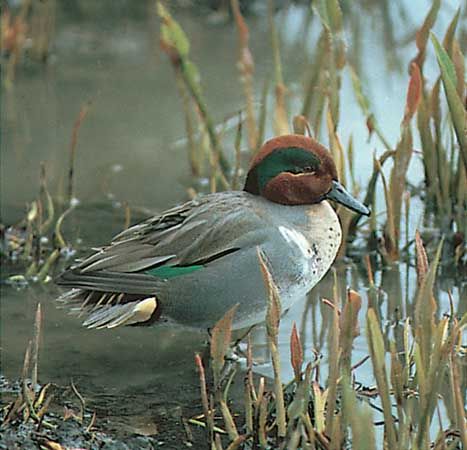
Teals are a group of approximately 32 species of small ducks belonging to the genus Anas within the dabbling duck family Anatidae. These birds are found…
What species of birds are commonly referred to as teals?
Teals are a group of approximately 32 species of small ducks belonging to the genus Anas within the dabbling duck family Anatidae. These birds are found globally across all major continents and many islands.12
Commonly recognized species include:
- Green-winged teal (A. crecca): A well-known Holarctic species that typically travels in dense flocks.1
- Blue-winged teal (A. discors): A small species that breeds in Canada and the northern United States.1
- Cinnamon teal (A. cyanoptera): A North American species distinguished by its rich reddish plumage and blue wing patch.1
- Laysan teal: A rare species found on Laysan Island, which was previously classified as a subspecies of the mallard but is now recognized as a distinct species.2
Teals are primarily herbivorous, though some species supplement their diet with animal matter. They are known for their synchronized flight patterns, often taking off and changing direction as a group.1
Where can teal birds be found in their natural habitats?
Teal birds are found globally across all six major continents and many islands. As members of the dabbling duck group, they are primarily associated with freshwater environments, particularly during the breeding season.13
Their preferred natural habitats include:
- Productive Wetlands: They favor glaciated regions rich in shallow, productive lakes and marshes, such as the “pothole” country of North America.3
- Diverse Water Bodies: Areas with many small bodies of water are often more supportive than single large lakes, as the increased shoreline provides essential cover from predators, shelter from winds, and diverse food sources.3
- River Deltas and Coastal Marshes: These silted and productive environments are key habitats for many waterfowl species.3
- Human-Altered Environments: Teals are highly adaptable and may utilize human-created areas, such as reservoirs or habitats modified by activities like beaver dam construction, which create attractive environments for nesting and roosting.3
Many species are migratory, allowing them to exploit seasonal resources in northern regions like the tundra and taiga before moving to warmer climates for the winter.3
What are the feeding habits and diet of teal birds?
Teal birds are primarily herbivorous, feeding mainly on plant material such as pondweeds and other aquatic vegetation. As members of the dabbling duck group, they typically forage on the water’s surface or by “upending”—tipping their bodies forward to reach food on the bottom of shallow ponds, marshes, lakes, and rivers.152
While their diet is largely plant-based, some species are more opportunistic; for example, animal matter can comprise up to 25 percent of the diet for species like the blue-winged teal.1
Young birds exhibit innate preferences for the size, shape, and color of objects they peck at, but they also learn through experience. As they mature, they become more adventurous in their feeding, gradually refining their diet by excluding unsuitable or unpalatable items based on their bill structure and the specific habitats they occupy.5
What defines a dabbling duck compared to other types of ducks?
Dabbling ducks are a distinct group of waterfowl characterized by specific behaviors, physical traits, and foraging strategies that set them apart from other ducks, such as diving or perching ducks.6
Key Characteristics of Dabbling Ducks
- Foraging Behavior: Unlike diving ducks, which submerge completely to reach food, dabbling ducks feed primarily on the surface or by “tipping up.” This involves tilting their bodies forward in shallow water to reach aquatic vegetation and invertebrates on the bottom without fully submerging.78
- Physical Anatomy: They possess a flat, broad bill equipped with lamellae (platelike structures) used for sifting food particles from mud or water. Their hind toe is unlobed, and their legs are positioned to allow for efficient walking on land, unlike the rear-set legs of diving ducks that are specialized for swimming.896
- Flight and Buoyancy: Dabbling ducks float high in the water and are known for their ability to leap directly upward into flight from the water’s surface, often accompanied by noisy wing beats.8
- Habitat: They are most commonly found in shallow inland waters, such as marshes, ponds, and river edges, rather than deep or marine environments.86
Sources
- Teal — Encyclopædia Britannica
- Mallard — Encyclopædia Britannica
- Anseriform - Ecology — Encyclopædia Britannica
- blue-winged teal — Merriam-Webster
- Anseriform - Behaviour — Encyclopædia Britannica
- What do ducks eat? — Encyclopædia Britannica
- Dabbling duck — Encyclopædia Britannica
- Duck — Encyclopædia Britannica
- Diving duck — Encyclopædia Britannica
- Anseriform - Anatomy — Encyclopædia Britannica
Published on · 3 min read