Magpie Goose
The magpie goose (Anseranas semipalmata) is a large, distinctive waterfowl native to Australia and Papua New Guinea.
What is the magpie goose and where is it primarily found?
The magpie goose (Anseranas semipalmata) is a large, distinctive waterfowl native to Australia and Papua New Guinea.1
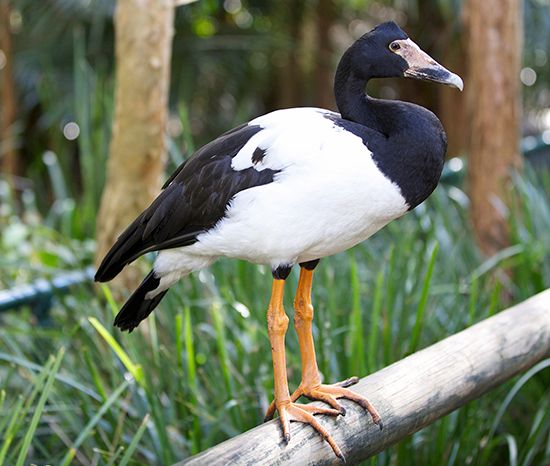
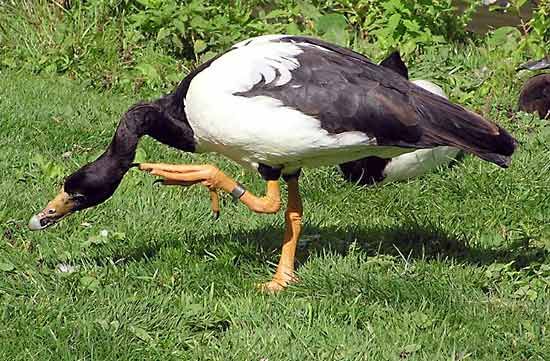
Often classified as the sole member of the subfamily Anseranatinae, this bird is notable for its primitive characteristics, which may warrant its recognition as a separate family within the order Anseriformes. The species is easily identified by its black-and-white plumage, long neck and legs, and a vulturish appearance caused by a bare face and a long, hooked bill.1
Unlike other waterfowl, the magpie goose possesses virtually unwebbed, long toes that allow it to perch in trees, and its legs are long enough to extend beyond its tail during flight. It is also unique for its breeding habits, which involve groups consisting of one male and two females, and its practice of feeding young bill-to-bill.1
How is the magpie goose different from other waterfowl species?
The magpie goose (Anseranas semipalmata) is distinct from other waterfowl due to several unique physical and behavioral characteristics:1
- Physical Anatomy: It possesses unusually long, virtually unwebbed toes, which allow it to perch in trees. It is the only waterfowl whose legs are long enough to extend beyond its tail during flight.1
- Molting: Unlike other waterfowl that experience a flightless period while molting, the magpie goose molts its flight feathers gradually, remaining capable of flight throughout the year.1
- Breeding Structure: It is the only waterfowl species known to have breeding groups consisting of one male and two females.1
- Parental Care: While many waterfowl leave their young to feed independently, magpie geese are unique in that parents feed their young bill-to-bill rather than placing food in the nest.1
These primitive traits are so distinct that some ornithologists suggest the species may merit its own family within the order Anseriformes rather than being grouped with other ducks, geese, and swans.1
What are the unique physical characteristics of the magpie goose?
The magpie goose (Anseranas semipalmata) possesses several distinct physical characteristics that set it apart from other waterfowl:
- Plumage and Build: It is a large bird, typically weighing 3 kg (6.5 pounds) and measuring 75–90 cm (30–35 inches) in length. Its black-and-white body gives it the name “magpie,” while its long neck, long legs, bare face, and long, hooked bill contribute to a vulturish appearance.1
- Head Structure: The male is distinguished by a pronounced dome atop its head.1
- Feet and Toes: Unlike most waterfowl, the magpie goose has unusually long, virtually unwebbed toes. This adaptation allows the bird to perch high in small branches, despite being a ground-nesting species.1
- Leg Length: Its legs are exceptionally long, making it the only waterfowl whose legs extend beyond the tail during flight.1
These primitive traits are so unique that some ornithologists argue the species should be classified in its own family within the order Anseriformes rather than within the family Anatidae.1
What is the scientific name of the magpie goose and what does it mean?
The scientific name of the magpie goose is Anseranas semipalmata.21
In the Linnaean system of nomenclature, scientific names are derived from Latin or Greek roots to describe the organism. The genus name Anseranas is a combination of the Latin anser (meaning “goose”) and anas (meaning “duck”), reflecting its unique position as a bird that shares characteristics with both groups. The specific epithet semipalmata is derived from the Latin semi- (meaning “half”) and palmatus (meaning “palmate” or “webbed”), which refers to the bird’s distinctive, partially webbed toes.41
Sources
- Magpie goose — Encyclopædia Britannica
- magpie goose — Merriam-Webster
- Goose — Encyclopædia Britannica
- taxonomy - Nomenclature — Encyclopædia Britannica
Published on · 3 min read