Fusulinella
Fusulinella is a genus of extinct fusulinid foraminiferans, which are single-celled protozoans characterized by complex, shell-like structures. These…
What is Fusulinella?
Fusulinella is a genus of extinct fusulinid foraminiferans, which are single-celled protozoans characterized by complex, shell-like structures. These organisms lived during the Late Carboniferous period, approximately 320 to 286 million years ago, and their remains are commonly found in marine rock formations from that era.12
Because Fusulinella existed within a relatively narrow window of time and was geographically widespread, it serves as an excellent guide fossil (or index fossil). Paleontologists and geologists rely on such fossils to correlate rock units across different regions and to refine the division of geologic time. Like other fusulinids, Fusulinella possessed a sophisticated internal shell structure, which is a key feature used by scientists for classification and the study of evolutionary relationships.12
What are guide fossils and why are they important?
Guide fossils, also known as index fossils, are the remains of plants or animals preserved in the Earth’s rock record that are characteristic of a specific span of geologic time or environment. To be effective, these fossils must be easily recognizable, abundant, widely distributed geographically, and possess a short temporal range.45
These fossils are essential to geology because they serve as the primary basis for defining boundaries within the geologic time scale and for the correlation of rock strata. By using biochronology—the dating of rock layers based on the known succession of fossilized life-forms—geologists can piece together chronological profiles of rock outcrops that are separated by vast distances. This is particularly vital for sedimentary rocks, which often lack the reliable radiometric data needed to determine absolute age. Because these organisms evolved rapidly and left behind durable remains like shells, bones, or teeth, they provide a reliable framework for understanding the history of our planet.46
How do foraminiferans build their complex shells?
Foraminiferans construct their protective shells, known as tests, through a variety of biological processes that incorporate both organic and inorganic materials. Depending on the species, the organism may secrete its own shell material or construct it using foreign objects found in its environment, such as sand grains or shell fragments.7
When the test is secreted by the organism, it is typically composed of calcium carbonate or silica plates. These structures are often complex, featuring internal partitions, wall laminations, and canal systems that provide structural support. As the foraminiferan grows, it adds new chambers to its shell; the term “foraminiferan” actually refers to the foramina, or openings, that remain between these adjacent chambers as the organism expands.78
The resulting tests are highly diverse in size, shape, and chemical composition, serving as essential protective housing for the organism’s cytoplasmic body. Once the foraminiferan dies, these durable calcareous tests often accumulate on the ocean floor, eventually contributing to the formation of limestone and chalk deposits.89
What defines the Carboniferous and Permian periods?
The Carboniferous and Permian periods represent two distinct, consecutive intervals of the Paleozoic Era.
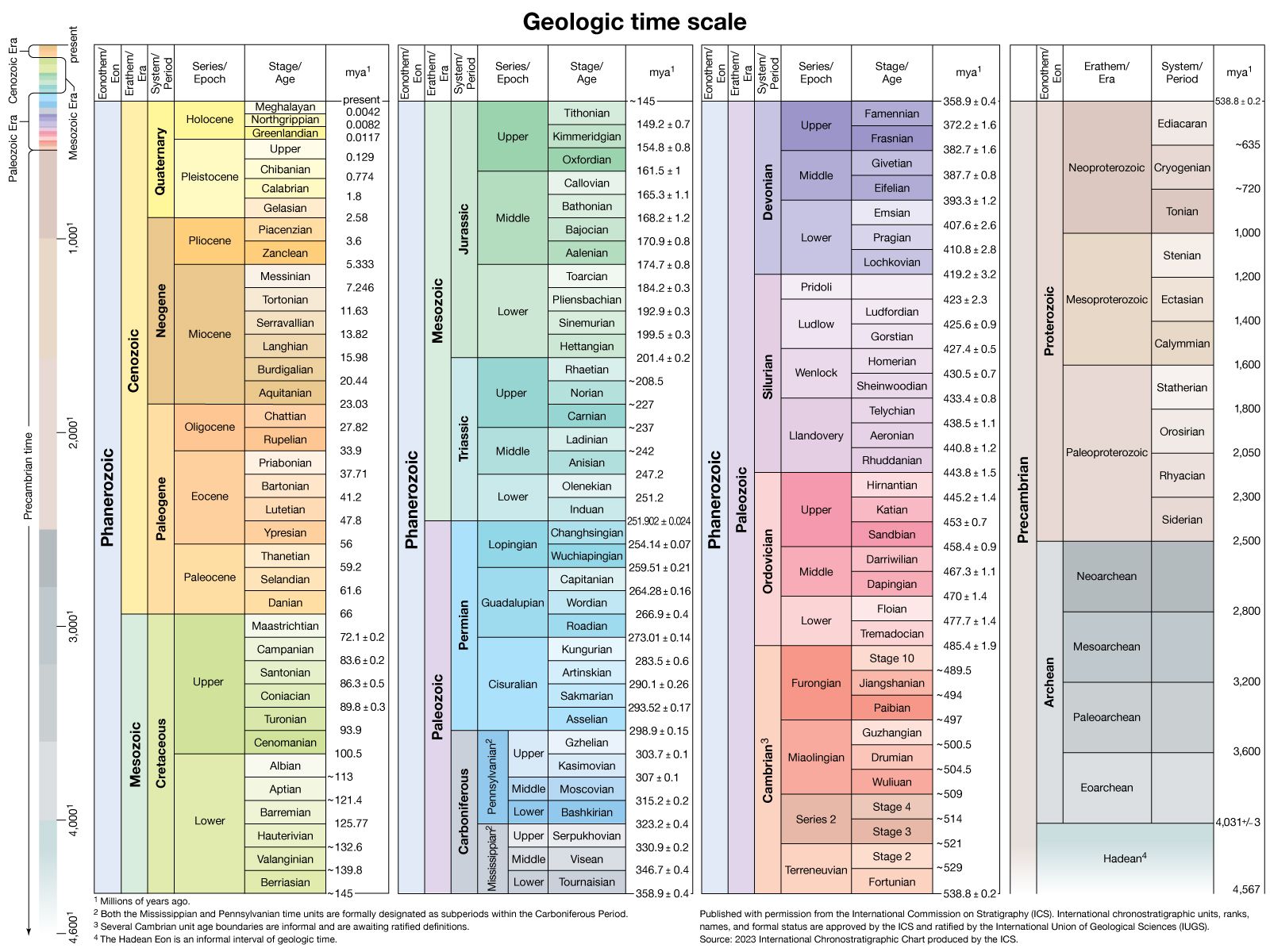
The Carboniferous Period (358.9 to 298.9 million years ago)
The Carboniferous is the longest period of the Paleozoic Era, named for the extensive coal-bearing strata formed during this time. It is divided into the Mississippian and Pennsylvanian subperiods. The era was characterized by diverse environments, including shallow marine settings and vast coal swamps populated by vascular plants like lycopods and seed ferns. Fauna included abundant crinoids, brachiopods, and amphibians, with the first reptiles appearing toward the end of the period.1011
The Permian Period (298.9 to 252.2 million years ago)
The Permian was defined by the assembly of the supercontinent Pangea, surrounded by the massive Panthalassa ocean. The climate shifted from widespread glaciation to increasingly hot and dry conditions. This period saw the diversification of terrestrial plants and insects, as well as the emergence of reptile lineages that would eventually lead to mammals. The period concluded with the largest mass extinction in Earth’s history, which eliminated the vast majority of marine and terrestrial species.121314
Sources
- Fusulinella — Encyclopædia Britannica
- fusulinid — Encyclopædia Britannica
- Parafusulina — Encyclopædia Britannica
- index fossil — Encyclopædia Britannica
- guide fossil — Merriam-Webster
- Triassic Period - Correlation of Triassic strata — Encyclopædia Britannica
- foraminiferan — Encyclopædia Britannica
- test — Encyclopædia Britannica
- skeleton - Calcareous structures — Encyclopædia Britannica
- Carboniferous Period — Encyclopædia Britannica
- A Journey Through Time Since the Precambrian - Permian Period: 298.9 million to 252.2 million years ago — Encyclopædia Britannica
- Permian Period - The Permian environment — Encyclopædia Britannica
- Carboniferous Period - Distinctive features — Encyclopædia Britannica
- end-Triassic extinction — Encyclopædia Britannica
Published on · 3 min read