Goliath Birdeater
The goliath birdeater (Theraphosa blondi) is a South American tarantula widely considered the largest arachnid in the world by mass. Found in the Amazonian…
What is Goliath birdeater?
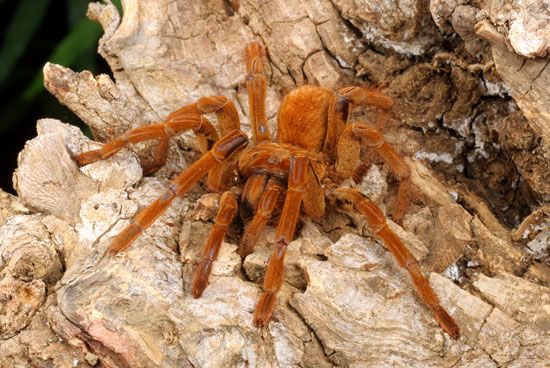
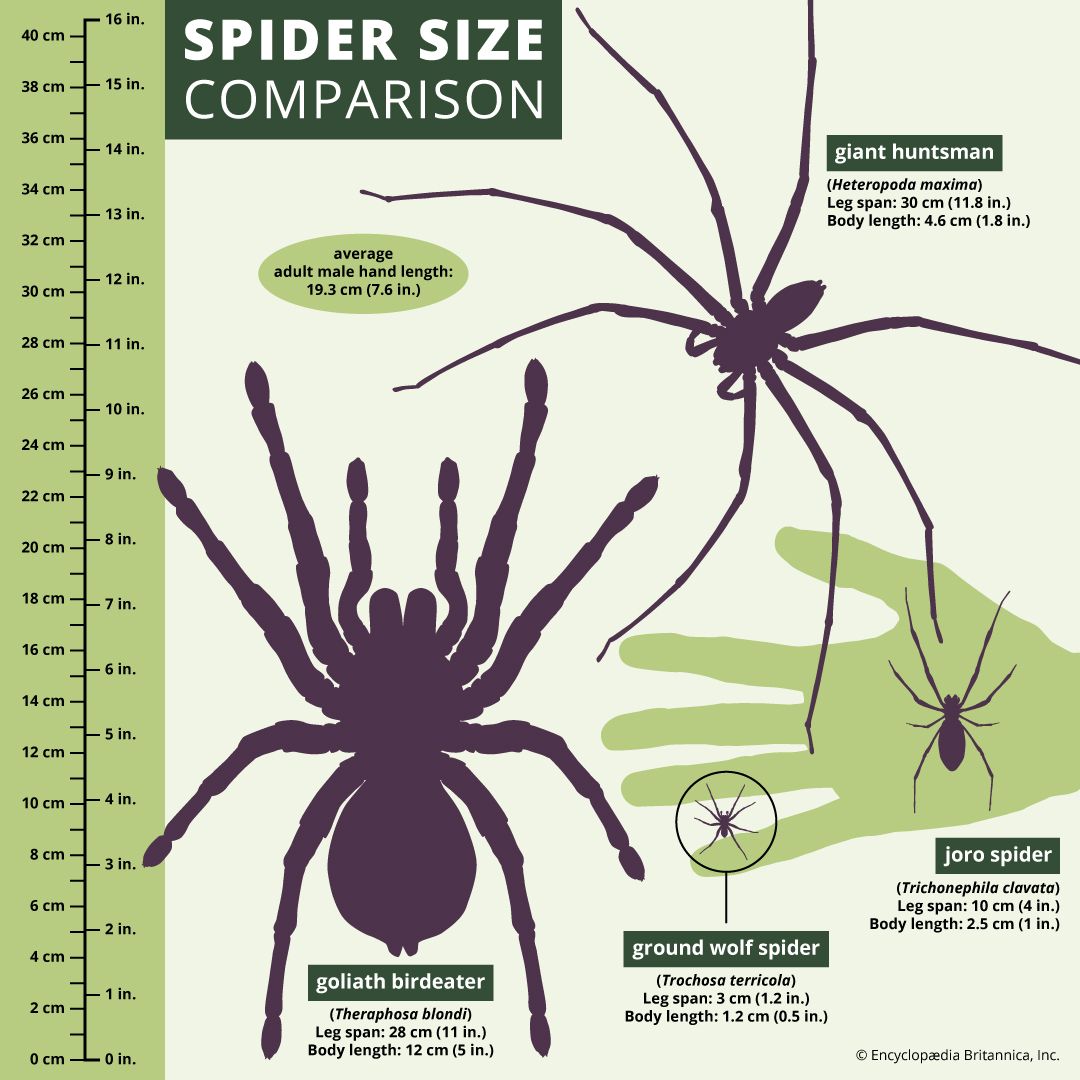
The goliath birdeater (Theraphosa blondi) is a South American tarantula widely considered the largest arachnid in the world by mass. Found in the Amazonian rainforests, this nocturnal hunter can weigh up to 170 grams (6 ounces)—roughly the weight of a pool ball—and reach a body length of 12 cm (5 inches). Its legs span up to 28 cm (11 inches), a size surpassed only by the giant huntsman spider.12
Despite its name, the spider rarely eats birds, feeding primarily on earthworms, insects, frogs, and small mammals. It is an ambush predator that uses sensitive hairs to detect vibrations. For defense, it can release irritating urticating hairs or produce a hissing sound through stridulation. While its venom is lethal to small prey, a bite to a human is generally comparable to a wasp sting.1
How do urticating hairs serve as a defense mechanism for spiders?
Urticating hairs serve as a highly effective defensive mechanism for many New World tarantulas. When these spiders feel threatened, they can release a cloud of these specialized, stinging hairs by rubbing their hind legs against their abdomen.45
The hairs are harpoon-shaped and feature tiny barbs that allow them to penetrate the skin and mucous membranes of potential predators. Once they make contact, they cause significant irritation, including temporary itching and allergic reactions. When these airborne hairs reach the eyes, face, or respiratory passages of a larger predator, the resulting discomfort can last for days, effectively deterring the attacker. In some instances, these hairs are even potent enough to kill smaller creatures, such as mice.45
While many New World species rely on this chemical-like defense, tarantulas from Africa and Asia typically lack these hairs, opting instead to rely on speed, aggressive threat displays, and often more potent venom to protect themselves.5
What are the main differences between tarantulas and other types of spiders?
Tarantulas belong to the infraorder Mygalomorphae, which distinguishes them from the vast majority of other spiders, which belong to the infraorder Araneomorphae.567
The primary differences include:
- Jaw Movement: Mygalomorphs (tarantulas) have chelicerae (jaws) that move forward and down, whereas araneomorphs have jaws that move sideways and together.57
- Respiratory Systems: Tarantulas possess two pairs of book lungs, while most araneomorphs typically have only one pair, sometimes replaced by tracheae.56
- Physical Traits: Tarantulas are generally characterized by their large size, hairiness, and three-segmented spinnerets.57
- Lifespan: Tarantulas are notably long-lived; some females can survive for 20 years or more, whereas most other spider species typically live for only one or two years.8
While many New World tarantulas utilize specialized urticating hairs as a unique defensive mechanism, other spiders rely on different strategies, such as speed, camouflage, or web-based hunting, to protect themselves and capture prey.56
How does the giant huntsman spider compare in size to the Goliath birdeater?
The giant huntsman spider and the Goliath birdeater are both record-holders, but they excel in different physical categories.10
Feature
Giant Huntsman Spider
Goliath Birdeater
Mass
~167 grams
Up to 170 grams
Body Length
4.6 cm (1.8 inches)
Up to 12 cm (5 inches)
Leg Span
25–30 cm (9.8–11.8 inches)
~28 cm (11 inches)
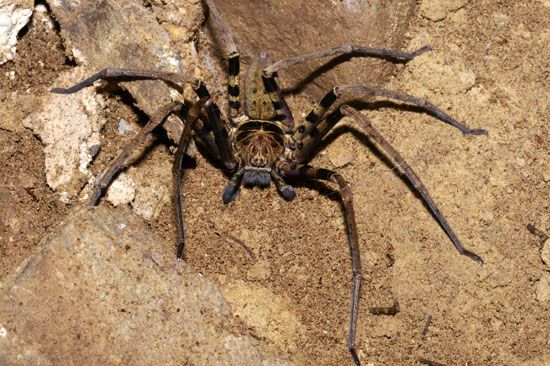
The Goliath birdeater is the heaviest known spider in the world, with a bulky body comparable to a human fist. In contrast, the giant huntsman spider possesses a more modest body size but holds the title for the longest leg span of any known spider, reaching up to 30 cm (11.8 inches). While the Goliath birdeater is a heavy-bodied tarantula that relies on ambush, the giant huntsman is a flat-bodied, active hunter that moves with a crab-like gait.11101
Sources
- Goliath birdeater: Top Questions — Encyclopædia Britannica
- Goliath birdeater — Encyclopædia Britannica
- goliath bird spider — Merriam-Webster
- spider - Importance — Encyclopædia Britannica
- tarantula — Encyclopædia Britannica
- spider - Annotated classification — Encyclopædia Britannica
- desert tarantula — Encyclopædia Britannica
- spider: Top Questions — Encyclopædia Britannica
- spider - Size range — Encyclopædia Britannica
- giant huntsman spider: Top Questions — Encyclopædia Britannica
- What is the largest spider in the world? — Encyclopædia Britannica
Published on · 3 min read