Eelpout
An eelpout is any of more than 250 species of elongated, tapered marine fishes belonging to the family Zoarcidae. These fish are typically found in cold…
What is eelpout?
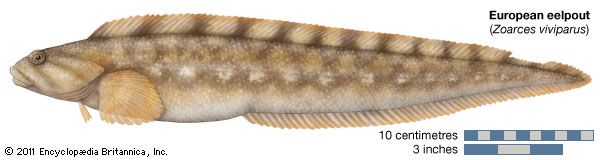
An eelpout is any of more than 250 species of elongated, tapered marine fishes belonging to the family Zoarcidae. These fish are typically found in cold waters and are particularly abundant in Arctic and Antarctic regions.12
Physically, eelpouts are characterized by their eel-like shape and thick lips. Their dorsal and anal fins are connected around the end of the tail, and they possess small pelvic fins located near the gills. While they can reach lengths of up to 90 centimeters (3 feet), most are significantly smaller. Eelpouts are bottom-dwellers, inhabiting environments ranging from shallow to deep waters.1
Reproductive habits vary among the family; while some species lay eggs, others—such as the European eelpout—are viviparous, meaning they give birth to live young. The term is also sometimes used to refer to the burbot.12
How do eelpouts survive in freezing Arctic and Antarctic waters?
Eelpouts, like many other ectotherms inhabiting polar marine environments, have evolved specialized physiological adaptations to survive in freezing waters that can drop below 0 °C (32 °F).13
Because their body temperature is largely determined by the surrounding water, these fish must prevent their internal fluids from freezing. They achieve this through several biochemical strategies:
- Cryoprotectants: Eelpouts and other polar fishes produce antifreeze compounds, such as glycoproteins, which circulate in their bloodstream and tissues.14
- Ice Inhibition: These proteins function by lowering the freezing point of their body fluids and restricting the growth of ice crystals, preventing them from forming or expanding within their cells.15
- Internal Chemistry: In addition to these proteins, some polar fishes maintain high internal salt concentrations, which further helps to inhibit freezing in extreme cold.1
These mechanisms allow eelpouts to thrive in environments that would otherwise be lethal to many other organisms.13
What is the difference between egg-laying and live-bearing fish?
The primary difference between egg-laying and live-bearing fish lies in where the embryo develops and how it receives nourishment.
Egg-Laying (Oviparous)
Most bony fishes are oviparous, meaning they lay eggs that develop outside the female’s body.81
- Fertilization: Typically external; males release milt to fertilize eggs scattered in the water or deposited on a substrate.8
- Development: The embryo develops within the egg, relying solely on the yolk for nutrients.8
- Survival: Because these eggs are often left in the open water, they face a higher mortality rate compared to live-bearing species.8
Live-Bearing
Live-bearing fish retain their young internally, providing a survival advantage by protecting the developing embryo from external predators. This category is further divided by how the young are nourished:8
- Ovoviviparous: The embryos develop inside the female’s body, but they are nourished by the egg yolk rather than directly by the mother.81
- Viviparous: The embryos have a direct tissue connection to the mother, receiving nourishment directly from her body.81
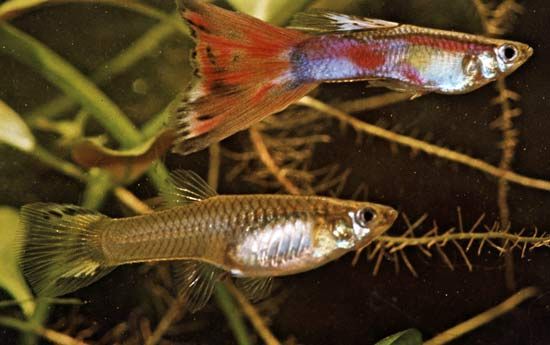
Live-bearing species, such as guppies or the European eelpout, typically produce fewer offspring than egg-layers, but the young are often born at a larger, more developed size.8910
What are some other types of bottom-dwelling marine animals?
Bottom-dwelling marine animals, collectively known as benthos, are categorized based on their relationship with the seafloor: epifauna live on the surface of the substrate or bottom objects, while infauna live within the sediments.121314
Beyond bottom-dwelling fish, a wide variety of organisms inhabit these environments:
- Worms and Mollusks: Polychaete worms are dominant deposit feeders on soft bottoms, while pelecypods (bivalves) are common suspension feeders.12
- Echinoderms: This group includes starfish, sea urchins, sand dollars, and sea cucumbers, which play vital roles in scavenging and altering seafloor sediment structure.1215
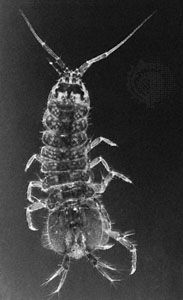
- Crustaceans: Many species, such as crabs, lobsters, and isopods, crawl over or burrow into the seafloor.1617
- Other Invertebrates: Sponges, anthozoans, ascidians, and barnacles are common fixtures on hard substrates.1217
- Microbenthos: The seafloor also hosts a diverse community of bacteria, diatoms, and amoebas that are smaller than 0.1 mm.12
Sources
- eelpout — Encyclopædia Britannica
- eelpout — Merriam-Webster
- Ectotherm — Encyclopædia Britannica
- antifreeze — Encyclopædia Britannica
- fish - Structural diversity — Encyclopædia Britannica
- protacanthopterygian - Ecology — Encyclopædia Britannica
- antifreeze — Merriam-Webster
- How do fish reproduce? — Encyclopædia Britannica
- live-bearer — Encyclopædia Britannica
- live-bearer — Merriam-Webster
- Reproductive behaviour - Fishes — Encyclopædia Britannica
- benthos — Encyclopædia Britannica
- fish - Locomotion — Encyclopædia Britannica
- echinoderm - Role in nature — Encyclopædia Britannica
- crustacean - Distribution and abundance — Encyclopædia Britannica
- epifauna — Merriam-Webster
- infauna — Merriam-Webster
- List of crustaceans — Encyclopædia Britannica
Published on · 3 min read