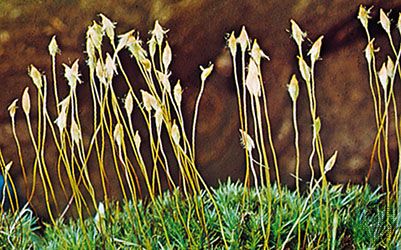
Hair-cap Moss
Hair-cap moss (Polytrichum) reproduces and spreads through both sexual and asexual processes.
How does hair-cap moss reproduce and spread in its environment?
Hair-cap moss (Polytrichum) reproduces and spreads through both sexual and asexual processes.
Sexual Reproduction
Hair-cap moss plants are typically unisexual, with male and female reproductive organs borne on separate plants. The tips of mature male shoots often form prominent, flowerlike structures composed of specialized leaves.12
Fertilization occurs when rain or heavy dew facilitates the movement of biflagellate sperm from the male organs to the archegonia (female organs). Following fertilization, a sporophyte develops, consisting of a stalk (seta) and a capsule (sporangium) that produces spores. In the subclass Polytrichidae, these spores are released through small holes between the capsule’s teeth and a membrane; slight movements of the capsule shake the spores into the air. Once a spore germinates, it grows into a protonema—a system of filaments that eventually produces buds, which develop into new leafy gametophores.213
Asexual Reproduction
Hair-cap moss also spreads through asexual means:
- Fragmentation: Small fragments of stems or leaves can regenerate into new plants if conditions provide sufficient moisture.4
- Rhizoids: The moss often grows and expands from underground rhizoids (filamentous structures).1
- Protonema Expansion: The protonema can proliferate under favorable conditions, increasing the population of leafy shoots that arise from it.2
What is the structure of hair-cap moss, including its leaves, stem, and rhizoids?
The structure of hair-cap moss (Polytrichum) is characterized by specialized components that support its growth and survival in various environments.
Leaves (Phyllids)
The leaves, or phyllids, are typically dark green or reddish-brown and can reach lengths of about 12 mm. They feature sheathed bases and pointed tips. These leaves are spirally arranged on the stem in more than three rows. Their surfaces often possess elaborate ornamentation, which plays a significant role in rapid water uptake.13
Stem
The internal structure of the stem in hair-cap moss is more complex than that of many other mosses. Within the subclass Polytrichidae, the stem contains a central conducting strand. This strand consists of:3
- Hydroids: An internal cylinder of cells specialized for water conduction.3
- Leptoids: Layers of living cells surrounding the hydroids that conduct sugars and other organic substances.3
This system is analogous to the vascular tissue found in higher plants, though it lacks lignin.3
Rhizoids
Hair-cap moss is anchored to its substratum by underground rhizoids, which are thin, filament-like structures. While they resemble roots, they are structurally similar to the cells of the protonema but lack chlorophyll3. Beyond anchoring the plant, rhizoids facilitate the absorption of water and minerals.15
What are the key characteristics that distinguish hair-cap moss from other types of mosses?
Hair-cap moss (Polytrichum) is distinguished from other mosses by several unique structural and reproductive features, primarily categorized within the subclass Polytrichidae.
Key Distinguishing Characteristics
- Advanced Internal Anatomy: Unlike many other mosses, hair-cap moss possesses a complex internal conducting system within its stems. This includes hydroids for water conduction and leptoids for transporting sugars, functioning similarly to the vascular tissue of higher plants, though they lack lignin.14
- Leaf Structure: The leaves are characterized by numerous chlorophyllose, flap-like structures on their upper surface, which aid in photosynthesis and water retention.4
- Spore Release Mechanism: The capsule (sporangium) features a unique arrangement where numerous multicellular teeth surround a membrane formed by the expanded apex of the columella. Spores are released gradually through the spaces between these teeth, rather than through the explosive mechanisms found in some other subclasses.14
- Distinctive Appearance: The mature sporophyte is topped by a hoodlike covering, or calyptra, which is covered in long, hair-like filaments—a feature that gives the moss its common name.7
How does hair-cap moss obtain and store water?
Hair-cap moss (Polytrichum) utilizes several specialized mechanisms to obtain and store water, allowing it to thrive in diverse environments like peat bogs and acidic soils.
Water Acquisition
- Rhizoids: These thin, rootlike filaments anchor the plant to its substratum and facilitate the absorption of water and minerals from the environment.61
- Leaf Ornamentation: The surfaces of the phyllids (leaves) often feature elaborate ornamentation. This structure is critical for rapid water uptake, allowing the plant to capture moisture efficiently from its surroundings.3
- External Conduction: In many mosses, rhizoids that invest the stem among the leaf bases play a significant role in the external conduction and retention of water before it is absorbed by the stem and leaves.3
Water Storage and Transport
- Internal Conducting System: Unlike many other mosses, hair-cap moss possesses a complex conducting strand in the center of its stem. This includes hydroids, which are specialized cells that form an internal cylinder dedicated to water conduction.3
- Tissue Differentiation: While this system is analogous to the vascular tissue of higher plants, it lacks lignin. This specialized internal anatomy allows for more efficient transport and management of water throughout the plant body.3
Sources
- hair-cap moss — Encyclopædia Britannica
- Plant reproductive system - Reproduction by fragments — Encyclopædia Britannica
- bryophyte - Form and function — Encyclopædia Britannica
- Plant reproductive system - Mosses — Encyclopædia Britannica
- haircap moss — Merriam-Webster
- rhizoid — Encyclopædia Britannica
- Polytrichidae — Merriam-Webster
- bryophyte - Annotated classification — Encyclopædia Britannica
Published on · 4 min read