Hermit Crab
Hermit crabs, belonging to the families Paguridae and Coenobitidae, are found in diverse environments worldwide. Because they possess soft, vulnerable…
What are the different habitats where hermit crabs can be found, both in the wild and as pets?
Hermit crabs, belonging to the families Paguridae and Coenobitidae, are found in diverse environments worldwide. Because they possess soft, vulnerable abdomens, they rely on empty snail shells or other hollow objects for protection.12
Wild Habitats
In the wild, hermit crabs occupy a wide range of settings:
- Marine Environments: Many species inhabit sandy- or muddy-bottomed marine waters, ranging from shallow coastal areas to deep-sea regions.1
- Terrestrial and Arboreal Areas: Some species are semiterrestrial or fully terrestrial, living on land or in trees.1
- Specialized Shelters: Beyond seashells, some crabs utilize unique structures such as bamboo stems, broken coconut shells, hollow wood cylinders, coral, sponges, or the tubes of polychaete worms.1
- Symbiotic Associations: Certain species live in association with other organisms, such as carrying anemones on their shells.1
Pet Habitats
While the provided information focuses on their natural biology, hermit crabs kept in captivity require environments that mimic these natural needs, specifically providing access to various sizes of empty shells to accommodate their growth.12
How do hermit crabs find and use shells for protection, and why is this behavior important?
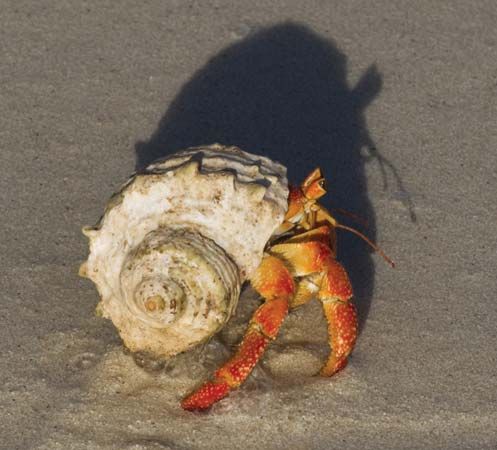
Hermit crabs possess soft, asymmetrical abdomens that lack a hard, protective carapace, making them extremely vulnerable to predators and harsh environmental conditions. To survive, they utilize empty snail shells or other hollow objects—such as bamboo stems, broken coconut shells, or wood cylinders—as portable shelters.21
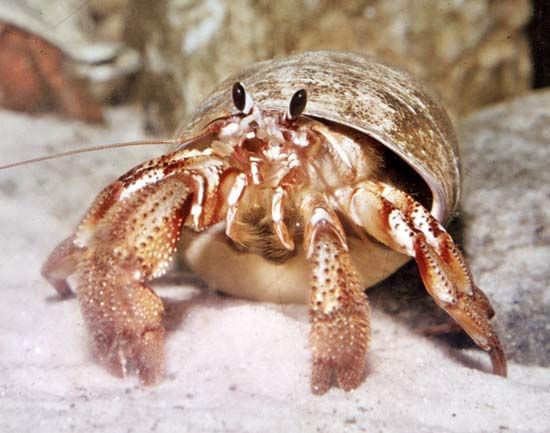
The crab’s body is physically adapted for this behavior; its flexible abdomen curls to fit inside the spiral of a shell, while its modified fourth and fifth pairs of legs grip the shell’s central column to hold it securely in place. When the crab retreats inside, its pincers are shaped to effectively block the shell’s entrance.1
This behavior is critical for survival, as the shell provides essential protection for their delicate bodies. Because hermit crabs continue to grow throughout their lives, they must periodically find and move into larger shells. This necessity creates intense competition, as the availability of suitable, high-quality shells is often limited in their natural habitats.21
What are the unique physical characteristics of hermit crabs that distinguish them from other crustaceans?
Hermit crabs are distinguished from other crustaceans, such as true crabs, by several unique physical characteristics primarily related to their reliance on external protection.21
- Soft Abdomen: Unlike true crabs, which possess a hard, protective carapace, hermit crabs have a soft, asymmetrical abdomen that lacks a hard outer covering. This abdomen typically curls to the right to fit into the spiral of a shell.21
- Shell-Dwelling Adaptation: Because their bodies are vulnerable, they have evolved to inhabit empty snail shells or other hollow objects. Their fourth and fifth pairs of legs are significantly shorter than their other limbs and are specifically adapted to grip the central column of these shells to hold them securely in place.21
- Modified Pincers: While they possess five pairs of legs, the first pair is modified into chelae (pincers). These are shaped so that when the crab retreats into its shell, the pincers can effectively cover and block the entrance, providing a defensive barrier against predators.1
- Anatomical Differences: Unlike true crabs, whose tails are curled under the thorax, the hermit crab’s body is specifically structured to accommodate its portable home.13
What are the different species of hermit crabs, and how do they vary?
Hermit crabs belong to the families Paguridae and Coenobitidae and exhibit significant diversity in their habitats, physical size, and shell-dwelling behaviors. While most species rely on empty gastropod shells for protection, others have adapted to different environments.1
Diversity in Habitat and Dwelling
- Marine Species: Many species, such as the common Pagurus bernhardus of European and North American waters, inhabit marine environments and often form symbiotic relationships by carrying anemones on their shells.1
- Semiterrestrial and Terrestrial Species: Tropical species of the family Coenobitidae can live on land, sometimes far from the sea, though they must return to the water to release their larvae. These crabs may utilize various hollow objects, including bamboo stems, broken coconut shells, and wood cylinders, in addition to traditional seashells.15
- Deepwater Species: Some species are highly specialized, such as Pylocheles, which lives in bamboo sections in the Indian Ocean, and Xylopargus, which inhabits hollow wood cylinders at significant depths.1
- The Robber Crab: The robber crab (Birgus latro) is a notable exception; it is a terrestrial species that has abandoned the shell-dwelling habit as an adult, developing hard, shelly plates on its abdomen instead.15
Variation in Size
Species vary greatly in physical dimensions. For example, Pagurus pollicaris is a relatively large Atlantic species measuring 10 to 12 cm (4 to 5 inches), while P. longicarpus is significantly smaller.1
Sources
- hermit crab — Encyclopædia Britannica
- 14 Questions About Aquatic Animals Answered - Which animals live inside empty seashells? — Encyclopædia Britannica
- crab — Encyclopædia Britannica
- crustacean - Appendages — Encyclopædia Britannica
- List of crustaceans — Encyclopædia Britannica
Published on · 4 min read