Paradoxides
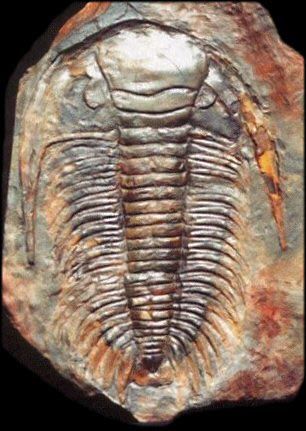
Paradoxides is a genus of trilobites—an extinct group of marine arthropods—that lived during the Middle Cambrian Period.
What is Paradoxides?
Paradoxides is a genus of trilobites—an extinct group of marine arthropods—that lived during the Middle Cambrian Period.12
These creatures are characterized by a well-segmented body, a large head region (cephalic shield) that terminates in pointed spines, and a very small tail (pygidium). Some species were notably large, reaching lengths of up to 45 cm (about 18 inches) or even two feet.12
Fossils of Paradoxides are found in Middle Cambrian rocks across western Europe and eastern North America. Because of their widespread distribution, they serve as important index fossils for correlating geological strata from that time. The term is also associated with the Paradoxides Series, a sequence of rocks deposited during the Middle Cambrian that is defined by the presence of these and related trilobites.13
What are trilobites and why are they extinct?
Trilobites were a group of extinct marine arthropods that first appeared approximately 521 million years ago during the Cambrian Period. They are easily identified by their distinctive three-lobed, segmented bodies, which were divided into a head region (cephalon), a thorax, and a tail region (pygidium). These animals possessed a chitinous exoskeleton that they shed as they grew, leaving behind the fossils that make them common in the geological record.4
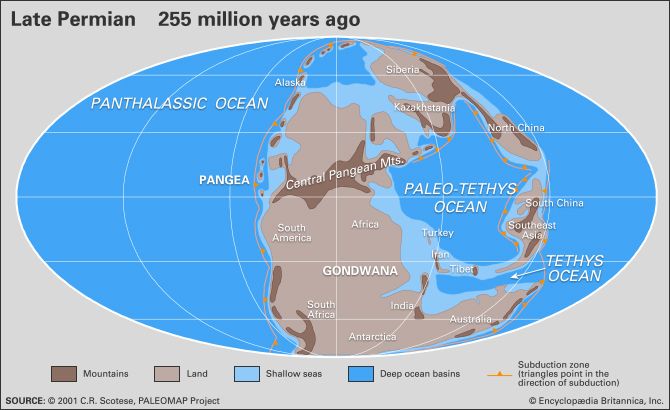
While trilobites dominated the early seas, their diversity declined significantly over subsequent geologic periods. They made their final appearance during the Permian Period, ultimately succumbing to the massive Permian-Triassic extinction event. This crisis, which eliminated 85 to 95 percent of marine invertebrate species, was likely driven by environmental shifts such as oceanic anoxia—a lack of dissolved oxygen—potentially caused by weakened oceanic circulation. By the time of this event, trilobites were already long past their evolutionary zenith.45
How do scientists use fossils to date rock layers?
Scientists use fossils to date rock layers primarily through the law of faunal succession, which observes that assemblages of fossil plants and animals succeed one another in a predictable, nonrepetitive order through time. By identifying these distinct fossil sequences, geologists can correlate rock strata found in different geographic locations, even when those sites are widely separated.67
A key tool in this process is the use of index fossils. To be effective, an index fossil must be:
- Easily recognizable and distinctive.8
- Abundant in the rock record.8
- Widely distributed geographically.8
- Short-lived in geologic time, allowing for precise dating.8
When geologists find these fossils in sedimentary rock, they can assign a relative age to the strata. Because the fossil record is not always continuous due to erosion or gaps in deposition, scientists often integrate data from multiple localities to build a comprehensive timeline. While fossils provide the framework for relative dating, they are often calibrated using absolute dating techniques—such as measuring radioactive isotopes—to provide precise numerical ages for the geologic time scale.7910
What was life like during the Cambrian Period?
The Cambrian Period (541 to 485.4 million years ago) was a transformative era characterized by the Cambrian explosion, a rapid emergence of most major animal phyla.1213
The Environment
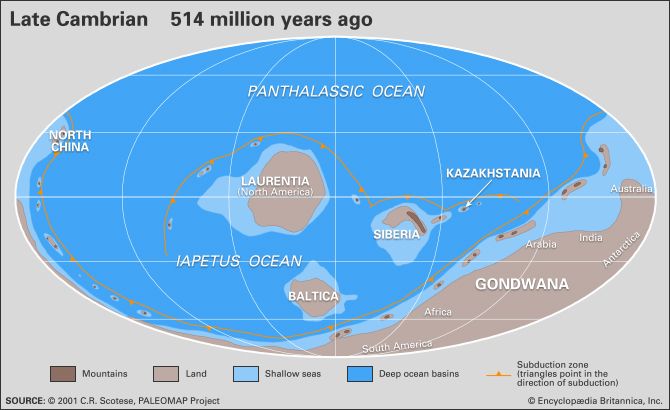
The global climate was warmer and more stable than today, with average temperatures around 22 °C (72 °F). Earth’s geography featured shifting continents, including the formation of Gondwana, and rising sea levels that flooded continental margins. Increased erosion from these changes altered ocean chemistry, likely boosting oxygen levels and enabling the evolution of complex life and hard body parts like calcium carbonate shells.141312
Life in the Cambrian
Life was almost entirely confined to the margins of the world’s oceans, with no complex organisms inhabiting land or the deep sea. However, shallow seafloor ecosystems were highly diverse. Key inhabitants included:1213
- Arthropods: Including trilobites and various scavengers.1213
- Predators: The large carnivore Anomalocaris was a dominant hunter, known to prey on trilobites.1215
- Reef Builders: Early carbonate reefs were constructed by archaeocyathids.12
- Soft-bodied organisms: Exceptional fossil sites like the Burgess Shale reveal a complex community of soft-bodied creatures, such as the five-eyed Opabinia, which are rarely preserved elsewhere.15
Sources
- Paradoxides — Encyclopædia Britannica
- Paradoxides Series — Encyclopædia Britannica
- Paradoxides — Merriam-Webster
- trilobite — Encyclopædia Britannica
- Triassic Period - Permian-Triassic extinctions — Encyclopædia Britannica
- index fossil — Encyclopædia Britannica
- Cambrian Period - Correlation of Cambrian strata — Encyclopædia Britannica
- law of faunal succession — Encyclopædia Britannica
- dating - Distinctions between relative-age and absolute-age measurements — Encyclopædia Britannica
- fossil record — Encyclopædia Britannica
- Tertiary Period - Correlation of Tertiary strata — Encyclopædia Britannica
- Cambrian explosion — Encyclopædia Britannica
- Cambrian Period - Paleoclimate — Encyclopædia Britannica
- Cambrian explosion — Merriam-Webster
- A Journey Through Time Since the Precambrian - Cambrian Period: 541 million to 485.4 million years ago — Encyclopædia Britannica
- Cambrian Period - Deposits with soft-bodied organisms — Encyclopædia Britannica
Published on · 3 min read