Lynx Spider
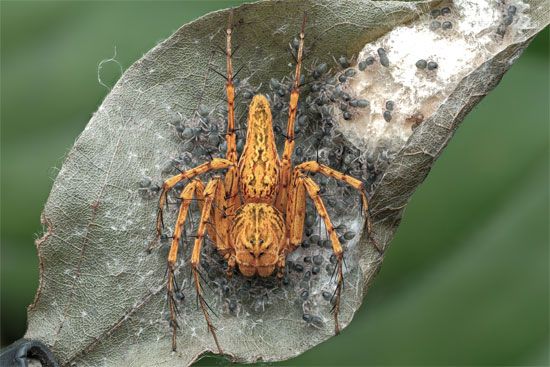
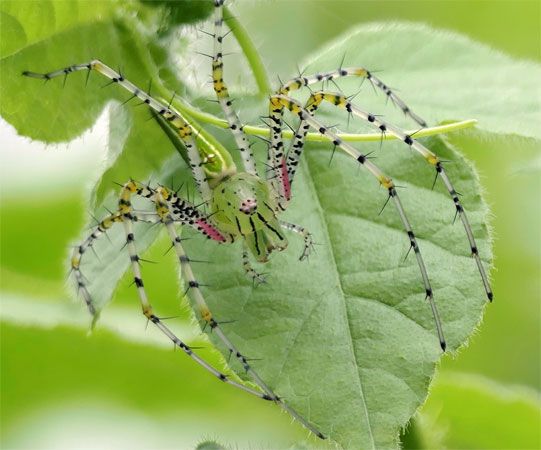
A lynx spider (family Oxyopidae) is any of nearly 450 species of active spiders that do not construct webs or nests to capture prey. Instead, these spiders…
What is lynx spider?
A lynx spider (family Oxyopidae) is any of nearly 450 species of active spiders that do not construct webs or nests to capture prey. Instead, these spiders are active hunters that pounce directly upon their prey.1
Key characteristics of lynx spiders include:
- Appearance: They possess eight eyes arranged in a hexagon, and their abdomen typically tapers to a point.1
- Habitat: They are distributed worldwide and are commonly found on vegetation, where they seek out insect prey.1
- Behavior: The green lynx (Peucetia viridans) is a notable species that can adjust its body color to match its surroundings. While they do not build webs for hunting, female green lynx spiders construct silk retreats to hold their egg sacs and will guard both the eggs and their young.1
Some researchers suggest that despite their hunting behavior, lynx spiders may be closely related to orb-weaving spiders due to shared body characteristics.1
How do lynx spiders camouflage themselves on flowers?
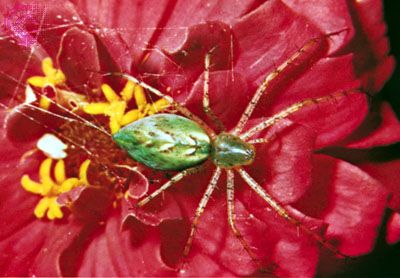
Lynx spiders, particularly the green lynx (Peucetia viridans), utilize a form of active camouflage to hunt on vegetation and flowers. These spiders possess the ability to adjust their body color to match the specific background of the plant or flower they are occupying.1
By blending into their surroundings, they can effectively ambush insect prey that lands on the flowers, as they do not rely on webs to capture food. This color-matching behavior allows them to remain concealed from both potential prey and predators while they wait to pounce.1
What are the main differences between hunting spiders and web-building spiders?
The primary distinction between hunting spiders and web-building spiders lies in their strategy for capturing prey. While all spiders produce silk, only about half of all species utilize it to construct webs for entrapment it to construct webs for entrapment.3
Web-Building Spiders
These spiders rely on instinctively constructed snares to capture prey, particularly flying insects.
- Mechanism: Webs act as air filters or traps. When an insect touches the silk, it becomes entangled, and the spider is alerted by vibrations or tension in the threads.34
- Variations: Designs range from the elaborate, circular nets of orb weavers to the irregular, three-dimensional webs of cobweb spiders. Some species, such as ogre-faced spiders, actively throw their webs over passing prey.3
- Maintenance: Many web-builders must frequently repair or rebuild their webs, as the sticky material can dry out or the structure may be damaged during a struggle.3
Hunting Spiders
Hunting spiders do not construct webs to capture food; instead, they actively seek out or ambush their prey.34
- Mechanism: These spiders typically rely on keen eyesight or a highly developed sense of touch to locate victims.54
- Strategies:
- Stalking: Jumping spiders and wolf spiders track prey and pounce when close.5
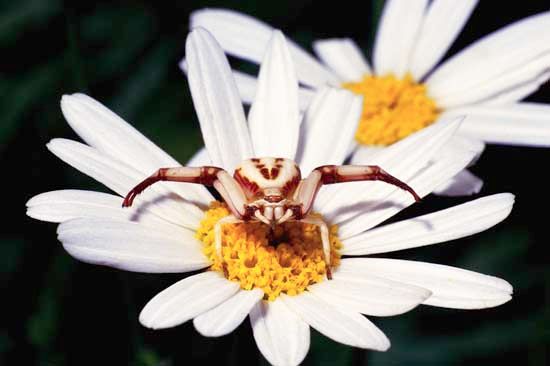
- Ambush: Crab spiders often wait on flowers, using camouflage to surprise insects.5
- Specialized Hunting: Spitting spiders immobilize prey by shooting a zigzag stream of sticky saliva.5
How do female lynx spiders protect their egg sacs?
Female lynx spiders, such as the green lynx, employ a dedicated approach to protecting their offspring. Unlike many other spider species that may abandon their eggs or carry them, female lynx spiders construct a specialized silk retreat on vegetation.8
Within this retreat, the female suspends her egg sac to keep it secure. She then remains with the sac, actively guarding both the eggs and the young spiders once they emerge, ensuring their safety within the structure. This behavior is a form of parental care, which is observed in various spider species to increase the survival rate of the next generation.81
Sources
- lynx spider — Encyclopædia Britannica
- neuropteran - Annotated classification — Encyclopædia Britannica
- spider - Spiderwebs — Encyclopædia Britannica
- spider - Stalking prey — Encyclopædia Britannica
- spider - Annotated classification — Encyclopædia Britannica
- spider - Silk — Encyclopædia Britannica
- spider — Encyclopædia Britannica
- spider - Eggs and egg sacs — Encyclopædia Britannica
Published on · 3 min read