Man-of-war Fish
The man-of-war fish (Nomeus gronovii) is a small marine fish, typically measuring about 7.5 to 8 cm (3 to 3.1 inches) in length, known for its striped or…
What is man-of-war fish?
The man-of-war fish (Nomeus gronovii) is a small marine fish, typically measuring about 7.5 to 8 cm (3 to 3.1 inches) in length, known for its striped or mottled appearance and large, black pelvic fins.12
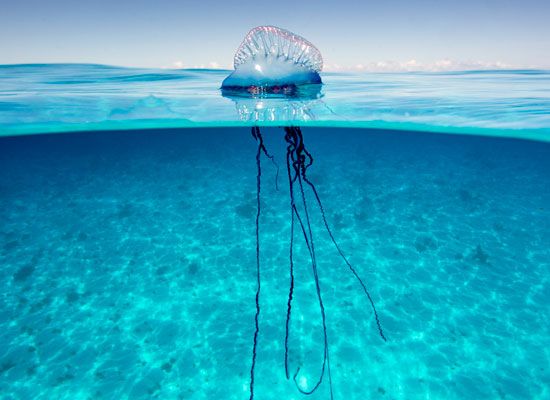
It is most notable for its association with the Portuguese man-of-war, a colonial, jellylike organism. The fish lives among the stinging tentacles of the man-of-war, though it is not immune to the creature’s venom. Instead, it relies on its agility to avoid being struck by the stinging cells, though it is occasionally captured and eaten by its host. In turn, the man-of-war fish feeds on the man-of-war’s gonads and its tentacles, which are capable of regeneration.2
How does the Portuguese man-of-war differ from a true jellyfish?
The Portuguese man-of-war (Physalia physalis) is frequently mistaken for a jellyfish, but it is biologically distinct. While both belong to the phylum Cnidaria, they differ fundamentally in their structure and movement.2
- Colonial vs. Individual: A true jellyfish is a single, individual organism. In contrast, the Portuguese man-of-war is a colonial organism composed of numerous specialized polyps that function together. These polyps are divided into four distinct types, each performing a specific role: the gas-filled float (pneumatophore), the stinging tentacles (dactylozooids), the digestive polyps (gastrozooids), and the reproductive polyps (gonozooids).2
- Movement: Jellyfish are individual organisms capable of independent movement. The Portuguese man-of-war, however, is a member of the Siphonophora order and cannot move on its own. It relies entirely on ocean currents and wind to drift across the water surface using its sail-like pneumatophore.2
What other marine animals have special relationships with stinging creatures?
Several marine animals have evolved specialized relationships with stinging creatures, primarily within the phylum Cnidaria, which includes sea anemones, corals, and jellyfish. These associations often involve mutualism, where both partners benefit, or unique defensive adaptations.
- Crustaceans: Certain hermit crabs form mutualistic bonds with sea anemones. The crab carries the anemone on its shell, providing the anemone with transport and access to food, while the anemone protects the crab from predators like octopuses. Some true crabs also carry anemones on their backs, legs, or in their claws for similar defensive advantages.67
- Anemone Fishes: Perhaps the most famous example is the anemone fish (such as the common clown fish). These fish live within the stinging tentacles of anemones, protected by a specialized mucous coating. In return, the fish clean parasites from the anemone and drive away predators that would otherwise consume the anemone’s tentacles.627
- Nudibranchs: These gastropods exhibit a remarkable defensive adaptation: they consume anemones and hydroids and sequester the prey’s undischarged stinging cells (cnidae). Once matured within the nudibranch, these stolen stinging cells are used for the mollusk’s own defense.6
- Other Fishes: Beyond anemone fish, various other species have been observed living in association with large medusae, utilizing the stinging tentacles as a refuge from predators.6
How do nematocysts work to capture prey?
Nematocysts are specialized, complex capsules produced by Cnidaria that function as a primary mechanism for capturing prey. Each capsule contains a coiled, hollow, and often barbed thread that remains stored until the organism is triggered by mechanical or chemical cues.1112
When stimulated, a lidlike structure on the capsule opens, and the thread everts explosively with a twisting motion. These threads capture prey through three primary methods:11
- Penetration: Armed with spines or barbs, the thread acts like a drill, penetrating the tissues of the prey.1112
- Injection: Once the thread has penetrated the target, toxins stored within the capsule are injected through the hollow tubule, effectively paralyzing the victim.1112
- Entanglement: Some types of threads are adhesive or designed to wrap around the prey, physically ensnaring it.1112
After the thread is fired, it separates from the nematocyst, and the capsule cannot be reused, as each cnida can be fired only once. Once the prey is immobilized or secured, the cnidarian’s tentacles move the food toward the mouth for ingestion.111213
Sources
- man-of-war fish — Encyclopædia Britannica
- Portuguese man-of-war — Encyclopædia Britannica
- Portuguese man-of-war — Merriam-Webster
- cnidarian - Annotated classification — Encyclopædia Britannica
- compound jellyfish — Merriam-Webster
- cnidarian - Associations — Encyclopædia Britannica
- common clown fish — Encyclopædia Britannica
- jellyfish — Encyclopædia Britannica
- cnidarian - Ecology and habitats — Encyclopædia Britannica
- sea anemone: Top Questions — Encyclopædia Britannica
- nematocyst — Encyclopædia Britannica
- cnidarian - Defense and aggression: nematocysts — Encyclopædia Britannica
- cnidarian - Food and feeding — Encyclopædia Britannica
Published on · 3 min read