Marsupium
The marsupium, or pouch, is a specialized structure that protects, carries, and nourishes newborn marsupials born in a vulnerable, embryonic state. While the…

How has the marsupium evolved over time, and are there any extinct marsupials with unique pouch structures?
The marsupium, or pouch, is a specialized structure that protects, carries, and nourishes newborn marsupials born in a vulnerable, embryonic state. While the pouch is a defining feature for many species, it is not universal; some marsupials have only simple skin folds, while others lack a pouch entirely, leaving the young to cling directly to the teats.123
Regarding its evolution, the marsupium is considered an adaptation to low-productivity environments, allowing mothers to support offspring through a prolonged period of development outside the womb. While the provided search results do not detail the specific evolutionary timeline of the pouch’s structural changes, they note that marsupials exhibit convergent evolution with placental mammals, adapting to similar ecological niches despite their distinct reproductive strategies.3
Information regarding extinct marsupials with unique pouch structures is not available in the current knowledge base. While large extinct marsupials like the Diprotodon are well-documented, their specific pouch morphology remains outside the scope of the provided data.4
What are the advantages and disadvantages of having a marsupium for marsupials?
The marsupium, or pouch, serves as a critical reproductive adaptation for marsupials, offering distinct advantages and disadvantages related to their unique life cycle.
Advantages
- Protection and Development: Because marsupials are born in a highly vulnerable, embryonic state, the pouch provides essential shelter, warmth, and nourishment. It acts as an external womb, allowing the young to complete their development while remaining firmly attached to the mother’s milk-giving teats.12
- Environmental Adaptation: This reproductive strategy is an adaptation to low-productivity environments. By limiting the period of internal gestation, the mother avoids the metabolic demands of a long pregnancy, which can be advantageous in resource-scarce habitats.2
Disadvantages
- High Infant Mortality: The journey from the birth canal to the pouch is arduous, and many young do not survive it. Furthermore, because the number of available teats is limited, any offspring that exceed this number often perish.2
- Vulnerability: The young are entirely dependent on the mother’s care for an extended period—sometimes lasting months—which can be a significant investment for the parent.12
Are there any marsupials that don’t have a permanent pouch?
Yes, there are several marsupials that do not possess a permanent, well-developed pouch. While the marsupium is a defining characteristic for many species, it is not a universal feature across the group.
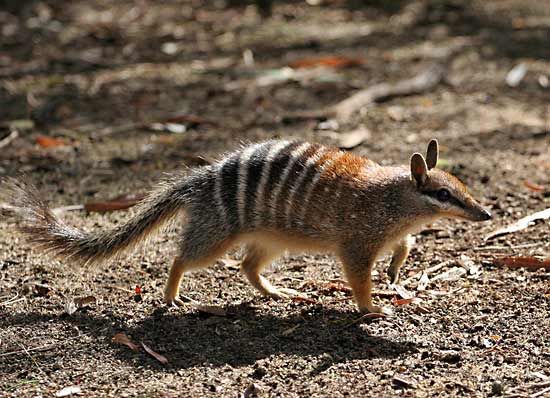
In some marsupials, the pouch is reduced to a simple fold of skin or may be entirely absent. In these “pouchless” species, the newborn young—which are born in a highly vulnerable, embryonic state—simply cling directly to the mother’s teats for protection and nourishment as they continue their development. A notable example of a pouchless marsupial is the numbat, which lacks a pouch and instead relies on this direct attachment method to support its young.
How do male marsupials differ anatomically from females in terms of the marsupium?
The marsupium, or pouch, is a specialized anatomical structure found in female marsupials that serves to protect, carry, and nourish their underdeveloped young.13
In terms of anatomical differences, the marsupium is a feature exclusive to females. Because its primary biological function is to enclose the mammary glands and provide a sheltered environment for the offspring to complete their development while attached to the teats, male marsupials do not possess a marsupium. While male marsupials share the same basic mammalian body plan as females, they lack the specialized skin folds or pouches required for the care of the young.173
Sources
- marsupium — Encyclopædia Britannica
- marsupial: Top Questions — Encyclopædia Britannica
- marsupial — Encyclopædia Britannica
- Diprotodon — Encyclopædia Britannica
- mammal - Estrus and other cycles — Encyclopædia Britannica
- numbat — Encyclopædia Britannica
- mammal - The female tract — Encyclopædia Britannica
- marsupium — Merriam-Webster
- kangaroo - Reproduction and development — Encyclopædia Britannica
Published on · 3 min read