Wallaby
Wallabies are defined as marsupials primarily by their reproductive biology, which is characterized by the birth of young in a highly premature, embryonic…
What are the key characteristics that define wallabies as marsupials?
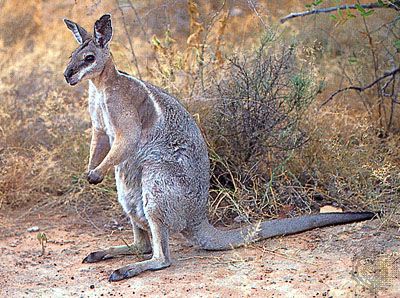
Wallabies are defined as marsupials primarily by their reproductive biology, which is characterized by the birth of young in a highly premature, embryonic state. Following birth, these young—known as joeys—must navigate to the mother’s lower belly to attach themselves to milk-giving teats for continued development.12
Key characteristics include:
- The Marsupium: Most wallabies possess a marsupium, a specialized pouch or skin fold that protects and houses the developing young while they remain attached to the teats.13
- Developmental Cycle: Because they lack the specialized uterine wall for long-term embryo implantation found in placental mammals, wallabies undergo a short gestation period, after which the joey completes its growth externally within the pouch.1
- Physical Adaptations: As members of the Macropodidae family, wallabies possess well-developed hind limbs that enable them to bound across their environment, a trait shared with their larger kangaroo relatives.14

How do wallabies differ from their larger cousins, kangaroos?
While wallabies and kangaroos both belong to the family Macropodidae, they are distinguished primarily by size, ecological niche, and dietary habits.
Size and Physical Build
The most immediate difference is scale. Kangaroos are the largest members of the family, with species like the red kangaroo reaching heights of up to 2 meters (6.6 feet) and weights of 90 kg (200 pounds). In contrast, wallabies are middle-sized or small marsupials. For example, brush wallabies typically have a head and body length of 45 to 105 cm (18 to 41 inches), while the dwarf wallaby is the smallest member of the family, weighing only about 1.6 kg (3.5 pounds).
Diet and Habitat
Their feeding strategies reflect their size differences:
- Grazers vs. Browsers: Large kangaroos are primarily grazers that feed on grass in open plains, similar to cattle or sheep. Wallabies tend to be more selective, often acting as browsers that focus on leaves, shrubs, and other vegetation.6
- Environment: Kangaroos are often associated with open grasslands and forests. Wallabies occupy more diverse and specialized niches; for instance, rock wallabies are adapted to agile movement on rocky terrain, while others inhabit dense brushlands or forests.7
What are the different species of wallabies, and where are they found?
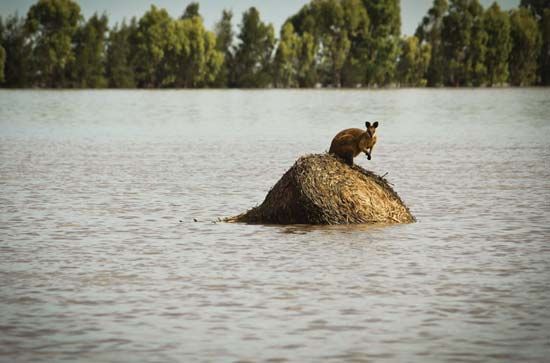
Wallabies are a diverse group of middle-sized marsupials within the family Macropodidae, found primarily in Australia, New Guinea, and surrounding islands like the Bismarck Archipelago and Tasmania.212
The various species are categorized by their physical traits and habitats:
- Brush Wallabies (Macropus): There are 11 species, such as the red-necked wallaby of southeastern Australia and Tasmania, and the pretty-faced wallaby of coastal eastern Australia.2
- Rock Wallabies (Petrogale): Six species adapted for agility on rocky terrain, typically found near water.2
- Nail-tailed Wallabies (Onychogalea): Three species distinguished by a horny growth on the tail tip.2
- Hare Wallabies (Lagorchestes): Two species that exhibit movements similar to hares.2
- Scrub Wallabies (Thylogale): Three stocky species found in New Guinea, the Bismarck Archipelago, and Tasmania. This group includes the quokka, now restricted to two islands off Western Australia.2
- Forest Wallabies (Dorcopsulus): Three species native to New Guinea, including the dwarf wallaby, the smallest member of the kangaroo family.2
How do wallabies care for their young in their pouches?
Wallabies, like other marsupials, give birth to young in a highly undeveloped state after a short gestation period—for example, the swamp wallaby has a gestation of about 38 days.1
Upon birth, the tiny, vulnerable joey must make its own way to the mother’s pouch, which serves as a vital source of shelter, warmth, and nourishment. Once inside, the joey attaches itself to one of the mother’s milk-giving teats. The teat then swells, becoming firmly fastened—or almost physically fused—to the young’s mouth tissues.51
The joey remains attached to the teat for weeks or months, receiving all the nutrients required for its continued development, which effectively replaces the later stages of fetal growth seen in placental mammals. While the pouch is a prominent feature for many species, it is essentially a flap of skin covering the nipples; in some marsupials, the pouch may be less developed or absent, in which case the young simply cling to the exposed teats.51
Sources
- marsupial — Encyclopædia Britannica
- wallaby — Encyclopædia Britannica
- macropodid — Merriam-Webster
- marsupium — Encyclopædia Britannica
- What are baby koalas called? — Encyclopædia Britannica
- kangaroo - Common features — Encyclopædia Britannica
- What do kangaroos eat? — Encyclopædia Britannica
- wallaroo — Encyclopædia Britannica
- kangaroo - Behaviour — Encyclopædia Britannica
- kangaroo - Descriptions of selected species — Encyclopædia Britannica
- Did you know? — Merriam-Webster
- kangaroo — Encyclopædia Britannica
Published on · 4 min read