Mastodon
Mastodons (genus Mammut) were heavily built, elephantine mammals belonging to the family Mammutidae. Their key physical characteristics included:
What are the key physical characteristics of mastodons?
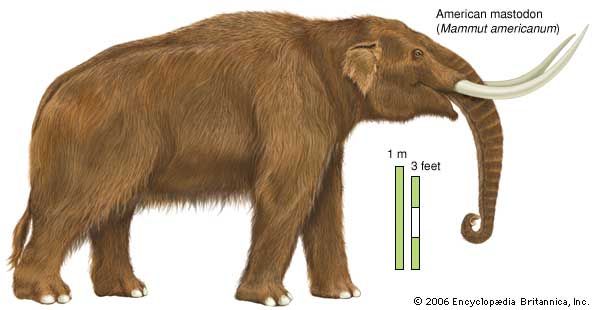
Mastodons (genus Mammut) were heavily built, elephantine mammals belonging to the family Mammutidae. Their key physical characteristics included:
- Teeth: They possessed distinctive, low-crowned, large, and strongly rooted grinding teeth featuring up to four prominent ridges separated by deep troughs, which were less complex than those of true elephants.1
- Tusks: They had prominent upper tusks that grew parallel with an upward curve. Males also possessed short lower tusks, which were absent in females.1
- Body Structure: While shorter than modern elephants, they were robust with a long body and short, massive, pillarlike legs. Their skulls were lower, flatter, and simpler in construction than those of modern elephants, and they had smaller, less prominent ears.1
- Appearance: They were covered in long, reddish-brown hair.1
These creatures were well-adapted to their environments until their extinction, which was likely driven by climate change and human hunting pressure.1
How long ago did mastodons live, and when did they go extinct?
Mastodons (genus Mammut) first appeared during the early Miocene epoch, approximately 23 million years ago. They persisted through the Pleistocene Epoch, which lasted until about 11,700 years ago.2
In North America, mastodons likely survived into the post-Pleistocene period, meaning they lived alongside Paleo-Indian groups. Their eventual extinction is attributed to a combination of human hunting pressure and rapid climate changes, which caused their geographic range to shrink as continental ice sheets retreated.2
How do mastodons differ from mammoths, another extinct proboscidean?
While both mastodons and mammoths are extinct proboscideans, they belong to distinct biological families and exhibit notable physical differences.
Taxonomic Classification
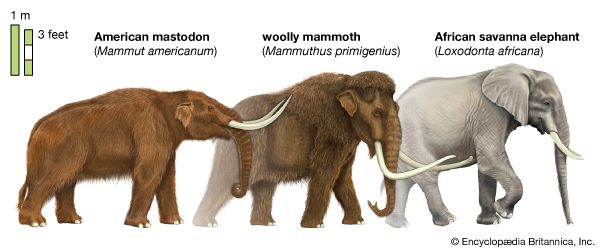
The most fundamental difference lies in their lineage. Mammoths (genus Mammuthus) are members of the family Elephantidae, making them close relatives of modern elephants. In contrast, mastodons (genus Mammut) belong to the separate family Mammutidae, representing a more distant evolutionary branch.1
Physical and Anatomical Differences
- Teeth: Mastodons possessed relatively primitive, low-crowned grinding teeth with prominent ridges and deep troughs, designed for browsing on leaves. Mammoth teeth were more complex and specialized, similar to those of modern elephants, reflecting a diet better suited for grazing.15
- Body Structure: Mastodons were generally shorter and more heavily built than mammoths, with a longer body and shorter, massive, pillarlike legs. Their skulls were lower, flatter, and simpler in construction compared to the more elevated and complex skulls of mammoths.5
- Tusks: While both animals had upper tusks, mastodon tusks typically grew parallel with an upward curve. Additionally, male mastodons possessed short lower tusks, a feature not found in mammoths.5
Are there any living species closely related to mastodons?
There are no living species closely related to mastodons. Mastodons belonged to the family Mammutidae, a distinct evolutionary branch of the order Proboscidea that is now entirely extinct.21
While mastodons are related to modern elephants in the sense that they share the same order (Proboscidea), they are only distantly related. Modern elephants belong to the family Elephantidae, which is the only surviving family within the order.1
On a broader scale, the closest living relatives to the entire order of proboscideans are not other land mammals, but rather marine mammals such as manatees and dugongs (order Sirenia), as well as the hyrax (order Hyracoidea), a small, rodent-like animal found in Africa and southwestern Asia.1
Sources
- proboscidean — Encyclopædia Britannica
- mastodon — Encyclopædia Britannica
- mastodons — Merriam-Webster
- Palaeomastodon — Merriam-Webster
- Quaternary - Fauna and flora — Encyclopædia Britannica
Published on · 3 min read