Mayfly
Adult mayflies typically live for only a few hours in their winged, reproductive stage. Because their mouthparts and digestive tracts are nonfunctional, they…
How long do mayflies typically live in their adult stage?
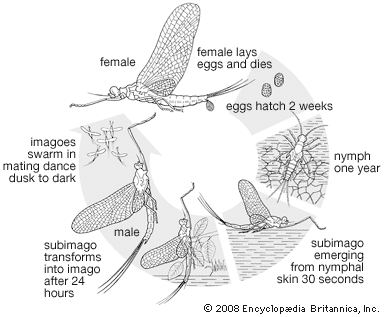
Adult mayflies typically live for only a few hours in their winged, reproductive stage. Because their mouthparts and digestive tracts are nonfunctional, they cannot feed, which necessitates this extremely brief lifespan.12
While most species die shortly after mating and egg deposition, there are minor variations depending on the species. For instance, some Hexagenia males and females may live long enough to engage in mating activities over two successive days. This short-lived adult phase follows a much longer aquatic immature stage, which typically lasts for one year, though it can range from two weeks to two years depending on the species and environment.21
What are some common species of mayflies and where can they be found?
There are more than 2,500 species of mayflies (order Ephemeroptera) described worldwide, with approximately 700 species found in the United States and Canada. These insects are found on every continent except Antarctica.
Common Groups and Classification
While many species remain undescribed, mayflies are categorized into three primary suborders based on their physical characteristics:
- Carapacea: Known as armored mayflies.
- Furcatergalia: Known as forked-gill mayflies.
- Pisciforma: A group that includes brush-legged, flat-headed, and minnow mayflies.
Additionally, the genus Hexagenia, often referred to as burrowing mayflies, is frequently noted in studies regarding population trends and environmental health.
Habitat and Distribution
The aquatic immature stage of the mayfly, known as a nymph or naiad, is widely distributed in freshwater environments. They thrive in various aquatic settings, ranging from shallow, fast-moving stream riffles to silty or sandy bottoms where some species are adapted to burrow. A few species are even capable of tolerating the brackish water found in marine estuaries.
Why are mayflies important to aquatic ecosystems?
Mayflies are essential components of freshwater ecosystems, playing a vital role in the health and functionality of these environments. Their importance is primarily defined by two factors:25
- Energy Transfer: As key members of local food webs, mayfly nymphs are critical to the energy transfer cycle. They serve as a significant food source for a wide array of predators, including fish, amphibians, birds, and carnivorous invertebrates.25
- Environmental Indicators: Because they are nonmigratory and often sensitive to habitat changes, mayflies serve as excellent indicators of environmental health. The presence of certain pollution-sensitive families, such as the spiny crawler mayflies (family Ephemerellidae), typically signals high water quality, whereas their decline can indicate issues like water pollution or algal blooms.25
Given their ecological significance, it is ethically imperative that we prioritize the protection of their habitats from pollution and environmental degradation to ensure the continued stability of aquatic biodiversity.2
What is a mayfly and what are its distinguishing characteristics?
A mayfly is a soft-bodied insect belonging to the order Ephemeroptera, known for its extremely short adult life span and massive summer emergences. They are found on every continent except Antarctica, with their immature aquatic stage, or nymph, inhabiting freshwater environments.
Distinguishing Characteristics
Mayflies are unique among insects for being the only ones to molt after developing functional wings. Their life cycle progresses through four stages: egg, nymph, subimago, and imago.
Adult Characteristics:
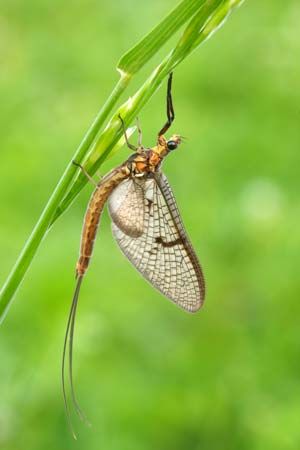
- Anatomy: They possess large compound eyes, short bristlelike antennae, and nonfunctional mouthparts and digestive tracts, meaning they cannot feed as adults.
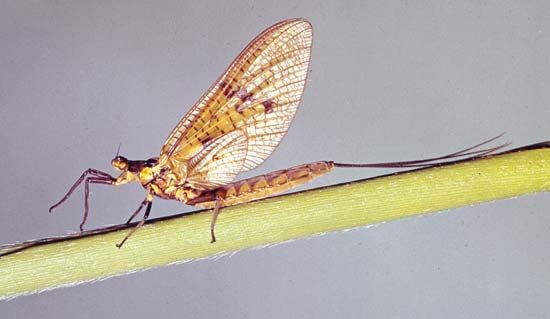
- Wings: They have membranous wings, typically with a large triangular front pair and a smaller, rounded hind pair. At rest, they hold their wings upright over their bodies.
- Tails: Adults feature two or three long, threadlike tails.
Nymphal Characteristics:
- Body: Nymphs have slender bodies with gills attached to the abdomen, which vary in shape (platelike, feathery, or filamentous) depending on the species’ habitat.
- Adaptations: Their legs and jaws are often specialized for their environment, such as being flattened for clinging to rocks in swift currents or modified for burrowing into silt and sand.
Sources
- The Mayfly Helps To Illustrate ephemeral — Merriam-Webster
- mayfly — Encyclopædia Britannica
- Lepidoptera - The adult — Encyclopædia Britannica
- mayfly — Merriam-Webster
- macroinvertebrate — Encyclopædia Britannica
Published on · 3 min read