Monterey Pine
The Monterey pine (Pinus radiata) is an economically significant conifer and the most widely planted pine species globally. While it is an endangered species…
What is a Monterey pine?
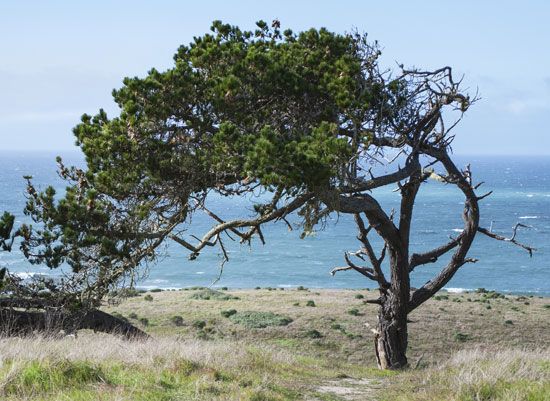
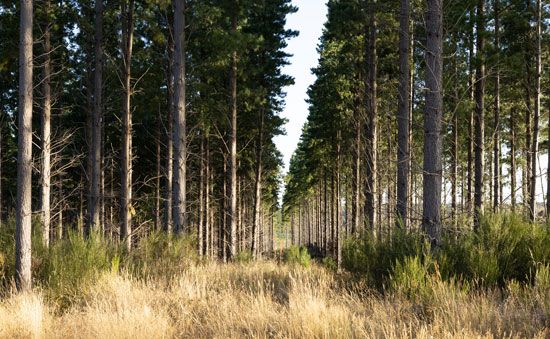
The Monterey pine (Pinus radiata) is an economically significant conifer and the most widely planted pine species globally. While it is an endangered species within its native range—limited to three locations on the central coast of California and two islands in Mexico—it is extensively cultivated in countries like New Zealand, Australia, South Africa, and Chile for timber and pulp.1
Physically, these evergreen trees are known for their rapid growth and deeply furrowed bark. They produce serotinous cones that often require fire or high temperatures to release their seeds. Despite their commercial success, native populations face severe threats from urbanization, fire suppression, and diseases such as pine pitch canker.1
Where does the Monterey pine naturally grow?
The Monterey pine (Pinus radiata) has a very limited natural distribution, being endemic to only five specific locations:1
- California, United States: Three distinct populations are found along the central coast, including one on the Monterey peninsula.1
- Mexico: Two populations are located on islands off the coast of Baja California, specifically Guadalupe Island and Cedros Island.1
Although these native populations are fragmented and considered an endangered species, the tree has been successfully introduced and cultivated globally for commercial use.1
What do the needles and cones of the Monterey pine look like?
The needles and cones of the Monterey pine possess distinct characteristics:
- Needles: These are glossy and dark green, though they may appear bluish-green on older trees. They grow in clusters of two or three and measure between 9 and 15 cm (3.5 to 6 inches) in length.2
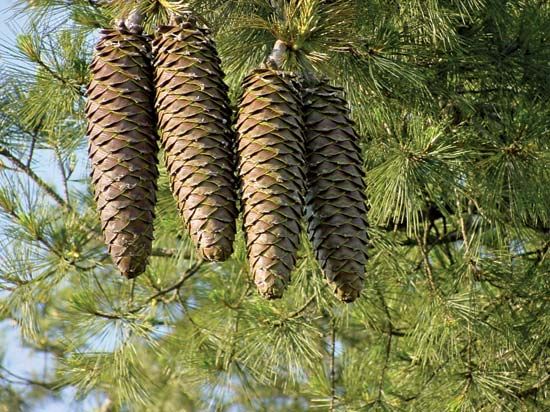
- Cones: The tree is monoecious, producing both male and female cones on the same individual:2
- Male cones: These are small, pollen-producing structures found in clusters at the tips of branches.2
- Female cones: These are pale brown, asymmetrically oval, and measure 6 to 15 cm (2 to 6 inches) in length. They grow either solitarily or in clusters of three to seven. These cones feature smooth, rounded scales that are sometimes sealed with resin. Because they are serotinous, they typically require fire or high temperatures to open and release their winged seeds.2
How is the Monterey pine used by people?
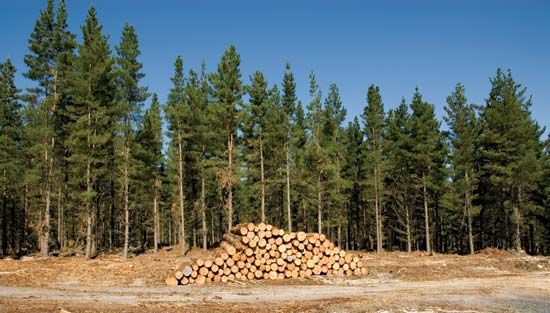
The Monterey pine (Pinus radiata) is recognized as the most widely planted pine in the world, serving as a vital global resource for the timber and paper industries. Despite its status as an endangered species within its limited native range, it is extensively cultivated in the Southern Hemisphere, particularly in New Zealand, Australia, South Africa, and Chile.12
The tree is highly valued for its rapid growth and the quality of its wood, which is pale, straight-grained, and features an even, medium texture. Because the wood is easily workable and free of knots, it is utilized for a wide variety of commercial applications, including:1
Sources
- Monterey pine — Encyclopædia Britannica
- Monterey pine — Merriam-Webster
Published on · 2 min read