Mormyrid
Mormyrid fish, a family of freshwater African fish, possess several unique anatomical adaptations that allow them to thrive in murky environments where…
What unique anatomical features do mormyrid fish possess?
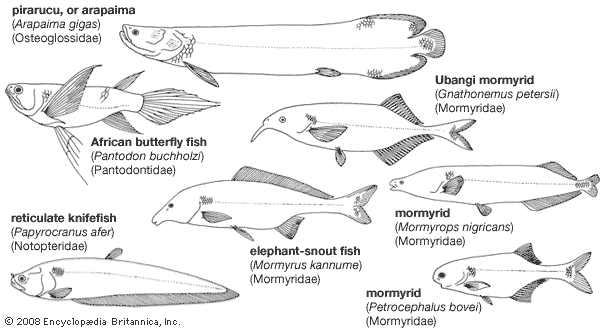
Mormyrid fish, a family of freshwater African fish, possess several unique anatomical adaptations that allow them to thrive in murky environments where vision is limited.12
Key Anatomical Features
- Brain Size: Mormyrids have exceptionally large brains relative to their body weight, with a cerebellum that is the largest known among all fish. This development is closely associated with their specialized sensory capabilities.13
- Electric Organs: Located in the tail, these organs are derived from modified muscle tissue that has lost the ability to contract. Instead, these cells have reorganized into “electroplates” that generate a continuous electric field used for navigation and communication.132
- Sensory Receptors: They possess specialized electroreceptor organs called mormyromasts in their skin, which detect distortions in the electric field caused by surrounding objects.32
- Cranial Vesicles: A bony plate on each side of the head covers a vesicle that communicates with the internal ear. This structure originates from embryonic tubes extending from the swim bladder into the skull from the swim bladder into the skull.13
- Inner Ear: The upper portion of the inner ear, responsible for balance, is completely separated from the lower portion, which is dedicated to hearing.3
How are mormyrid fish studied by scientists, and what have we learned from them?
Scientists study mormyrid fish primarily to understand their sophisticated electroreception and sensory processing capabilities, which are highly adapted for life in murky, low-visibility environments like the Nile River.14
Methods of Study
Researchers utilize a variety of scientific approaches to investigate these fish:
- Electrophysiological Experiments: Scientists record the electrical discharges produced by the fish’s tail organs and measure the activity of their brain and nerves to understand how they process sensory data5.5
- Behavioral Experiments: By observing how mormyrids navigate and interact with objects of varying conductivity, researchers have confirmed that these fish use their self-generated electric field as a radar-like sensory screen to distinguish between prey, predators, and obstacles.234
- Anatomical Analysis: Studies of their internal structure—such as the specialized mormyromasts in their skin and their exceptionally large cerebellum—have revealed how their anatomy supports their unique sensory needs.135
Key Scientific Findings
Through these studies, we have learned that mormyrids possess a “double sensitivity” to their environment, using their electric organs for both navigation and communication. Their ability to emit pulses at specific frequencies allows them to signal other members of their species, facilitating social and sexual interactions. Furthermore, their rigid-bodied swimming style is a functional adaptation that keeps their electric organs stable relative to their head-mounted receptors, ensuring the accuracy of their electrical “vision”.342
How do mormyrid fish use electric fields for communication and navigation?
Mormyrid fish, which inhabit murky African rivers where vision is often impossible, have evolved a sophisticated system of active electrolocation and communication to navigate and interact with their environment.37
Navigation via Electrolocation
Mormyrids possess specialized electric organs located in their tails that emit a continuous series of weak electrical pulses. These pulses create an electric field around the fish. As the fish moves, nearby objects—whether living prey or inorganic obstacles—distort this field based on their conductivity.357
These distortions are detected by specialized sensory cells in the skin called mormyromasts. By interpreting these “electrical shadows,” the fish can map its surroundings in a radar-like manner. To maintain the accuracy of this system, many mormyrids have evolved a rigid-bodied swimming style, using their fins for propulsion rather than tail movements, which ensures the electric organs in the tail remain stable relative to the head-mounted receptors.75
Communication
Beyond navigation, these electrical discharges serve as a vital means of communication discharges serve as a vital means of communication. Each species produces pulses with unique frequencies and patterns. Mormyrids use this “electric language” to convey information regarding:347
- Social status and threats: Signaling aggression or submission.34
- Courtship: Recognizing potential mates.4
- Individual and species recognition: Identifying other members of their group.4
How do mormyrid fish compare to other electric fish species?
Mormyrid fish are distinguished from other electric fish by their unique evolutionary adaptations and sensory processing capabilities. While many fish possess some form of electroreception, the differences lie primarily in whether they can generate their own electric fields and how they utilize them.
Comparison with Other Electric Fish
- Active vs. Passive Electroreception: Mormyrids (found in Africa) and gymnotids (found in South America) are unique because they possess both specialized electric organs to generate fields and receptors to detect them, allowing for active “radar-like” navigation. In contrast, fish like sharks and many catfish possess passive electroreception; they can detect the weak electric fields produced by the neuromuscular activity of other organisms but cannot generate their own fields to probe their environment.13
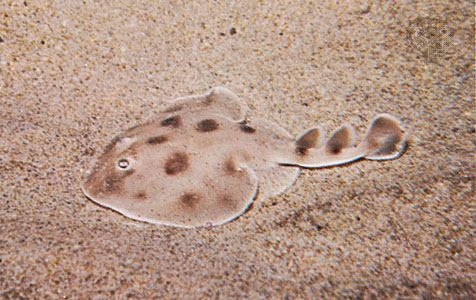
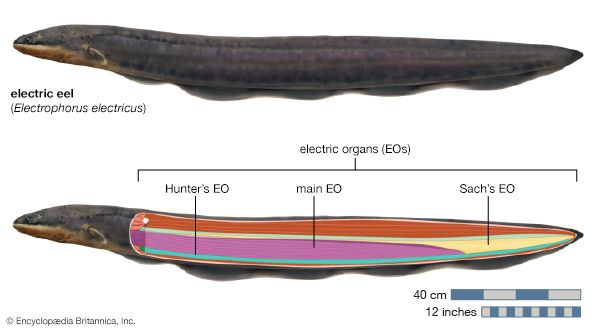
- Power and Purpose: While mormyrids and many gymnotids produce weak electrical discharges for navigation and communication, other species, such as the electric eel and electric catfish, have evolved high-voltage discharges capable of stunning prey or defending against predators.2
- Brain Development: Mormyrids are notable for having the largest brain relative to body weight among all fish, with an exceptionally large cerebellum specifically dedicated to processing complex electrosensory data.45
- Swimming Adaptations: To maintain the accuracy of their electrical “vision,” mormyrids have evolved a rigid-bodied swimming style that keeps their tail-mounted electric organs stable relative to their head-mounted receptors. This is a specialized adaptation not shared by all other electric fish.6
Sources
- mormyrid — Encyclopædia Britannica
- osteoglossomorph - Form and function — Encyclopædia Britannica
- Senses - Electric sense — Encyclopædia Britannica
- osteoglossomorph - Behaviour and ecology — Encyclopædia Britannica
- Mechanoreception - Ampullary lateral-line organs ( electroreceptors ) — Encyclopædia Britannica
- ostariophysan - Electric organs — Encyclopædia Britannica
- Electroreception — Encyclopædia Britannica
- lateral line system — Encyclopædia Britannica
Published on · 4 min read