Bioelectric Organ
Several species of fish have evolved specialized bioelectric organs composed of flattened cells called electroplaques. These organs allow the animals to…
Which animals are known for having powerful bioelectric organs?
Several species of fish have evolved specialized bioelectric organs composed of flattened cells called electroplaques. These organs allow the animals to generate, store, and discharge electricity for hunting, defense, or communication.123
The most notable examples include:
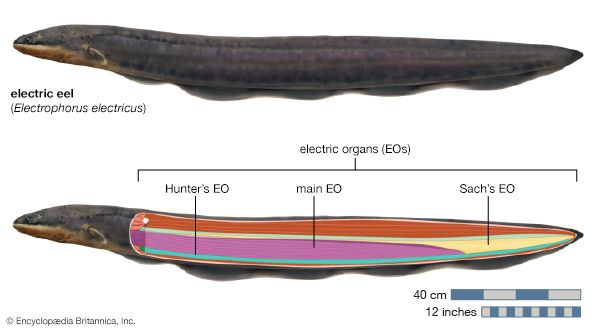
- Electric Eel: Possessing three pairs of electric organs that span most of its body length, this fish can generate powerful shocks ranging from 300 to 1,000 volts to stun prey or defend itself.123
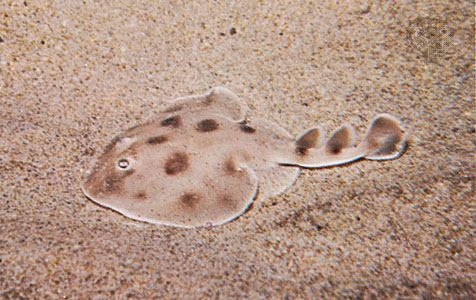
- Electric Rays: These fish feature two large, disk-shaped organs that function like batteries. A large Atlantic torpedo ray can produce a shock of approximately 220 volts.123
- Electric Catfish: Native to Africa, this species uses electric shocks of up to 400 volts for both self-defense and capturing prey.123
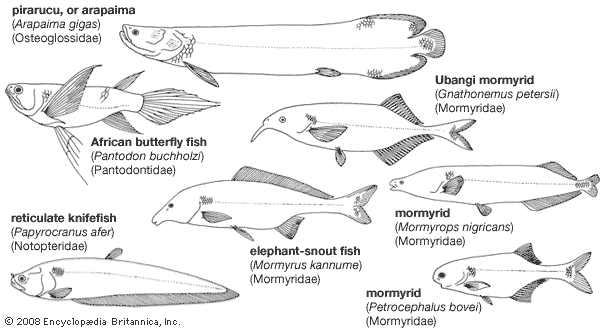
- Mormyrids and Knifefish: These fish often use their bioelectric capabilities for “electrolocation,” acting as a form of biological radar to navigate murky waters and detect food.124
How do animals with bioelectric organs detect and process electrical signals from their environment?
Animals with bioelectric organs detect and process environmental signals through a specialized sensory system known as electroreception. This process relies on dermal electroreceptor organs that act as a pathway for electric current to reach sensory epithelial cells containing voltage-sensitive ion channels.3
Detection Mechanisms
- Passive Electrolocation: Used by animals like sharks and rays, this method detects weak direct current (DC) fields produced by the neuromuscular activity of prey. These signals are captured by the ampullae of Lorenzini, which consist of gel-filled canals that conduct electricity to sensory cells.35
- Active Electrolocation: Certain fish, such as mormyrids and knifefish, generate their own weak electric discharges. They use “tuberous” electroreceptors to sense distortions in these self-generated fields caused by nearby objects, effectively creating an electrical “image” of their surroundings.36
Processing
When an electroreceptor is stimulated by a voltage change, the sensory cell’s polarization state shifts, triggering an action potential. This nerve impulse travels to the central nervous system, where the brain interprets the signal to guide behavior, such as hunting, navigation, or social communication.35
How do bioelectric organs generate electricity?
Bioelectric organs generate electricity through the coordinated activity of specialized, flattened cells known as electroplaques. These cells are arranged in both series and parallel configurations, which allows the organ to build up significant voltage and current-producing capacity.24
The process functions similarly to a biological battery:
- Cellular Basis: Like all living cells, electroplaques maintain a resting potential across their membranes by regulating the concentration of ions—such as sodium and potassium—inside and outside the cell.4
- Activation: When the fish needs to discharge electricity, it sends nervous impulses to the electroplaques. These impulses trigger a temporary change in the permeability of the cell membranes, often involving the transport of sodium ions through ion channels.47
- Discharge: This change in permeability causes the stored electric potential to discharge as a current. By precisely timing these nervous impulses, the fish ensures the simultaneous activation of the entire array of electroplaques, resulting in a sudden, powerful electric shock.24
What are the main anatomical components of a typical bioelectric organ?
The primary anatomical component of a bioelectric organ is the electroplaque, a specialized, flattened cell. These organs function as biological batteries by arranging vast numbers of electroplaques in series and parallel configurations to amplify voltage and current capacity.42
In many species, these organs are derived from modified muscle tissue. The structural arrangement varies by species:8
- Electric Eels: Possess three pairs of electric organs that account for the majority of the fish’s body mass and length.42
- Electric Rays: Feature two large, disk-shaped organs located on either side of the body.42
- Electric Catfish: Utilize a specialized gelatinous coat of tissue that sheathes most of the body directly beneath the skin.8
The organ’s function is controlled by the nervous system, which precisely times impulses to trigger the simultaneous activation of the entire array of electroplaques, resulting in a sudden electrical discharge.42
Sources
- 14 Questions About Aquatic Animals Answered - Which undersea creatures are known for making electricity? — Encyclopædia Britannica
- bioelectric organ — Encyclopædia Britannica
- Electroreception — Encyclopædia Britannica
- bioelectricity — Encyclopædia Britannica
- Senses - Electric sense — Encyclopædia Britannica
- ampulla of Lorenzini — Encyclopædia Britannica
- ion channel — Encyclopædia Britannica
- ostariophysan - Electric organs — Encyclopædia Britannica
Published on · 3 min read