Olm
The olm (Proteus anguinus) is a specialized, aquatic salamander that serves as a predator within the subterranean stream environments of karst regions along…
What role does the olm salamander play in its cave ecosystem?
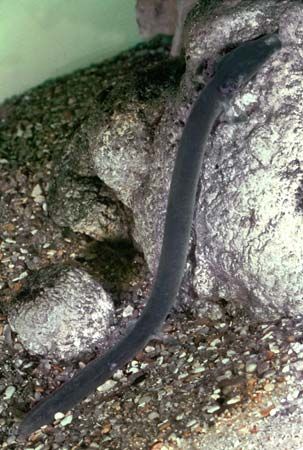
The olm (Proteus anguinus) is a specialized, aquatic salamander that serves as a predator within the subterranean stream environments of karst regions along the Adriatic coast. As a cave-dwelling species, it has evolved unique adaptations to survive in total darkness, including the loss of skin pigmentation and the development of vestigial, skin-covered eyes.12
While the provided information does not detail the specific prey species the olm consumes, it notes that salamanders generally function as predators that feed on insects, worms, snails, and other small animals. Aquatic salamanders typically hunt by lunging at their prey with an open mouth, using suction created by expanding their oral cavity to capture their food. The olm retains larval traits throughout its life, such as external gills and a lateral line system, which likely assist in navigating and detecting movement in its lightless habitat.341
How has the olm salamander been portrayed in local folklore and culture?
The provided search results do not contain information regarding the portrayal of the olm in local folklore or cultural traditions. While the olm is a well-documented salamander native to the subterranean waters of the Adriatic coast, its historical or mythological significance is not addressed in the available data.
Where is the olm salamander found in nature, and what is its natural habitat?
The olm (Proteus anguinus) is found exclusively in the subterranean streams of karst regions along the Adriatic coast. Its natural range extends from northeastern Italy southward through Slovenia and into Montenegrocom/place/Slovenia) and into Montenegro.1
The olm’s habitat consists of dark, aquatic environments within solution caves. These caves are typically formed by the dissolution of limestone or dolomite bedrock by groundwater, creating complex underground conduit systems. Because these environments are characterized by total darkness and internal drainage, the olm has evolved specialized traits, such as the loss of skin pigmentation and the development of vestigial, skin-covered eyes, to survive in these isolated, water-filled passages.51
What can the olm salamander teach us about evolution and adaptation to extreme environments?
The olm (Proteus anguinus) serves as a remarkable example of evolutionary adaptation to extreme, lightless environments. By inhabiting subterranean karst streams, the olm has undergone significant physiological changes to survive in total darkness and isolation.
Key evolutionary adaptations include:
- Paedomorphosis: The olm exhibits a permanent larval state, retaining juvenile traits such as external gills and a lateral line system throughout its adult life. This condition, where an organism reaches sexual maturity while retaining larval features, is a specialized evolutionary strategy common in the family Proteidae.16
- Sensory and Physical Reduction: Living in constant darkness has led to the loss of skin pigmentation and the development of vestigial, skin-covered eyes. These traits demonstrate how natural selection favors energy conservation in nutrient-poor cave ecosystems by reducing the development of unnecessary structures.14
- Reproductive Plasticity: The olm demonstrates flexibility in its life cycle, capable of either laying eggs or bearing live young. This strategy appears to be influenced by environmental factors, specifically temperature, allowing the species to optimize survival based on the conditions of its subterranean habitat.1
Sources
- olm — Encyclopædia Britannica
- amphibian - Food and feeding — Encyclopædia Britannica
- salamander — Encyclopædia Britannica
- olm — Merriam-Webster
- cave — Encyclopædia Britannica
- Caudata - Life cycle and reproduction — Encyclopædia Britannica
Published on · 2 min read