Parnassian Butterfly
A parnassian butterfly is any member of the Parnassiinae subfamily within the Papilionidae family of insects. Often referred to as the apollo, the genus…
What is parnassian butterfly?
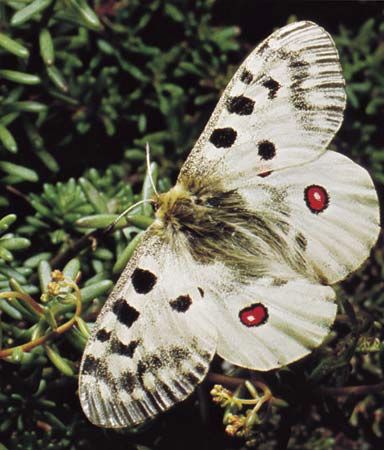
A parnassian butterfly is any member of the Parnassiinae subfamily within the Papilionidae family of insects. Often referred to as the apollo, the genus Parnassius is typically found in the mountainous alpine regions of Asia, Europe, and North America.1
These medium-sized butterflies are characterized by their translucent white, yellow, or gray wings, which feature dark markings and often display distinct red or orange spots on the hindwings. They are highly regarded by collectors for their unique coloration.1
Parnassians are biologically distinct from most other true butterflies because they pupate inside cocoon-like webs constructed from leaves or debris, whereas most other butterfly species pupate as a naked chrysalis. Due to these and other traits, they are sometimes classified into their own separate family, Parnassiidae.12
How do Parnassian butterflies survive in cold mountain climates?
Parnassian butterflies survive in harsh, cold mountain climates through a combination of behavioral and physiological adaptations, primarily centered on diapause. This state of reduced metabolic activity allows them to halt growth and development during unfavorable environmental conditions, such as extreme cold.1
Key survival strategies include:
- Developmental Standstill: By regulating their endocrine systems, these butterflies can enter a state of developmental arrest. This is controlled by the cessation of specific hormones, such as ecdysone, which prevents metamorphosis until more favorable conditions return.1
- Protective Pupation: Unlike most butterflies that pupate as a naked chrysalis, Parnassians construct cocoon-like webs using leaves or debris. These structures provide a sheltered environment that helps protect the developing insect from the elements.231
- Overwintering: Many insects, including butterflies, survive winter by seeking out sheltered, relatively dry locations. Some species can even survive while covered by snow and ice for several months, which acts as an insulating layer against extreme temperature fluctuations.1
What makes the pupation process of Parnassians unique compared to other butterflies?
The pupation process of Parnassian butterflies is distinct because they are among the few “true” butterflies that construct a cocoon for their resting stage.1
While the vast majority of butterfly species pupate as a “naked” chrysalis—where the insect’s own body forms the protective outer shell—Parnassians and satyr butterflies produce a cocoon-like web. These structures are typically fashioned from silk and incorporated with debris, such as leaves or rubbish, to create a sheltered environment for the developing insect. This behavior provides an additional layer of protection that is not present in the exposed, naked pupae of most other butterfly families.12
What are the main differences between moths and butterflies?
Moths and butterflies are both members of the order Lepidoptera, but they exhibit several distinct physical and behavioral differences.7
Physical Characteristics
- Antennae: Most moths possess thick or feathery antennae, whereas butterflies typically have simple, club-tipped antennae.7
- Body Shape: Butterflies generally have slim, dainty bodies, while moths are often stout and fuzzy.7
- Coloration: Butterflies are frequently colorful with dramatic wing patterns, while moths are often more drab, though notable exceptions exist in both groups.7
Behavioral and Developmental Differences
- Activity Patterns: Butterflies are typically diurnal (active during the day), while most moths are nocturnal.7
- Resting Position: When at rest, butterflies usually hold their wings vertically over their backs. Moths typically fold their wings tentlike over the body, wrap them around the body, or hold them extended at their sides.7
- Metamorphosis: Butterflies form a “naked” chrysalis during their pupal stage. In contrast, most moths build fibrous cocoons, often made of silk. While most butterflies pupate without a cocoon, satyr and parnassian butterflies are notable exceptions that do construct them.72
Sources
- parnassian butterfly — Encyclopædia Britannica
- Lepidoptera - Pupa , or chrysalis — Encyclopædia Britannica
- Dormancy - Diapause in insects — Encyclopædia Britannica
- coloration - Physiological functions — Encyclopædia Britannica
- Cocoon — Encyclopædia Britannica
- Diptera - Pupa — Encyclopædia Britannica
- What’s the difference between moths and butterflies? — Encyclopædia Britannica
Published on · 3 min read