Polecat
Polecats are weasel-like carnivores belonging to the family Mustelidae. While physical traits vary by species, they generally share a slender, elongated body…
What are the main physical characteristics of polecats?
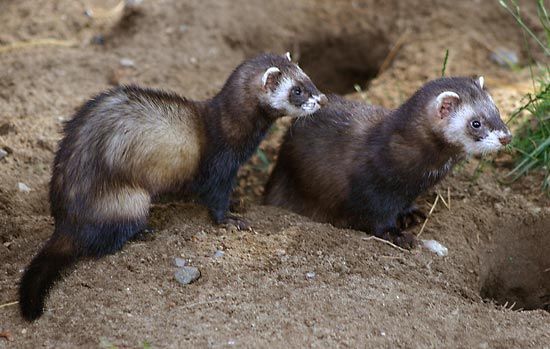
Polecats are weasel-like carnivores belonging to the family Mustelidae. While physical traits vary by species, they generally share a slender, elongated body and a bushy tail.1
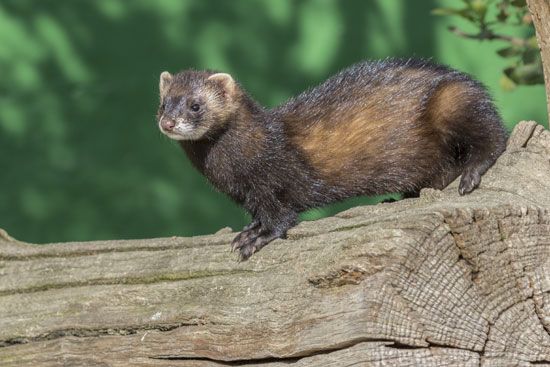
The European polecat is a representative example, characterized by:
- Size: Weighs 0.5–1.4 kg (1–3 pounds) and measures 35–53 cm (14–21 inches) in body length, with a 13–20 cm (5.1–7.9 inch) tail.1
- Appearance: Features long, coarse fur that is brown on the upper body, black underneath, and marked with distinctive yellowish patches on the face.1
Other related species exhibit distinct variations:
- Steppe polecat: Generally larger, weighing 1.4–2 kg (3–4.4 pounds) with lighter fur.1
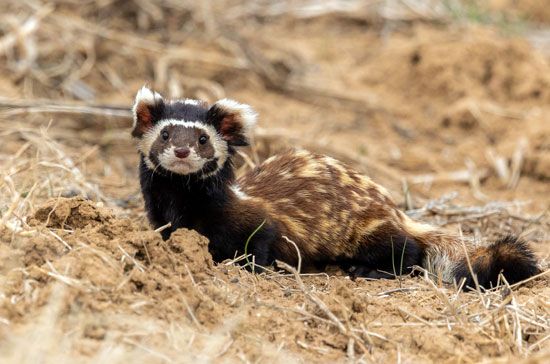
- Marbled polecat: Smaller, weighing 0.3–0.7 kg (0.7–1.5 pounds) with a mottled reddish-brown and yellowish coat.1
- Zorille (striped polecat): A smaller African mustelid weighing 1–1.4 kg (2.2–3 pounds) with a body length of 28–30 cm (11–12 inches).1
Where are polecats primarily found in Eurasia and Africa?
Polecats are widely distributed across Eurasia and parts of Africa, with specific ranges depending on the species:
- European Polecat (Mustela putorius): This species is found throughout much of Europe, ranging from the United Kingdom, Sweden, and Finland in the north to the Ural Mountains in Russia and the Black Sea coasts of Ukraine, Romania, and Bulgaria. It is also found in woodlands in northern Morocco.12
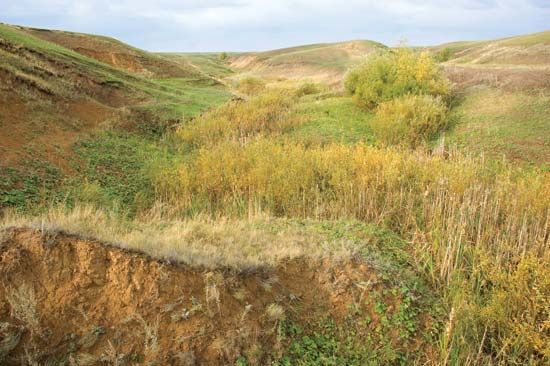
- Steppe Polecat (M. eversmanii): This species inhabits dry, open environments across Eurasia, including steppes, grasslands, and farmland.1
- Marbled Polecat (Vormela peregusna): Found in foothills and steppes stretching from southeastern Europe to southern Mongolia and northern China.1
- African Species: The zorille (Ictonyx striatus) is found in sub-Saharan Africa in arid and semiarid regions, while the Libyan striped weasel (I. libycus) inhabits similar arid environments in northern Africa.1
How do polecats differ from their close relatives, such as ferrets and weasels?
Polecats, ferrets, and weasels are all members of the family Mustelidae and the genus Mustela, which explains their shared physical traits, such as elongated, tube-shaped bodies, short limbs, and inquisitive, active natures. However, they can be distinguished by specific characteristics:213
- Taxonomy and Relationship: The domestic ferret is widely considered a domesticated form of the European polecat (Mustela putorius). While they share a lineage, other animals colloquially called “polecats”—such as the marbled polecat (Vormela peregusna) and the zorille (Ictonyx striatus)—are more distantly related and belong to different subfamilies or genera within the mustelid family.423
- Physical Differentiation: Species are primarily differentiated by size, coloration, and the relative length of their tails. For example, the European polecat is generally larger than many weasels, while the least weasel is the smallest living carnivore.13
- Behavioral Distinctions: Unlike martens, polecats rarely climb trees. Weasels are noted for their extreme agility, allowing them to pursue prey into narrow burrows and crevices, often killing more than they can immediately consume due to their high metabolic needs.21
What is the typical diet and hunting behavior of polecats?
Polecats are primarily terrestrial carnivores that hunt at night. Their diet is varied, consisting largely of small mammals, such as mice and rats, as well as birds. In addition to these prey items, they consume snakes, lizards, frogs, fishes, and eggs.2
Unlike some other members of the family Mustelidae, such as the marten, polecats rarely climb trees, preferring to conduct their hunting activities on the ground. While the European polecat is a generalist, other related species like the steppe polecat are specifically noted for their reliance on rodents within their respective grassland and steppe habitats.2
Sources
- Polecat — Encyclopædia Britannica
- Polecat: Top Questions — Encyclopædia Britannica
- weasel — Encyclopædia Britannica
- mustelid — Encyclopædia Britannica
Published on · 3 min read